Asia · Trade
Vietnam Textile Exports Climb to $27 Billion as Upstream Production Gains Momentum
Fiber and yarn shipments surged over 11% in the first seven months, signaling reduced import reliance and deeper supply-chain integration across Southeast Asia's second-largest apparel exporter.
KEY TAKEAWAYS
- ·Vietnam exported $27.02 billion in textiles and garments over seven months, a 2.7% annual increase, with July shipments reaching $4.7 billion.
- ·Fiber and yarn exports surged 11.34% to $2.73 billion, while fabric climbed 9.57% to $1.76 billion, signaling reduced dependence on imported materials.
- ·Tighter sustainability requirements from EU and US buyers are driving investment in energy-efficient production and centralized wastewater treatment infrastructure.
July Performance Lifts Seven-Month Total
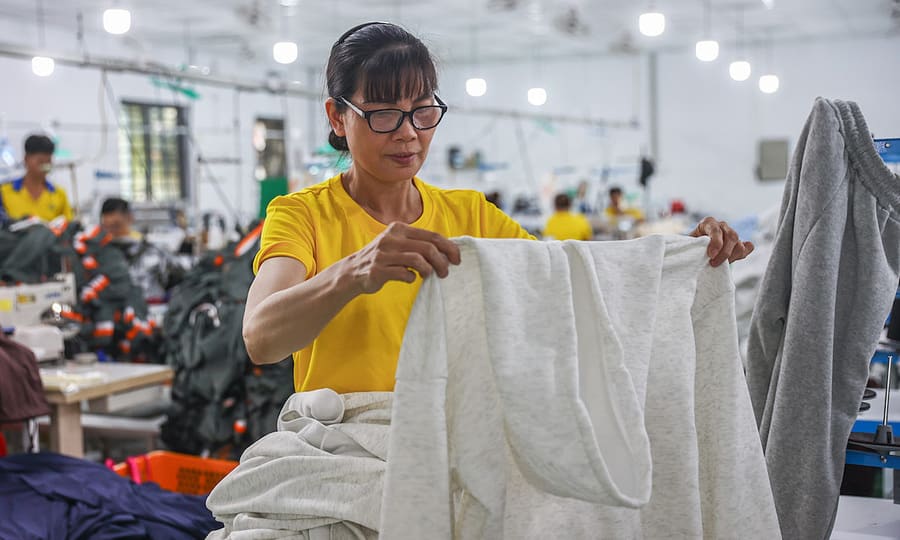
Vietnam shipped $4.7 billion of textile and garment goods in July, a 4.3% increase from the same month in 2025, according to official trade data. The result brought cumulative exports for the January-to-July period to $27.02 billion, up 2.7% year on year.
Apparel alone accounted for $3.74 billion in July, climbing 8.9% from June and 2.1% from a year earlier. Over seven months, finished garment exports totaled $21.13 billion, edging up 0.7% compared with the prior-year stretch.
The modest gain in finished goods masks a sharper shift upstream. Fiber and yarn exports generated $2.73 billion during the period, jumping 11.34% year on year. Fabric shipments reached $1.76 billion, up 9.57%, while accessories rose 11.18% to $929 million. Non-woven fabric added $471 million, a 6.56% increase.
Supply-Chain Integration Accelerates
The double-digit growth in intermediate products reflects a strategic pivot among Vietnamese manufacturers. By expanding capacity in spinning, weaving, and dyeing, producers are capturing more value within the country and reducing exposure to import price volatility.
Imports of textile materials and inputs totaled $15.26 billion over seven months, a 3.27% annual rise. Fabric accounted for $8.94 billion of that figure, up 2.08%, while accessories reached $2.61 billion, up 3.6%. Cotton imports stood at $1.89 billion, climbing 1.02%.
The narrowing gap between import growth and export growth in upstream categories suggests that domestic mills are substituting for foreign suppliers in certain segments, particularly synthetic yarn and industrial fabrics used in technical textiles.
Regulatory Pressure and Green Transition
Truong Van Cam, vice chairman of the Vietnam Textile and Apparel Association, said buyers in major markets are tightening requirements around sustainability, traceability, and carbon reporting. European Union regulations on circular textiles and extended producer responsibility are reshaping procurement criteria, particularly for brands sourcing large volumes from Asia.
Vietnamese exporters have begun investing in energy-efficient dyeing equipment, wastewater recycling systems, and renewable-energy installations to meet these standards. Several large manufacturers in the south have completed solar rooftop projects over the past year, cutting grid dependence and improving environmental disclosures required by multinational buyers.
The industry association is urging state agencies to accelerate planning for centralized textile parks equipped with shared wastewater treatment infrastructure. Such zones would allow smaller weaving and dyeing operations to meet discharge standards without individual capital outlays, opening bottlenecks in the domestic supply of dyed and finished fabrics.
Market Diversification and Trade Policy
Vietnam's textile sector benefits from tariff preferences under multiple free-trade agreements, including the Comprehensive and Progressive Agreement for Trans-Pacific Partnership and the EU-Vietnam Free Trade Agreement. However, rules of origin under these pacts require a minimum share of regional or domestic content, creating an incentive to source yarn and fabric locally rather than from China or other third countries.
Analysts expect this dynamic to support continued investment in spinning and weaving capacity, particularly in provinces with established industrial clusters and reliable power supply. The government has identified textiles as a priority for green-bond financing, and several export-oriented mills are preparing sustainability-linked loan facilities with domestic and regional banks.
Outlook Through Year-End
To meet full-year targets, manufacturers are being advised to deepen engagement with niche segments such as performance apparel, medical textiles, and recycled-fiber products. Brands in North America and Europe are increasing allocations for garments made from post-consumer polyester and organic cotton, categories where Vietnamese suppliers have room to expand.
Trade economists also recommend that companies monitor policy developments in the United States and the European Union, where legislative proposals on supply-chain due diligence and carbon border adjustments could reshape cost structures. Firms that build traceability systems and transparent emissions accounting now will be better positioned when these measures take effect.
Vietnam remains the world's third-largest garment exporter by value, behind China and Bangladesh, and the second-largest in Southeast Asia. Sustaining that position will depend on the industry's ability to move upmarket, integrate production vertically, and align with the sustainability benchmarks that increasingly define access to premium retail channels.
RELATED STORIES
Shein Retreats From Vietnam Warehouse Bet as China Manufacturing Proves Irreplaceable
Cheng Wei-Lun · 4 min
Shein Scales Back Vietnam Expansion, Reinforces China Manufacturing Base
Cheng Wei-Lun · 3 min

Vietnam Pours Capital Into Laos as Vientiane Seeks Relief From Beijing Debt
Priyanka V. Rao · 4 min
Sojitz Expands Vietnamese Beef Operations With Japanese Hygiene Standards
Cheng Wei-Lun · 3 min
Spot something wrong? Email editor@briefasia.com. We log every correction publicly.