Asia · Business
Shein Retreats From Vietnam Warehouse Bet as China Manufacturing Proves Irreplaceable
The ultra-fast fashion retailer has cut its Vietnam warehouse footprint by 60 percent and laid off thousands, highlighting its dependence on southern China's unmatched supply-chain speed and flexibility.
KEY TAKEAWAYS
- ·Shein cut its Vietnam warehouse footprint from 15 hectares to roughly six hectares and laid off thousands of workers starting in April.
- ·US elimination of the de minimis duty exemption and narrowing tariff gaps between China and Vietnam undermined the business case for Vietnamese manufacturing.
- ·Chinese suppliers in Guangdong offer unmatched speed and flexibility for small-batch production that Vietnamese factories cannot replicate at comparable cost.
The Experiment Unravels
Shein's ambitious Vietnam gambit has collapsed in spectacular fashion. The Singapore-headquartered fast-fashion giant began leasing 15 hectares of warehouse space near Ho Chi Minh City in early 2025, equivalent to 21 football pitches, positioning Vietnam as a major export hub. Today, that footprint has shrunk to roughly six hectares, according to people familiar with the matter. Mass layoffs began in April, with some teams retaining only one in four employees. A late-July visit to the site revealed a handful of workers and a few trucks, a stark contrast to the bustling activity at neighboring warehouses operated by other tenants.
The pullback marks one of the most visible retreats by a major Chinese e-commerce player from Southeast Asian manufacturing, and it comes as Shein prepares for a Hong Kong initial public offering after failing to secure listings in New York and London.
Tariff Calculus Shifts
The initial logic behind the Vietnam move seemed sound. In late 2024, with Donald Trump's second-term election looming, fears of an intensified US-China trade war were mounting. By April 2025, US tariffs on many Chinese goods had surged to 145 percent. Shein, which built its business on selling five-dollar tops and ten-dollar dresses, began encouraging its largest Chinese suppliers to establish manufacturing bases in Vietnam to sidestep the tariff wall.
But the tariff landscape shifted in ways that undermined the Vietnam strategy. The most damaging blow came on July 30, 2025, when the Trump administration eliminated the de minimis exemption for duty-free shipments under 800 dollars from all countries, not just China. The exemption had been removed for Chinese shipments a few months earlier. The change took effect in August 2025, erasing much of Vietnam's tariff advantage.
While Vietnamese apparel still faces lower baseline tariffs than Chinese goods, the gap has narrowed. A knit polyester dress from Vietnam carries a 16 percent duty; the same item from China faces an effective rate around 33.5 percent when additional Section 301 tariffs are included. That spread, though meaningful, proved insufficient to justify the operational challenges of manufacturing outside China.
A July decision by Washington to impose 12.5 percent tariffs on both China and Vietnam over forced-labor concerns further eroded Vietnam's relative advantage, putting it at a disadvantage compared to other Southeast Asian apparel producers.
The China Advantage
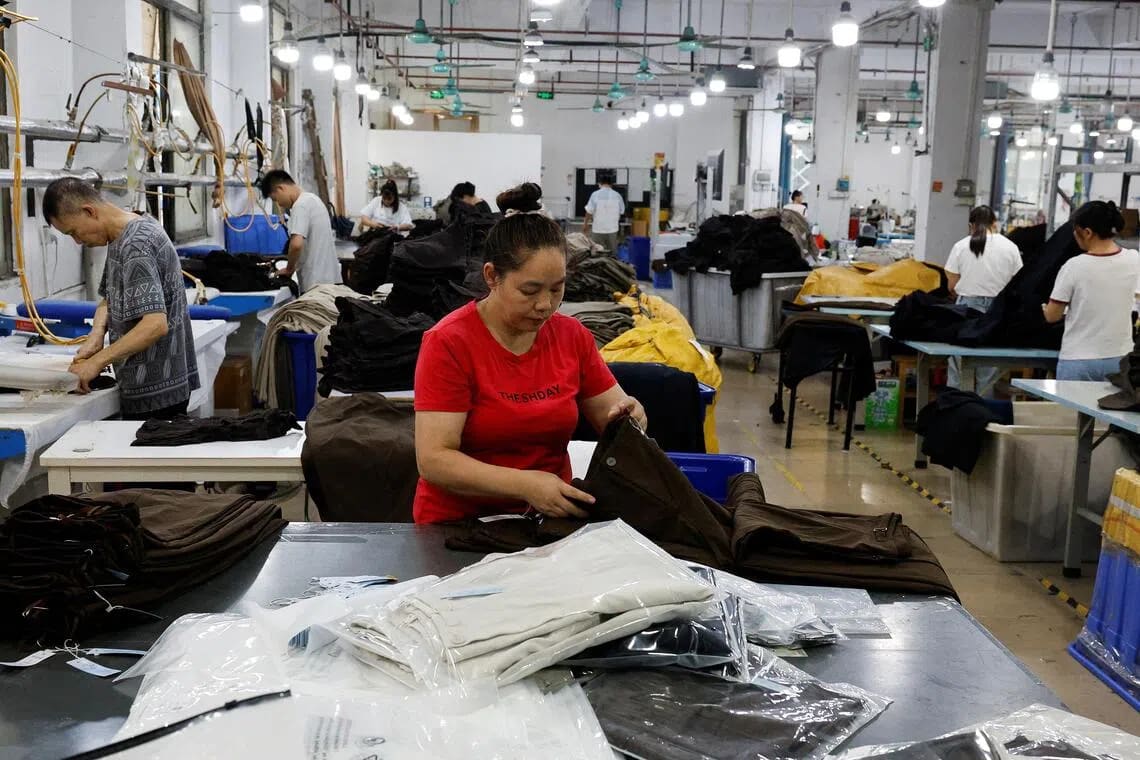
Tariffs tell only part of the story. Shein's business model depends on a vast network of small Chinese factories, concentrated in Guangdong province's "Shein villages," that produce millions of styles in tiny batches with razor-thin margins as low as one yuan per piece. Orders are fulfilled in days and rapidly reordered if any of Shein's 273 million shoppers show interest.
Vietnamese manufacturers have proven unwilling or unable to match those terms. Finding workers willing to work long hours for minimal pay has been difficult, suppliers said. Many Chinese factories that established Vietnam operations have returned home.
"They realized that despite the smaller US tariff rate on Vietnamese goods compared to Chinese ones, the low efficiency still makes it less viable than manufacturing in China," said a factory manager surnamed Wen in Guangzhou's Panyu district. Wen, who declined to give his full name, said Shein had warned suppliers against speaking to media.
Authorities in Guangzhou, keen to protect local employment, also pushed back against Shein's efforts to subsidize Chinese manufacturers opening Vietnam plants. In mid-2025, officials warned the company against shifting orders significantly away from the region, according to a person with direct knowledge of the matter.
Doubling Down on Guangdong
Shein is now deepening its commitment to southern China. CEO Sky Xu made a rare public appearance in February to announce over ten billion yuan in spending on a smart supply-chain system in Guangdong province.
Yet even as Shein recommits to China, some suppliers are hedging their bets. Shein's draft prospectus showed a 14 percent drop in US revenue during the first quarter, attributed to the end of the de minimis exemption. Four suppliers said orders from Shein were either flat or showing minimal growth. Demand is expected to slow further after the European Union imposed a three-euro duty on low-value e-commerce imports in July.
Thousands of smaller Shein suppliers have begun diversifying by opening stores on Temu, owned by PDD Holdings, or on Amazon, according to Ping He, who has worked in operations management for Shein and TikTok Shop. Others are returning to larger orders with longer lead times from traditional retailers.
"Shein's profit margins are just too thin. Their order volumes are quite small, often just dozens of pieces at a time, which makes production a hassle. So we decided to drop them," said Yang, a manager at Jiang Gong Clothes, a Panyu factory that worked with Shein until recently.
What Comes Next
Shein's Vietnam retreat offers a clear lesson for companies betting on supply-chain diversification away from China. For businesses whose competitive edge rests on speed, flexibility, and micro-batch production, alternatives remain limited. Vietnam's apparel sector, built around larger orders and longer lead times, lacks the infrastructure and labor pool to replicate Guangdong's hyper-responsive ecosystem.
The company now faces a delicate balancing act. It must maintain the low prices and rapid inventory turnover that fueled its growth while navigating a global tariff environment that punishes both its Chinese manufacturing base and potential alternatives. Its pending Hong Kong listing will test whether investors believe that model can survive in a world where the de minimis loophole has closed and trade barriers remain high.
RELATED STORIES
Shein Scales Back Vietnam Expansion, Reinforces China Manufacturing Base
Cheng Wei-Lun · 3 min
Asian Tech Stocks Surge as Weak US Jobs Data Dims Rate Hike Outlook
Cheng Wei-Lun · 4 min
Hong Kong's Wealth Hub Status Faces Test as Beijing Tightens Tax Enforcement
Cheng Wei-Lun · 3 min
Hong Kong and China Regulators Announce Market Integration Reforms
Cheng Wei-Lun · 3 min
Spot something wrong? Email editor@briefasia.com. We log every correction publicly.