Technology · AI
Beijing's AI Bar Offers Free DeepSeek Access as Price Wars Reshape Global Market
A tech-district watering hole serves up complimentary AI tokens while Chinese startups raise fees and US labs slash prices to compete
KEY TAKEAWAYS
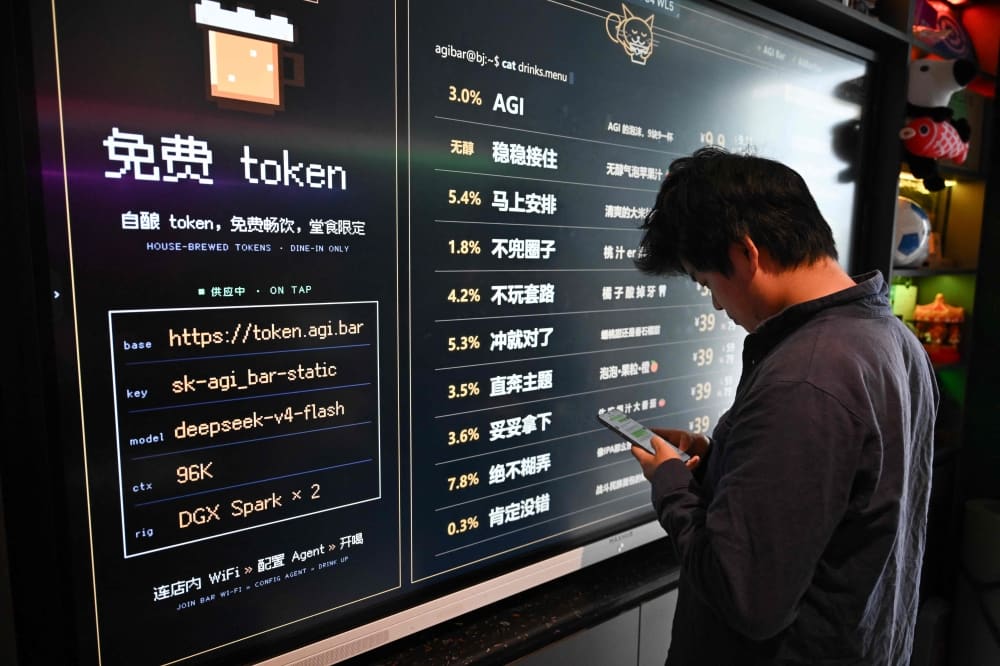
- ·AGI Bar in Beijing's Zhongguancun district self-hosts DeepSeek V4 Flash on Nvidia workstations, offering patrons free AI access while the startup plans significant developer price increases.
- ·OpenAI slashed Luna model fees by 80 percent and Anthropic introduced a half-price alternative as US labs face pressure to demonstrate profitability ahead of planned public offerings.
- ·Open-source Chinese models from DeepSeek, Alibaba, and Moonshot AI are closing performance gaps with proprietary US systems, driving developers toward cost-efficient alternatives for agent-based applications.
A Beer, a Chat, and Free AI Tokens
Song De runs an unusual establishment in Beijing's Zhongguancun tech hub. At AGI Bar, customers ordering drinks can tap into DeepSeek's latest model without paying a cent. Two Nvidia workstations sit behind the bar, self-hosting the V4 Flash system so Song avoids subscription fees to the Chinese startup.
The venue opened last summer as a gathering spot for developers and investors navigating China's artificial intelligence surge. Walls display logos from domestic AI labs. The menu plays on technical terminology. The house cocktail, named AGI after the theoretical future of human-level artificial intelligence, arrives as a glass nearly filled with foam, a visual joke about industry hype.
"Bars typically offer routers for connectivity at no charge. I'm doing the same with tokens," Song explained, referring to the usage units that measure interaction with large language models.
Pricing Dynamics Flip
The complimentary access at Song's bar captures a broader transformation. Chinese AI companies that initially competed on cost are now raising rates as adoption grows. DeepSeek announced plans last week for substantial price increases targeting developers, citing demand for its V4 Flash model, which leads usage rankings on OpenRouter's technical platform.
Meanwhile, established US labs are moving in the opposite direction. OpenAI cut fees by 80 percent for Luna, its newest lightweight system. Anthropic introduced a model delivering performance close to its flagship offering at half the expense.
The shift reflects intensifying competition as companies race to convert user growth into sustainable revenue. Both Anthropic and OpenAI are preparing initial public offerings, adding pressure to demonstrate profitability rather than simply accumulate market share.
Jack Gold, founder of technology research firm J.Gold Associates, characterizes the moment as competitive pricing rather than outright warfare. "Enterprises are pushing back, saying AI capabilities are valuable but costs can't exceed double an employee's annual salary," he noted.
Open-Source Models Narrow the Gap
Chinese systems increasingly challenge the technical lead long held by Silicon Valley. Moonshot AI's Kimi K3 and Alibaba's Qwen family have drawn attention from programmers worldwide. Most Chinese offerings carry open-source licenses, allowing developers to modify underlying code, a contrast to proprietary US alternatives where architecture and training data remain locked.
Wang Tiezhen, an independent consultant and former Asia-Pacific ecosystem lead at developer platform HuggingFace, tracks the convergence. "What counted as cutting-edge twelve months ago has become standard infrastructure today. Open-source systems are closing performance gaps faster than projections suggested."
The trend extends beyond China. Meta recently launched Muse Spark 1.2 as a budget option. Elon Musk's xAI reduced pricing on select Grok models. Smaller, more efficient systems prove sufficient for many applications, particularly autonomous agent software designed to execute real-world tasks without continuous human oversight.
Gold points to practical use cases. "Plenty of work gets done with earlier-generation or specialized models, especially as agent-based tools run on local infrastructure rather than cloud services."
Developers Welcome Downward Pressure
Song represents a growing cohort of independent builders abandoning premium models. He previously used Anthropic's Fable 5 for projects but switched to leaner alternatives that deliver adequate results at a fraction of the cost.
Leo Feng, founder of Chinese agent operating system Cola.APP, views declining prices as inevitable and beneficial. "This trend will likely accelerate development of downstream applications," he said.
Max Liu of LobeHub, another agent platform, frames the competition in global terms. "Lower AI costs benefit everyone. The more affordable these tools become, the better for the world."
DeepSeek's decision to increase developer fees suggests confidence in product-market fit despite new rivals. The company's V4 Flash model has gained traction for balancing performance with efficiency, appealing to businesses seeking alternatives to more resource-intensive systems.
What Comes Next
The pricing turbulence signals a maturing industry moving past the initial land-grab phase. Companies must now balance growth ambitions with unit economics, particularly as investors demand clearer paths to profitability ahead of public market debuts.
For customers like those at AGI Bar, the immediate effect is favorable. More choices, lower barriers to experimentation, and pressure on incumbents to justify premium pricing all expand access to tools that were prohibitively expensive months ago.
Whether the current dynamics produce a sustainable equilibrium or further consolidation remains uncertain. Song plans to keep his workstations running as long as patrons keep ordering drinks. In Beijing's tech district, at least, artificial intelligence now comes with the beer rather than a monthly invoice.
RELATED STORIES
Chinese Robotics Firms Capture Near-Total Control of Humanoid Market
Cheng Wei-Lun · 3 min
Seoul Court Upholds Prison Term for Ex-SK Hynix Engineer in Chip Leak Case
Cheng Wei-Lun · 3 min

WeChat Trials AI Writing Tools in Social Feed as China's Super-App Leans Into Generative Tech
Cheng Wei-Lun · 4 min

Samsung Doubles BOE Panel Orders as Chinese Suppliers Tighten Grip on TV Display Market
Cheng Wei-Lun · 3 min
Spot something wrong? Email editor@briefasia.com. We log every correction publicly.