Technology · Products
Chinese Robotics Firms Capture Near-Total Control of Humanoid Market
Mainland manufacturers shipped over 97 percent of global humanoid units in H1 as U.S. competitors lag behind despite recent import restrictions
KEY TAKEAWAYS
- ·Mainland Chinese robotics manufacturers delivered 97 percent of the 19,100 humanoid robots shipped globally in the first half, with volumes tripling year-on-year.
- ·Agibot Innovation captured 44 percent market share with 8,400 units while Unitree Robotics shipped 5,900 units, both far exceeding American competitors.
- ·Unitree Robotics raised 6.1 billion yuan in Shanghai IPO with retail demand oversubscribed 5,526 times, becoming mainland China's first publicly traded humanoid maker.
Mainland Producers Dominate Global Volumes
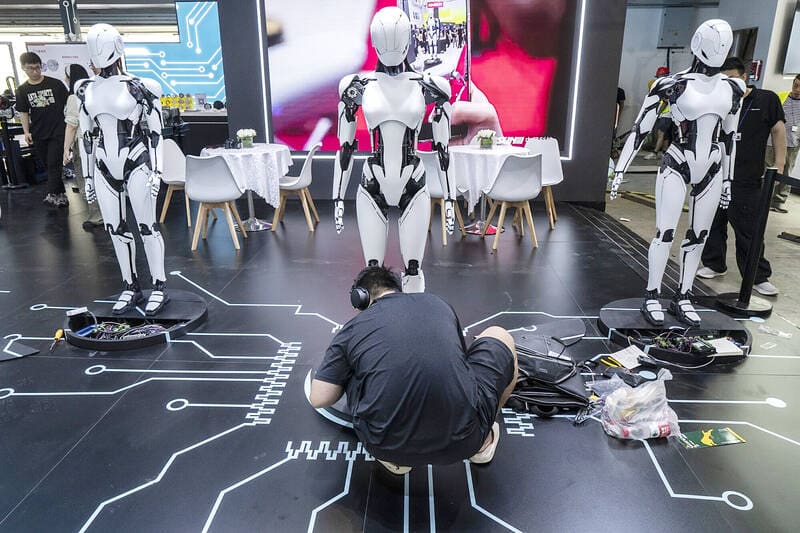
Robotics manufacturers from mainland China accounted for 97 percent of worldwide humanoid robot deliveries during the first six months of this year, cementing early dominance in a sector that American rivals are only beginning to enter at scale.
Industry data from Smart Analytics Global recorded 19,100 humanoid units delivered globally between January and June, representing a threefold increase from the 5,100 units shipped during the same window last year. The California research house projects total deliveries will climb to approximately 60,000 units by year-end, then surge to 500,000 units by 2030.
Agibot Innovation Technology, based in Shanghai, claimed the largest market position with 8,400 units shipped in the half, capturing 44 percent of the global total. Hangzhou's Unitree Robotics followed with 5,900 units. Both companies shipped volumes that far exceed the combined output of leading American producers including Tesla, Figure AI, and Agility Robotics.
Washington Moves to Block Imports
The disparity in production scale prompted Washington to impose import restrictions on new Chinese humanoid and four-legged robots in late July, along with certain components. Officials cited national security concerns and potential cybersecurity threats to critical artificial intelligence infrastructure as justification for the ban.
Despite the regulatory move, policy backing and multi-tier government funding across mainland China continue to accelerate commercialization timelines for domestic manufacturers. The strategic priority Beijing places on humanoid robotics was visible at the World AI Conference in Shanghai last month, where dozens of producers demonstrated advances in manipulation precision, locomotion speed, and task versatility.
Industrial Adoption Accelerates
A significant shift is occurring in deployment patterns. Smart Analytics Global founder Linda Sui noted that industrial and commercial applications represented more than 70 percent of humanoid shipments in the first half, up from roughly 50 percent in the prior-year period. The migration from research and demonstration units toward productive workplace roles signals growing confidence in the technology's maturity and return on investment.
Sui cautioned that regulatory friction and geopolitical tensions will likely influence the trajectory of future expansion. Trade restrictions, export controls, and supply-chain realignments could reshape competitive dynamics as the sector scales.
Unitree IPO Draws Heavy Demand
Investor appetite for exposure to the humanoid sector was evident in the reception to Unitree Robotics' initial public offering in Shanghai. The retail tranche attracted subscription demand 5,526 times the shares available, with individual investors submitting 9.8 million orders, according to exchange filings released this week.
Unitree sold 40.4 million shares priced at 150.8 yuan each, raising approximately 6.1 billion yuan. The offering valued the company at roughly 61 billion yuan, making it the first publicly traded humanoid robotics manufacturer on the mainland. The stock is scheduled to begin trading on Shanghai's STAR Market later this month.
Listing Wave Builds Momentum
A strong debut for Unitree could catalyze additional public offerings from mainland robotics companies. Leju Robotics Technology in Shenzhen and Deep Robotics are both pursuing IPO preparations, while Agibot has initiated the listing process in Hong Kong, according to Securities Daily.
The fundraising activity reflects both the capital intensity of scaling humanoid production and investor optimism about near-term commercial adoption. Manufacturing facilities require significant investment in assembly lines, component sourcing, and quality control systems, while software development teams work to refine motion planning, perception algorithms, and task learning capabilities.
Asia Angle: Regional Production Hub Emerges
The concentration of humanoid manufacturing in mainland China mirrors broader patterns in Asia's robotics ecosystem. Shenzhen and the Pearl River Delta already serve as global centers for industrial automation, drone production, and consumer electronics assembly. Humanoid makers are leveraging this existing supply-chain infrastructure, accessing component suppliers, contract manufacturers, and engineering talent pools that took decades to build.
Japan and South Korea, traditional leaders in industrial robotics, have yet to match the pace of humanoid commercialization seen in China. While Japanese firms like Honda and Sony pioneered early humanoid research, mainland producers have moved faster to transition from laboratory prototypes to volume manufacturing.
The competitive landscape in Asia will likely intensify as governments in Tokyo and Seoul reassess their robotics strategies and consider policy measures to support domestic champions. For now, mainland China's combination of state funding, manufacturing scale, and aggressive go-to-market timelines has established a commanding lead in the race to define the humanoid sector's early years.
RELATED STORIES
Beijing's AI Bar Offers Free DeepSeek Access as Price Wars Reshape Global Market
Cheng Wei-Lun · 3 min
SK Hynix Reviews Future of China Packaging Facility Amid $3 Billion Valuation Talk
Cheng Wei-Lun · 2 min
China Invites Science Elites to Annual Leadership Retreat as Research Push Accelerates
Cheng Wei-Lun · 3 min
BYD Targets Japan's Regional Markets With Racco Mini EV
Aiko Nakamura · 4 min
Spot something wrong? Email editor@briefasia.com. We log every correction publicly.