Sustainability · Climate
Cambodia's Salt Harvest Shrinks as Monsoon Rains Arrive Earlier
Shifting weather patterns disrupt traditional production cycles in Kampot and Kep, threatening a centuries-old industry that depends entirely on sun and dry conditions.
KEY TAKEAWAYS
- ·Cambodia's salt harvest fell to 30,000 metric tonnes in 2025, roughly half the expected 2026 output of 75,000 tonnes, after heavy rains disrupted the dry season in Kampot and Kep provinces.
- ·The country ranks 12th globally on the Global Climate Risk Index, with intensifying floods, droughts, and erratic rainfall compressing the production window for solar evaporation.
- ·Cheaper imported salt and poor infrastructure, including limited road access and electricity, add competitive and logistical pressure on 141 small-scale producers who rely on traditional methods.
A Season Out of Sync
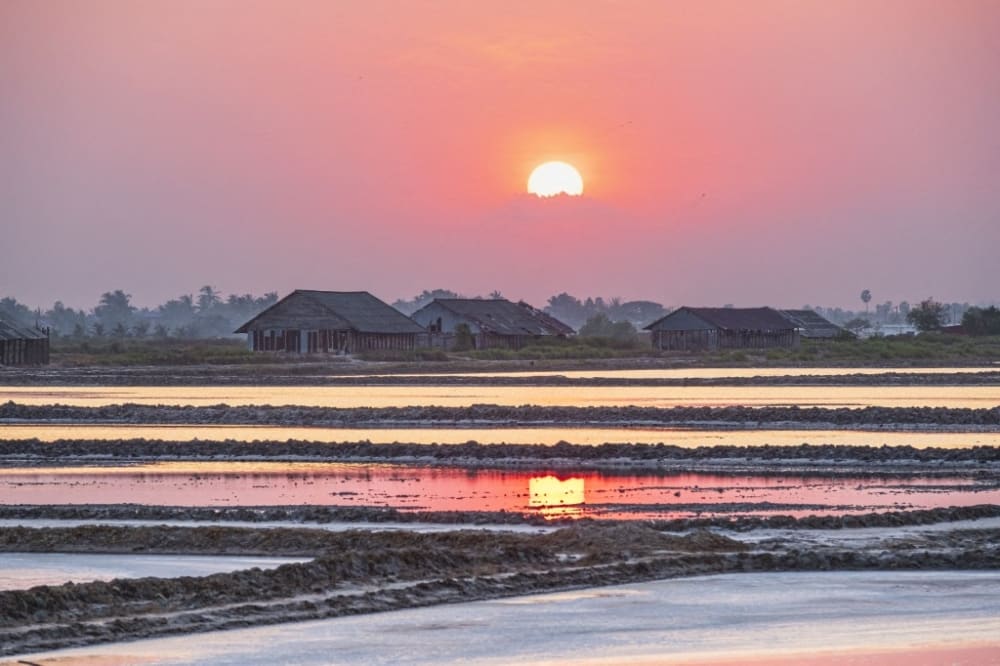
Salt farmers along Cambodia's southern coast have worked the same rhythm for decades. Seawater flows into shallow ponds each October, evaporates under relentless sun through May, and leaves behind crystalline layers harvested by hand. But that rhythm is breaking.
Kampot and Kep provinces, located 150 kilometres southwest of Phnom Penh, produce nearly all of Cambodia's traditional sea salt. Across 141 small-scale operations, farmers still use solar evaporation methods that require weeks of uninterrupted sunshine. Over the past five years, they have watched those weeks vanish.
Heavy rains now arrive during what used to be the driest months. High tides flood evaporation ponds. Production windows shrink. In 2025, total output fell to roughly 30,000 metric tonnes, less than half the volume farmers expect to harvest this year, according to the Association of Geographical Indication Kampot-Kep Salt Producers.
"Production patterns have changed due to heavy rain and high tides. Climate change is a big challenge because our production depends entirely on weather conditions," Bun Narin, president of the association, told Bernama.
The Mechanics of Disruption
Salt production in Kampot and Kep operates on a tight margin. Seawater must evaporate at a steady rate for crystals to form cleanly. Rainfall dilutes the brine, resets concentration levels, and can ruin weeks of work. When tides rise unexpectedly, they breach pond walls and wash out partially crystallised salt.
The region received Geographical Indication certification in April 2023, marking Kampot-Kep salt as a protected product with distinct qualities tied to its origin. That designation raises the commercial value of the harvest, but it cannot insulate farmers from weather.
Cambodia ranks 12th globally on the Global Climate Risk Index, according to the National Council for Sustainable Development. Floods, droughts, and erratic rainfall patterns are intensifying across the country. Agriculture, which employs millions and remains deeply vulnerable to climate shifts, bears the brunt.
For salt farmers, the problem is not simply more rain, it is the timing. Monsoon patterns are arriving earlier and lingering longer, compressing the dry season into a narrower, less predictable window.
Infrastructure Gaps Compound the Problem
Climate volatility is only part of the challenge. Farmers in Kampot and Kep also contend with poor infrastructure. Many production sites lack reliable road access, making it difficult to transport salt to markets or bring in supplies. Electricity is inconsistent, and clean drinking water is scarce.
These limitations make it harder for producers to invest in equipment that might help them adapt, such as pumps to manage flooding or storage facilities to protect harvested salt from unexpected rain.
Meanwhile, cheaper imported salt from neighbouring countries continues to flow into Cambodian markets, according to local reports. Domestic producers, who rely on labour-intensive methods and face higher input costs, struggle to compete on price. The GI certification offers some differentiation, but it does not guarantee market share.
What Comes Next
Producers expect to harvest around 75,000 metric tonnes of salt in 2026, a rebound from last year's disrupted season. But the recovery depends on weather cooperating, and recent history offers little reassurance.
Adaptation options are limited. Salt production cannot be moved indoors or mechanised easily without abandoning the traditional methods that underpin the GI designation. Farmers can adjust pond depths, reinforce walls, or shift harvest schedules slightly, but none of those measures can offset weeks of lost evaporation time.
The broader question is whether the traditional dry season will remain viable at all. If monsoon patterns continue to shift, the window for solar evaporation may shrink further, forcing farmers to make difficult choices about the future of an industry that has anchored coastal communities for generations.
RELATED STORIES
Philippine Farmers Cut Methane Emissions With Water-Saving Rice Technique
Mariel D. Santos · 3 min
Bangladesh's Jute Mandate Fails to Displace Plastic in Packaging
Priyanka V. Rao · 5 min
Climate Target Body Opens Door to Southeast Asian Producers on Land-Use Rules
Priyanka V. Rao · 2 min

Indonesia Reviews School Meal Program to Strengthen Local Food Systems
Siti Nuraini · 4 min
Spot something wrong? Email editor@briefasia.com. We log every correction publicly.