Asia · Environment
Riau Battles Wildfire Surge With Skeleton Budget
Indonesia's fire-prone province faces peak dry season with drastically reduced funding as El Niño compounds the threat across 15,600 hectares already burned.
KEY TAKEAWAYS
- ·Riau province is battling active fires across eight locations with helicopter water bombing and ground crews, having already lost 15,608 hectares this season, mostly in Bengkalis and Pelalawan regencies.
- ·Severe budget cuts are forcing the disaster agency to prioritize resources as El Niño-driven drought and peak dry season conditions from August to September amplify ignition risk.
- ·The outcome hinges on rainfall timing; extended drought could push fire totals significantly higher and repeat Indonesia's transboundary haze crises seen in previous El Niño years.
Crisis on Multiple Fronts
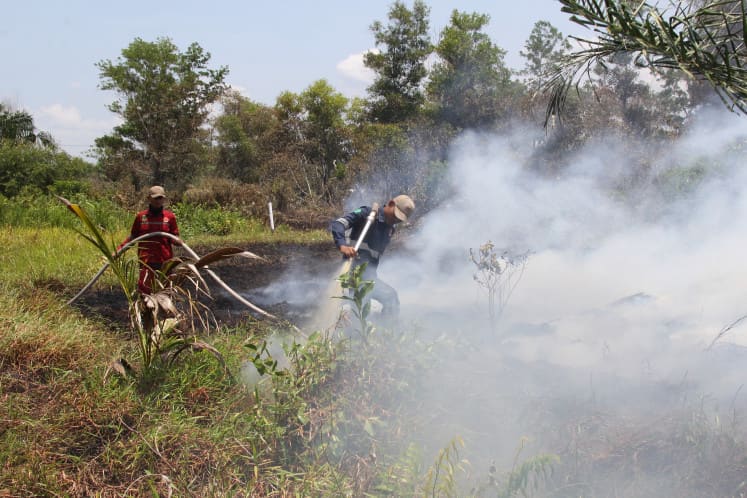
Riau province is fighting active forest and land fires across eight locations while grappling with severe budget constraints, a collision that comes as El Niño-driven drought intensifies the annual fire season. Joint firefighting teams are deploying ground crews and helicopter water bombing to suppress blazes in Bengkalis, Indragiri Hilir, Indragiri Hulu, Pelalawan, and Rokan Hilir regencies, the provincial disaster agency confirmed this week.
The air temperature across the Sumatran province has climbed to extreme levels with negligible rainfall, creating conditions ripe for ignition. Hot spots continue to appear in plantation company concessions and smallholder farmland, stretching response capacity thin.
Edy Afrizal, head of the Riau Disaster Mitigation Agency, said firefighters are simultaneously cooling two recently extinguished sites in Kampar and Siak regencies where smoke persists and reignition remains a risk. Four additional hot spots in Pekanbaru city and Siak have been fully suppressed.
The Scale of Damage
Since the start of the season, fires have consumed 15,608 hectares across 12 cities and regencies in Riau. Bengkalis regency accounts for the largest share at 8,273 hectares, followed by Pelalawan with 4,629 hectares, according to data from the provincial disaster agency.
The timing compounds the challenge. Indonesia's meteorological service has forecast the peak dry season to run from August through September, the precise window when fire risk historically reaches its apex in Riau. The province, home to extensive oil palm plantations and peatland, has long been a flashpoint for smoke haze that crosses borders and triggers diplomatic friction with Singapore and Malaysia.
Budget reductions have forced the disaster agency to prioritize resources, concentrating firefighting efforts on the most severe blazes while relying on inter-agency coordination with military, police, and forestry units to cover gaps.
The Broader Southeast Asia Pattern
Riau's predicament mirrors a wider trend across Southeast Asia, where El Niño cycles amplify fire seasons and strain government capacity. The phenomenon suppresses rainfall across the Indonesian archipelago, drying out peatland that can smolder for weeks and produce thick transboundary haze.
Indonesia's fire problem is structural as well as climatic. Land clearing by burning remains common practice among smallholders and, occasionally, plantation operators, despite legal prohibitions. Enforcement is patchy, and prosecutions rare. Peatland drainage for agriculture further dries the landscape, turning carbon-rich soil into tinder.
The economic cost extends beyond suppression. Haze disrupts air travel, closes schools, and drives respiratory illness spikes. In 2015, Indonesia's worst fire season in two decades, economic losses exceeded USD 16 billion and smoke blanketed the region for months.
What Comes Next
Riau's disaster agency is maintaining round-the-clock monitoring of hot spots via satellite and ground patrols. Helicopter water bombing will continue as long as active fires threaten populated areas or critical infrastructure, but sustained operations depend on budget availability and aircraft access.
Weather will be the determining factor. If the dry season extends beyond September or rainfall remains below normal, the province could see fire totals climb well above the current 15,600-hectare mark. Early rains would ease pressure, but forecasts offer little optimism.
The budget squeeze also raises questions about preparedness for the 2027 season. Without adequate funding for firebreaks, early detection systems, and community education, Riau risks repeating the cycle each year El Niño returns.
RELATED STORIES
Jakarta Charts Course for 8% Growth With State-Led Resource Strategy
Priyanka V. Rao · 4 min

Indonesia Takes Control of Whoosh Railway Debt as B2B Model Collapses
Siti Nuraini · 4 min

Indonesia's Free Meal Program Leaves Rural Kitchen Operators Trapped in Debt
Siti Nuraini · 3 min
Indonesia's Mining Sector Contracts for Second Straight Quarter
Siti Nuraini · 3 min
Spot something wrong? Email editor@briefasia.com. We log every correction publicly.