Technology · Products
Mitsubishi Electric Scales Satellite Manufacturing to Match Japan's H3 Launch Tempo
As H3 rockets approach higher flight rates, the electronics giant is reconfiguring production lines to build multiple satellites in parallel, marking a structural shift in Japan's space industrial base.
KEY TAKEAWAYS
- ·Mitsubishi Electric is reconfiguring satellite production to support parallel manufacturing, driven by the higher launch cadence of Japan's H3 rocket program developed by JAXA and Mitsubishi Heavy Industries.
- ·The shift from sequential to parallel production reflects a broader move toward industrialized space hardware output, borrowing modular assembly practices from automotive and electronics sectors.
- ·Japan's space sector is transitioning from low-volume, high-value projects to higher throughput models in response to competitive pressure from China, India, and private launch providers across Asia-Pacific.
Production Overhaul Tied to Launch Economics
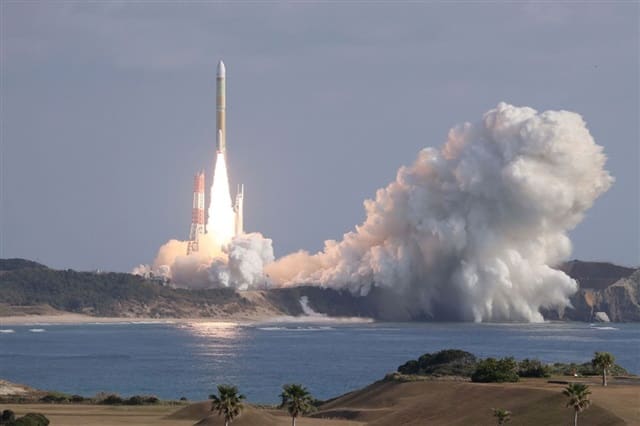
Mitsubishi Electric is reconfiguring its satellite manufacturing operations to support parallel production runs, a change driven by the accelerating flight schedule of Japan's H3 rocket. The H3 program, developed jointly by JAXA and Mitsubishi Heavy Industries, is targeting a higher launch cadence that demands a steady pipeline of payloads.
The shift represents more than incremental capacity expansion. Traditional satellite manufacturing in Japan has operated on a largely sequential basis, with long lead times and bespoke engineering for each mission. The new approach borrows from automotive and electronics assembly paradigms, where modularity and process standardization enable multiple units to move through production stages simultaneously.
This transition aligns with broader trends in the Asia-Pacific space sector, where launch vehicle economics are forcing upstream manufacturers to rethink their throughput models. As launch costs decline and flight opportunities multiply, the bottleneck is shifting from access to orbit to the speed at which spacecraft can be designed, tested, and delivered.
H3 as Catalyst
The H3 rocket entered service in 2024 after a protracted development cycle marked by engine redesigns and a high-profile failure during its debut flight. Since achieving operational status, JAXA and Mitsubishi Heavy Industries have worked to raise the annual flight rate, aiming to compete with lower-cost international alternatives and secure a foothold in the commercial launch market.
A higher H3 tempo creates immediate demand for domestic payloads. Mitsubishi Electric, already a major supplier of satellites for government and commercial customers, is positioning itself to absorb that demand without lengthening delivery schedules. The company's manufacturing footprint includes facilities in Kamakura and other sites where precision electronics and spacecraft integration occur under clean-room conditions.
Parallel production requires more than floor space. It demands modular satellite architectures, standardized interfaces, and tighter coordination between subsystem vendors. Mitsubishi Electric has been moving in this direction for several years, but the H3 program's maturation has accelerated the timeline.
Regional Implications
Japan's space industry has historically operated with a small number of high-value, low-volume projects. The pivot toward higher throughput reflects both domestic policy priorities and competitive pressure from China, India, and private launch providers in the region.
China's state-owned satellite manufacturers have demonstrated the ability to produce and deploy constellations at scale, a capability that has strategic and commercial ramifications. India's space sector, now open to private participation, is also scaling up production capacity. Japan's response involves tighter integration between launch vehicle developers, satellite manufacturers, and government customers.
For Mitsubishi Electric, the expansion is a hedge against future market dynamics. As constellation operators seek to refresh satellites on shorter cycles and replace units lost to debris or component failures, manufacturers that can deliver on predictable schedules will capture a larger share of contracts.
Manufacturing Model Shift
The move toward parallel production is not without risk. Satellite manufacturing has long been a domain where customization and redundancy justify extended timelines and high costs. Standardization introduces the possibility of common-mode failures, where a design flaw or component defect affects multiple units simultaneously.
Mitsubishi Electric's approach appears to balance these concerns by retaining mission-specific customization at the payload level while standardizing bus architecture and power systems. This allows the company to achieve economies of scale without sacrificing flexibility for customers with unique requirements.
The H3 program's success will determine whether this model proves sustainable. If launch rates meet or exceed projections, Mitsubishi Electric's investment in parallel production will position it as a dominant player in Japan's space supply chain. If H3 struggles to secure commercial customers or faces technical setbacks, the company may find itself with excess capacity and underutilized facilities.
For now, the trajectory is clear: Japan's space sector is moving from artisanal production to industrial scale, and Mitsubishi Electric is leading that transition.
RELATED STORIES
Mitsubishi Electric Prepares Satellite Production Surge as Japan Accelerates Launch Cadence
Cheng Wei-Lun · 4 min
WeRide Eyes Regional Push Across Australia and Asia-Pacific Markets
Cheng Wei-Lun · 2 min

Rakuten Partners With German AI Firm Helsing on Military Drone Tests in Japan
Aiko Nakamura · 3 min

Akita Plans Major AI Data Center to Launch by 2030
Aiko Nakamura · 3 min
Spot something wrong? Email editor@briefasia.com. We log every correction publicly.