Asia · Trade
China-ASEAN Trade Jumps to $643 Billion in First Half of 2026
Intermediate goods account for two-thirds of bilateral commerce as regional industrial chains deepen integration through infrastructure and trade pacts.
KEY TAKEAWAYS
- ·China-ASEAN trade reached $643.2 billion in the first half of 2026, up 18.2% year-on-year, with intermediate goods rising 24.5% to account for two-thirds of total commerce.
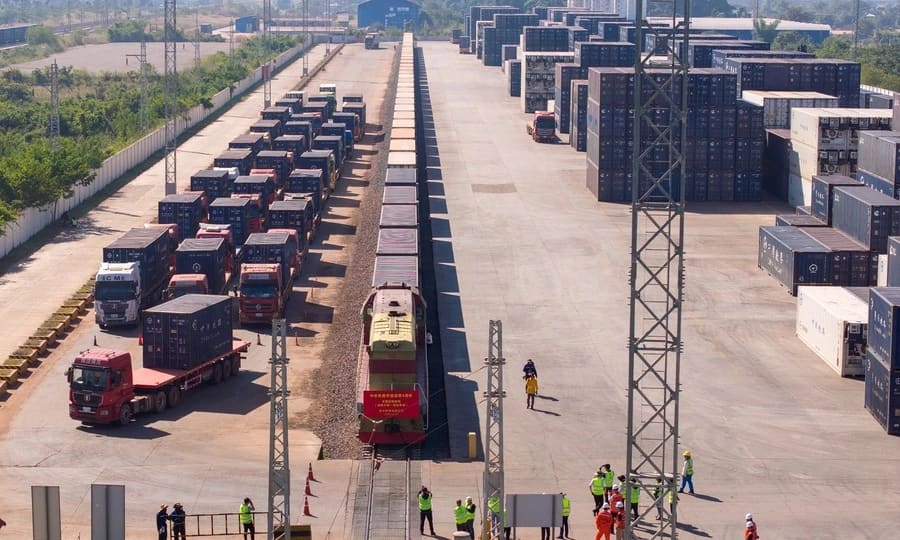
- ·Vietnam trade through China's Guangxi region hit a record 183.71 billion yuan in the first seven months, supported by daily freight rail services replacing three weekly runs.
- ·The China-Laos Railway recorded $17.17 billion in cargo value in H1 2026, up 33.8%, with tropical fruit imports climbing 25.8% as the line serves 19 countries.
Trade Momentum Accelerates
Bilateral commerce between China and the Association of Southeast Asian Nations climbed to 4.34 trillion yuan ($643.2 billion) in the first half of 2026, according to the General Administration of Customs of China. The figure represents an 18.2% increase over the same period last year, underscoring the momentum in one of Asia's most critical trade corridors.
Intermediate goods drove much of the expansion. Parts, components, and production inputs totaled 2.86 trillion yuan during the six-month period, up 24.5% year-on-year and representing roughly two-thirds of all cross-border transactions. The shift reflects tightening integration between Chinese manufacturing hubs and Southeast Asian assembly operations, with supply chains increasingly treating the region as a unified production zone.
Lyu Daliang, spokesperson for China's customs administration, pointed to the growing connectivity between industrial and value chains across the bloc as the primary force behind the surge in intermediate goods flows.
Vietnam Corridor Expands
Trade between China's Guangxi Zhuang Autonomous Region and ASEAN reached 248.21 billion yuan in the first seven months of 2026, data from Nanning Customs showed. The 2.5% year-on-year gain set a new record for the January-July window. Vietnam accounted for the lion's share: 183.71 billion yuan, up 3.3% from the prior year.
Freight rail services linking Guangxi with Vietnam now run daily, a sharp increase from three weekly departures previously. Southbound trains carry electronics and machinery; northbound consists haul tropical produce including durians and mangosteens destined for Chinese consumers.
The expanded schedule reflects rising demand on both sides of the border and illustrates how physical infrastructure upgrades translate directly into trade volume gains.
RCEP Framework Lowers Barriers
The Regional Comprehensive Economic Partnership continues to reshape tariff and customs landscapes. The 15-member pact, which includes China, Japan, South Korea, Australia, New Zealand, and the ten ASEAN states, entered force in January 2022 and reached full implementation across all signatories in June 2023.
Under RCEP rules of origin, materials sourced in one member country and incorporated into products in another qualify as originating goods of the latter. The provision simplifies cross-border value chains and reduces documentation burdens for manufacturers operating multi-country production networks.
Xu Yingming, who leads the Institute of International Market Research under China's Ministry of Commerce, noted that RCEP and the China-ASEAN Free Trade Area together have cut transaction costs and encouraged closer industrial chain integration across the region.
China-Laos Railway Gains Traction
The China-Laos Railway, operational since December 2021, posted import-export cargo value of 17.17 billion yuan in the first half of 2026, up 33.8% from a year earlier. The line runs from Kunming in southwest China to Vientiane, threading through mountainous terrain that previously hindered overland freight movement.
Tropical fruit imports via the railway surged 25.8% to 4.22 billion yuan during the period. Durians, mangosteens, and longans now move north in refrigerated containers, reaching inland Chinese cities within days rather than weeks.
The railway now handles more than 3,900 product categories, with freight services extending to 19 countries and territories. The expansion demonstrates how a single infrastructure project can unlock latent trade flows and reshape regional logistics patterns.
Outlook
The data points to a regional economy where production fragmentation and specialization are accelerating. Intermediate goods flows growing faster than finished goods trade signal that manufacturers are slicing value chains into finer segments, allocating tasks to the most cost-effective locations within the bloc.
Transport infrastructure investments are paying off. Daily rail frequencies, expanded customs facilities, and streamlined documentation under RCEP are compressing lead times and lowering costs, making just-in-time production models viable across borders that once required weeks of buffer inventory.
As ASEAN economies continue to industrialize and China's coastal provinces push higher-value manufacturing inland, the intermediate goods corridor between the two is likely to deepen further. The first-half figures suggest the trajectory remains firmly upward.
RELATED STORIES
Asian Routes Become Conduit for Billions in Tariff Evasion
Cheng Wei-Lun · 3 min
Thailand Named in US Transshipment Risk Report Alongside 40 Countries
Priyanka V. Rao · 4 min
Vietnam's Manufacturing Surge Raises Questions About Industrial Independence
Cheng Wei-Lun · 4 min
Singapore Tightens Transshipment Rules Amid US Tariff Scrutiny
Lim Hui Ying · 4 min
Spot something wrong? Email editor@briefasia.com. We log every correction publicly.