Asia · Business
Vietnam's Manufacturing Surge Raises Questions About Industrial Independence
Chinese firms are flooding into northern industrial zones, but most high-value production and R&D remain anchored across the border
KEY TAKEAWAYS
- ·Chinese tenant share at major Vietnamese industrial parks rose from 9 percent in 2021 to 15 percent by 2025, driven by US tariff pressure on mainland exports.
- ·Vietnam imported approximately USD 168 billion from China in the first eleven months of 2025, up nearly 30 percent year on year, with a third consisting of electronic components for re-export.
- ·Hanoi plans to train 50,000 chip design engineers by 2030 and began construction on its first semiconductor fabrication plant in January, with pilot production expected by end-2027.
A New Manufacturing Corridor
Fu Mingdong opened his first Vietnamese lubricants plant in Ho Chi Minh City in 2017. Six years later, he opened a second in Bac Ninh, the industrial belt north of Hanoi that has attracted a wave of Chinese manufacturers in the past 24 months. Fu, who spent three decades building Fable Lubricants in Dongguan, Guangdong, now sees peers and customers making the same southward journey.
The immediate trigger is clear. US tariffs on Chinese exports have pushed factory owners to seek production sites outside mainland borders. Chinese tenants at Vietnam-Singapore Industrial Park complexes rose from 9 percent in 2021 to 15 percent by 2025, according to Sembcorp Development. At Deep C Industrial Zones in Hai Phong, the share climbed from roughly 7 percent before the pandemic to 20 percent today.
The composition of arriving firms has shifted. Electronics suppliers Luxshare and Goerker have established Vietnamese operations, reflecting a move beyond the garment and furniture factories that dominated earlier waves. Marco Foerster, Asean Regional Director at Acclime Vietnam, noted that Chinese manufacturers are offshoring mid-tier, export-focused production while keeping higher-end processes at home.
Assembly Lines Move, Engineering Stays
Uni-Trend, a Chinese instrument maker with a Bac Ninh facility, treats Vietnam primarily as an export platform for the US market. Zhang Deng, general manager of Uni-Trend Vietnam, said the company has built advanced production lines but has not yet started formal output because local capability remains insufficient for certain products.
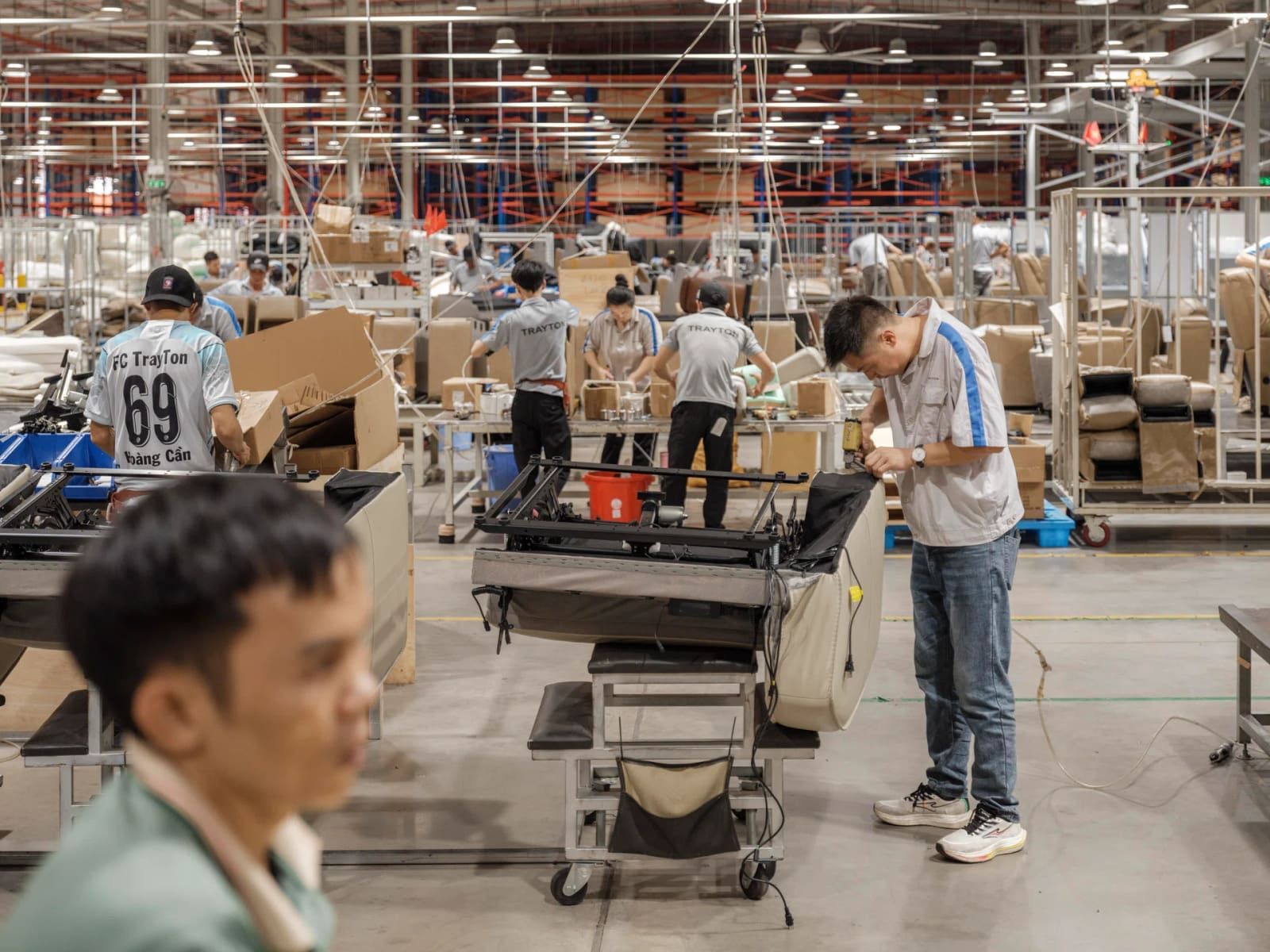
Trayton Group, a large Chinese furniture manufacturer, began Vietnamese production last year to serve American buyers. Founder Simon Lichtenberg said the Vietnamese plant handles simpler items while Chinese factories continue making more complex designs. All research, development, and design work remains in China, where the company has maintained its headquarters and technical teams for 30 years.
This pattern extends across sectors. Vietnam's domestic machine shops are emerging but cannot yet meet tight tolerance requirements for precision components, which continue to arrive from China, Taiwan, and South Korea. When equipment fails or technical issues arise, Vietnamese operations still depend on technicians flown in from the mainland, according to Fu.
The Import Dependency
Vietnamese government data showed the country imported approximately USD 168 billion in goods from China during the first 11 months of 2025, a year-on-year increase of nearly 30 percent and already above the full-year 2024 total. About one-third comprised electronic components that were assembled in Vietnam and then shipped onward, often to the United States.
Tommy Xie, Head of Asia Macro Research at OCBC, pointed to a structural shift in trade flows. Before 2019, China ran trade deficits with the six largest Asean economies in machinery, electrical equipment, and semiconductors. By 2025, China recorded a USD 133 billion surplus in those categories with the same group, representing 12.4 percent of its overall trade surplus.
The result is a supply chain in which final assembly occurs in Vietnam while core inputs, capital goods, and advanced technologies remain concentrated in China. Xie argued this does not necessarily hollow out local industry. Imports of intermediate goods can stimulate employment and industrial development, much as Japanese investment in China did decades ago, when core technology stayed in Japan yet Chinese firms gradually built their own capabilities.
A Different Era for Industrial Catch-Up
Le Hong Hiep, senior fellow at ISEAS - Yusof Ishak Institute, sees a structural difference between Vietnam today and the East Asian economies that industrialized in the late 20th century. Japan, South Korea, and Taiwan entered manufacturing sectors that were still contested, with shallower global supply chains and genuine openings for new entrants.
Vietnamese suppliers now face Chinese competitors that can undercut on price, scale rapidly, and often deliver better quality. The rational response for many Vietnamese firms has been to import from China rather than attempt to develop their own supply base, which Le described as a persistent hollowing-out of domestic industrial capacity.
Vietnam's constraint extends to human capital. Foerster noted that the country's greatest bottleneck is a shortage of skilled talent. Newly recruited employees often require six months to a year of training before they can contribute effectively. Relatively complete industrial ecosystems exist only within a handful of industrial parks, limiting the spillover effects that drove earlier waves of industrialization in Northeast Asia.
Vietnam's Bid for Semiconductor Capability
Hanoi has set a target to train 50,000 chip design engineers by 2030 and expand its semiconductor workforce to more than 100,000 by 2040. In January, Viettel, the military-run telecoms and industrial conglomerate, broke ground on Vietnam's first chip fabrication plant, with pilot production scheduled to begin by the end of 2027.
The semiconductor push reflects a broader ambition to move beyond assembly. Whether Vietnam can replicate the trajectory of earlier East Asian economies or remain an extension of Chinese manufacturing networks will depend on policy choices, workforce development, and the willingness of Vietnamese firms to invest in capabilities that Chinese suppliers already provide at lower cost.
For Chinese manufacturers, Vietnam represents another node in an increasingly distributed supply chain. For Hanoi, the influx of factories poses a more fundamental question about the path to industrial autonomy in an era when dominant players already occupy most segments of global manufacturing.
RELATED STORIES

Vietnam Pushes Rare Earth Processing to Strengthen Supply Chain Autonomy
Cheng Wei-Lun · 3 min
Vietnam's Durian Shipments to China Jump 43% as Harvest Season Peaks
Tran Quoc Bao · 3 min
HiteJinro Expands Vietnam Footprint with Scholarship Program and New Production Facility
Cheng Wei-Lun · 3 min
Vietnam Textile Exports Climb to $27 Billion as Upstream Production Gains Momentum
Priyanka V. Rao · 3 min
Spot something wrong? Email editor@briefasia.com. We log every correction publicly.