Asia · Politics
Modi Unveils Free Exam Prep and AI Skills Push After Education Protests
New Delhi rolls out digital coaching platform and pledges training for 10 million youth as government attempts to defuse anger over exam scandals and job scarcity
KEY TAKEAWAYS
- ·India will provide free online coaching for competitive exams and train 10 million youth in artificial intelligence over one year, Modi announced August 15.
- ·The programs respond to nationwide protests over leaked exam papers that forced Education Minister Dharmendra Pradhan to resign last month.
- ·India plans eight new semiconductor plants and five nuclear reactors targeting 100 gigawatts of atomic power by 2047 as part of development push.
Digital Platform Targets Middle-Class Burden
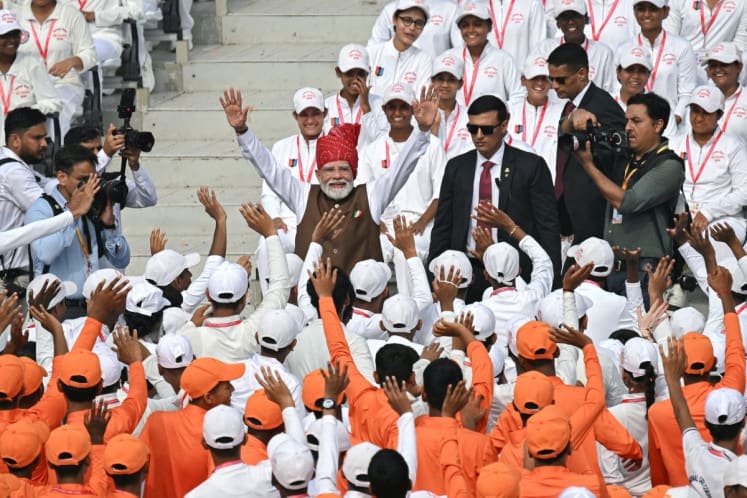
India will launch a government-funded online coaching platform offering preparation courses for competitive entrance examinations at no charge, Prime Minister Narendra Modi said in his Independence Day address from Red Fort on August 15. The initiative aims to reduce expenses for families navigating the country's high-stakes college admission system, where a single test can determine economic futures.
Modi framed the program as relief for households stretched thin by private tutoring costs. The platform will leverage existing digital infrastructure and draw on educators already working within the system, he said. Students can now prepare from home rather than relocating to coaching hubs, cutting both tuition fees and living expenses that have become a defining financial strain for India's middle class.
The announcement arrives six weeks after nationwide demonstrations forced the resignation of Education Minister Dharmendra Pradhan. Protests erupted following the leak of a national medical entrance exam paper, part of a broader pattern of compromised recruitment processes that exposed systemic failures in India's examination apparatus. Young protesters framed the scandals as emblematic of a rigged system that prioritizes connections over merit in a labor market already struggling to absorb new graduates.
Coaching Economy Under Pressure
India's private coaching sector has grown into a multi-billion-dollar industry, concentrated in cities like Kota and Delhi where students spend years in intensive preparation. Families routinely allocate substantial portions of household income to secure spots in these programs, betting that structured tutoring offers the only realistic path to admission at government colleges, which charge a fraction of private institution fees.
The scale of competition is staggering. Millions of students sit for entrance exams annually, vying for a limited number of seats in engineering, medicine, and civil service programs. The National Testing Agency, which administers many of these exams, has faced mounting criticism over security lapses and logistical failures that undermine public confidence in meritocratic selection.
Modi's digital coaching plan seeks to disrupt this dynamic by offering an alternative that bypasses geographic and financial barriers. Whether the platform can match the rigor and personalized attention of established coaching centers remains an open question. Execution will depend on content quality, user interface design, and the government's ability to attract top instructors to a public initiative.
AI Training at Scale
Alongside the coaching platform, Modi committed to training 10 million young Indians in artificial intelligence skills over the next year. The timeline is aggressive, requiring coordination across educational institutions, industry partners, and government agencies. The goal reflects New Delhi's ambition to position India as a hub for technology talent, particularly as global firms diversify supply chains and talent pipelines beyond China.
AI training at this scale would represent one of the largest workforce development programs globally. Success hinges on curriculum relevance, access to computing resources, and pathways from training to employment. India's technology sector already employs millions, but much of that workforce focuses on IT services and business process outsourcing rather than cutting-edge AI development. Bridging that gap requires not just skills training but also investment in research infrastructure and startup ecosystems.
Modi tied the AI initiative to a broader development agenda he outlined in the 90-minute address. He reiterated a target of achieving developed-nation status by 2047, the centenary of independence. The roadmap includes expansion in manufacturing, agriculture, defense, and cultural exports, with an emphasis on integrating India into global supply networks.
Semiconductor and Energy Expansion
The prime minister announced plans for eight additional semiconductor fabrication plants and five new nuclear reactors, with a target of 100 gigawatts of nuclear power generation by 2047. These infrastructure commitments signal continued public investment in sectors where India lags regional competitors. Taiwan, South Korea, and Japan dominate global chip production; India's entry into semiconductor manufacturing is recent and still small-scale.
The nuclear expansion builds on last year's policy shift allowing private firms to construct and operate atomic power facilities. That move marked a departure from decades of state monopoly in the sector and reflects urgency around energy security as India's economy grows and electrification accelerates.
Modi positioned young Indians as the primary beneficiaries of this development trajectory. Economic opportunity for youth has become a central political challenge as the country adds millions of working-age citizens annually while job creation lags. The protests over exam leaks brought that tension into sharp relief, demonstrating that discontent over fairness and access can quickly mobilize large numbers.
Political Calculus
The education protests represented one of the most significant challenges to Modi's government since it took office in 2014. His administration has faced criticism before, but rarely has youth mobilization been so visible and sustained. The swift resignation of Pradhan and subsequent parliamentary action increasing penalties for exam fraud indicate the government recognized the political risk.
Free coaching and AI training are policy responses, but they also function as political messaging. Modi's Independence Day speech emphasized inclusion and opportunity, themes designed to reassure a demographic that has grown increasingly skeptical of promises. Whether these programs translate into tangible outcomes will shape public perception heading into future electoral cycles.
India's demographic dividend, long cited as a competitive advantage, becomes a liability if education systems and labor markets cannot absorb new entrants. The initiatives Modi outlined address symptoms of that mismatch, but structural reforms in hiring practices, educational quality, and economic diversification will determine whether the country can convert its young population into sustained growth rather than social instability.
RELATED STORIES
Modi Targets 50 Indian Companies in Fortune 500 With Seven-Pillar Growth Plan
Rajesh K. Iyer · 3 min
Seoul and New Delhi Strengthen Customs Cooperation to Ease Trade Friction
Cheng Wei-Lun · 3 min
Gautam Adani Secures Dismissal of U.S. Securities Fraud Case
Priyanka V. Rao · 3 min
Tata Sons Chairman Exits After Board Deadlock on Reappointment
Priyanka V. Rao · 2 min
Spot something wrong? Email editor@briefasia.com. We log every correction publicly.