Asia · Trade
Vietnam Pushes Local Suppliers Into Global Tech Networks
A small Ho Chi Minh City chip tester's rise to Intel's top-tier supplier list signals Hanoi's shift from chasing capital to building industrial depth.
KEY TAKEAWAYS
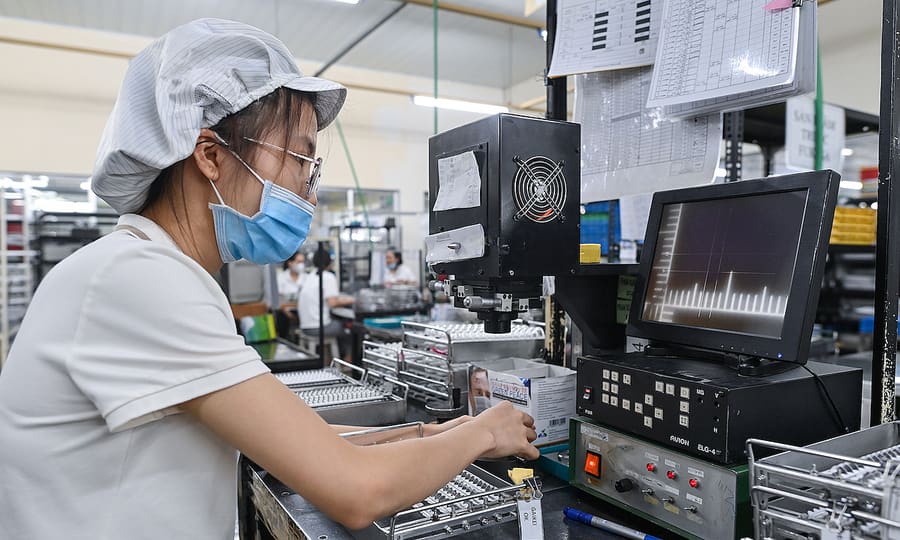
- ·Saigon Fabrication, a small Ho Chi Minh City chip tester, joined Intel's top supplier group after years of training, illustrating Vietnam's push to embed domestic firms in multinational networks.
- ·Vietnam hosts nearly 42,000 foreign enterprises with over $560 billion in committed capital, yet linkages with local suppliers and technology transfer remain limited.
- ·Hanoi's new policy ties investment incentives to local procurement and technology commitments, while analysts recommend supplier development programs similar to those in Thailand and Malaysia.
From Cautious Call to Top Supplier
When Viet Tran picked up the phone several years ago, he did not expect Intel to be on the other end. His company, Saigon Fabrication (Fab-9), ran chip testing operations in Ho Chi Minh City with a modest workforce and limited equipment. Tran doubted his firm could meet the standards of the U.S. semiconductor giant.
Kenneth Tse, vice president and general manager of Intel Products Vietnam, approached the partnership with similar caution. Intel had never before trained a local Vietnamese supplier from scratch. Yet Fab-9's technical know-how and willingness to learn convinced Intel to commit. Over the following years, Fab-9 climbed into Intel's circle of outstanding suppliers, a designation earned by only a handful of companies from a pool of thousands worldwide.
The trajectory illustrates a broader shift in Vietnam's four-decade pursuit of foreign capital. Domestic firms have long operated several rungs below their multinational counterparts in capability and scale. Now, policymakers in Hanoi are pushing to close that gap by embedding local companies into global supply chains rather than leaving them on the periphery.
Strategic Investment Over Capital Volume
Vietnam hosts nearly 42,000 foreign enterprises with cumulative committed capital exceeding $560 billion, according to the Ministry of Finance. Yet linkages between those investors and domestic suppliers remain thin. Indigenization rates stay low, technology transfer lags, and Vietnamese supplier networks have not expanded in proportion to the tax breaks and land concessions extended to foreign firms.
The Politburo issued a resolution calling for a pivot from volume-driven foreign direct investment to strategic investment that strengthens domestic industrial ecosystems. Tim Evans, CEO of HSBC Vietnam, framed the distinction in practical terms. A high-quality FDI project should not be measured by dollar size alone but by its ability to deepen manufacturing and innovation capacity and help local firms climb the value chain.
Recent commitments suggest the policy shift is gaining traction. DHL broke ground in Hung Yen province on a logistics and warehousing complex budgeted at 1.9 trillion dong, or roughly $72 million. The facility will become the largest of its kind in Southeast Asia. DHL has already expanded its Hanoi gateway and freight operations in the northern port city of Hai Phong. Singapore-based YCH Group is developing an integrated logistics hub at the Moc Bai Border Gate Economic Zone in Tay Ninh and studying a second site in the Da Nang Free Trade Zone.
Spillover Effects and Workforce Mobility
Bertrand Juvigny, CEO of DHL Supply Chain Vietnam, pointed to employee mobility as a key mechanism for diffusing global standards. Workers trained under DHL's international protocols carry that knowledge to other employers, raising the baseline across the logistics sector. The pattern holds in other industries. SCG Vietnam, a construction materials producer, has deployed $7 billion in the country and works with 5,000 tier-one domestic suppliers, who represent 70 to 80 percent of its supplier base.
Value chain integration, competitive pressure, and strategic partnerships amplify those spillover effects. Kim Ngoc Thanh Nga, deputy director of the National Innovation Center, argued that investment incentives should be explicitly tied to the use of Vietnamese suppliers and measurable technology transfer commitments. Dau Anh Tuan, deputy secretary general of the Vietnam Chamber of Commerce and Industry, said domestic companies need to overhaul corporate governance and adopt risk-sharing arrangements with strategic partners rather than transactional, project-by-project relationships.
Analysts have called for supplier development programs modeled on initiatives in Thailand and Malaysia, where governments provide targeted support to raise the technical and managerial capacity of small and mid-sized manufacturers.
Semiconductor Workforce and Policy Consistency
Human capital constraints are particularly acute in semiconductors. Chung Won Seok, general director of Hana Micron Vina, noted that Vietnam has accumulated only four years of experience in semiconductor workforce training, compared with three to four decades in China and South Korea. Customer standards and competitive pressure remain uniform across markets, however. Hana Micron has responded by launching partnership programs with universities and provincial authorities to cultivate talent while students are still enrolled.
Kulachet Dharachandra, country director of SCG Vietnam, said research and innovation capabilities will determine which countries attract the next generation of high-value investment. Juvigny of DHL emphasized that investors committing to 20-year horizons need confidence that policy frameworks will remain stable and that regulatory changes will be telegraphed well in advance. Evans of HSBC added that broad policy goals must be translated into clear, predictable implementation measures. The difference between investor interest and a signed contract often hinges on that clarity.
Closing the Gap
The partnership between Intel and Fab-9 demonstrates that small domestic firms can integrate into multinational networks if they invest in technical capability and commit to meeting exacting standards. Tran credited Intel not only with selecting Fab-9 but with nurturing the company into a viable supplier. That nurturing model, scaled across industries and backed by policy mechanisms that incentivize technology transfer and local procurement, could narrow the long-standing gap between foreign and domestic enterprises in Vietnam.
The stakes extend beyond individual companies. As global supply chains continue to fragment and diversify beyond China, Vietnam's ability to offer not just low labor costs but a capable, integrated industrial base will shape its position in regional production networks over the next decade.
RELATED STORIES
Samsung's Vietnam Operations Post 23% Profit Jump to $2.3 Billion
Tran Quoc Bao · 3 min
Vietnam's Trade Turnover Hits $770 Billion as Imports Surge Past Exports
Jun-ho Seo · 2 min

Samsung's Vietnam Factories Ship Half a Trillion Dollars in Mobile Phones Since 2009
Priyanka V. Rao · 3 min
Southeast Asian Factories Adopt Proximity Planning to Retain Workers and Investors
Lim Hui Ying · 3 min
Spot something wrong? Email editor@briefasia.com. We log every correction publicly.