Asia · Trade
Vietnam's Trade Turnover Hits $770 Billion as Imports Surge Past Exports
The country posted a $20.5 billion trade deficit in the first eight months of 2026, with foreign-invested firms driving 80 percent of outbound shipments.
KEY TAKEAWAYS
- ·Vietnam recorded $770 billion in total trade during the first eight months of 2026, with exports rising 22.4% to $375 billion and imports jumping 35.3% to $395 billion, resulting in a $20.5 billion deficit.
- ·Foreign-invested enterprises accounted for 80% of exports and drove 40% growth in imports, while manufactured goods represented over 90% of outbound shipments.
- ·The United States remained the top export market at $122 billion and China the largest import source at $162 billion, with officials urging diversification into Halal, Latin American, and African markets.
Record Turnover, Widening Gap
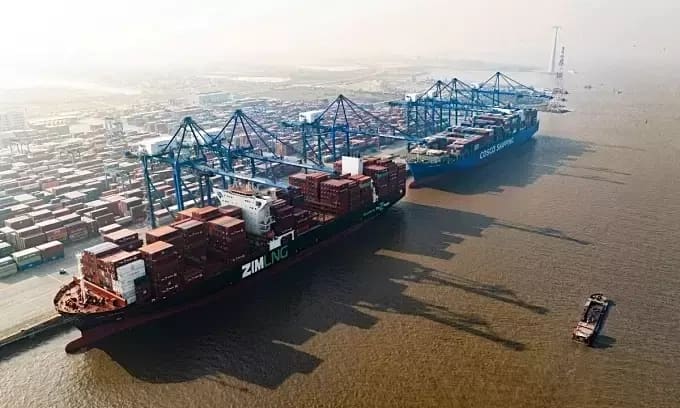
Vietnam's total trade reached $770.14 billion in the eight months through August 2026, a 28.7 percent increase from the same period last year, according to data released by the National Statistics Office. Exports climbed 22.4 percent to $374.84 billion, while imports surged 35.3 percent to $395.3 billion, leaving the country with a trade deficit of $20.46 billion.
The foreign-invested sector continues to dominate outbound trade, contributing $300.37 billion, or just over 80 percent of total exports. That segment grew 26.9 percent year-on-year. Domestic exporters accounted for $74.47 billion, up a more modest 7.4 percent.
Thirty-three product categories each exceeded $1 billion in export value, together representing 93.6 percent of shipments. Seven items topped $10 billion each and made up 70 percent of the total. Manufactured industrial goods led the mix at $337.99 billion, or 90.2 percent of exports, followed by agricultural and forestry products at $26.65 billion, seafood at $8 billion, and fuels and minerals at $2.2 billion.
Import Appetite Grows Faster
On the buy side, foreign-invested enterprises pulled in $290.23 billion worth of goods, a 40.1 percent jump from last year. Domestic firms imported $105.07 billion, up 23.7 percent. Production inputs accounted for $372.04 billion, or 94.1 percent of all imports. Within that category, machinery, equipment, tools, and spare parts made up 57.6 percent, while raw materials, fuels, and other inputs represented 36.5 percent. Consumer goods totaled $23.26 billion, or 5.9 percent of inbound shipments.
Forty-three product lines each recorded more than $1 billion in import value, accounting for 93.9 percent of the total. Three items exceeded $10 billion and together represented 55.5 percent of imports.
United States and China Anchor Trade Flows
The United States remained Vietnam's largest export destination, absorbing $122 billion in goods over the eight-month period. China held its position as the top source of imports, with $161.9 billion flowing into Vietnam.
In August alone, total trade turnover stood at $109.7 billion, down 0.1 percent from July but up 31.7 percent compared to August 2025. Exports that month reached $54.79 billion, a 3.2 percent increase from the previous month and 26 percent higher than the year-earlier figure. Imports came in at $54.91 billion, down 3.1 percent month-on-month but up 37.9 percent year-on-year.
Policy Recommendations on the Table
Nguyen Thi Huong, general director of the statistics office, outlined a series of measures to narrow the trade gap and lift export performance. She emphasized the need to diversify supply chains and export markets, improve product quality, and make better use of free trade agreements already in force.
Huong also highlighted opportunities in underserved regions, including Halal markets, Latin America, and Africa. She called on authorities to provide enterprises with timely information on evolving standards, support firms facing anti-dumping investigations, facilitate access to capital, and encourage the adoption of advanced manufacturing technologies to raise product value and competitiveness.
The trajectory of Vietnam's trade balance in the coming months will depend on how quickly exporters can scale operations and whether import demand moderates as domestic production capacity expands. For now, the country's manufacturing base is absorbing capital goods and intermediate inputs at a faster pace than it can ship finished products abroad.
RELATED STORIES
Samsung's Vietnam Operations Post 23% Profit Jump to $2.3 Billion
Tran Quoc Bao · 3 min

Vietnam Urged to Move Up Value Chain in ASEAN Digital Economy Push
Tran Quoc Bao · 3 min
Vietnam Bets $76 Billion Funding Gap Can Lure Capital Without Copying Rivals
Priyanka V. Rao · 4 min

Vietnam Draws $7.5 Billion From Singapore in Seven Months
Priyanka V. Rao · 3 min
Spot something wrong? Email editor@briefasia.com. We log every correction publicly.