Technology · Products
Ubtech and Unitree Share Beijing Robot Spotlight as Nvidia Executives Appear
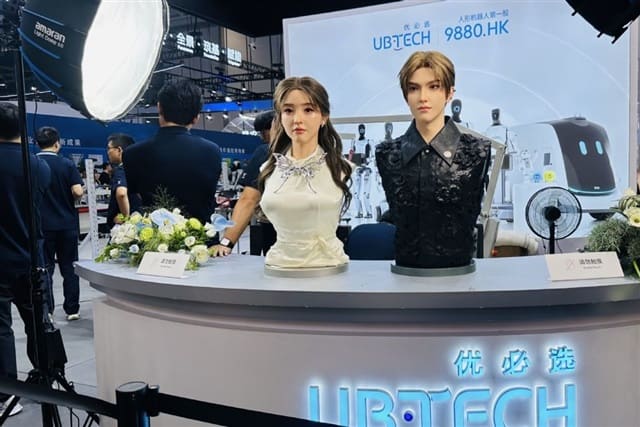
China's two publicly traded humanoid robot makers displayed competing platforms at the 2026 World Robot Conference while drawing quiet attention from Nvidia leadership.
KEY TAKEAWAYS
- ·Ubtech Robotics and Unitree Robotics, China's only publicly listed humanoid robot companies, displayed competing platforms at the 2026 World Robot Conference in Beijing.
- ·Nvidia executives made an unannounced visit to Ubtech's booth, signaling continued collaboration despite U.S. semiconductor export controls on advanced AI chips.
- ·Both firms face commercial pressure to prove humanoid robots can deliver return on investment in real-world industrial and service deployments beyond pilot contracts.
Two Listed Players Converge
Ubtech Robotics and Unitree Robotics brought their newest humanoid platforms to Beijing's 2026 World Robot Conference, marking the first major public appearance where both of China's publicly traded humanoid robot manufacturers stood side by side. Ubtech, which went public earlier and carries the informal title of China's "first humanoid robot stock," faced fresh competition from Unitree, a recently listed rival that has rapidly gained market attention.
The conference floor offered a snapshot of how quickly China's humanoid robotics sector is evolving. While Ubtech has held the symbolic position of being the sector's inaugural public company, Unitree's recent listing has intensified the race for commercial validation. Both firms displayed humanoid units designed for industrial and service applications, signaling their intent to move beyond research demonstrations into revenue-generating deployments.
Nvidia's Quiet Presence
During the event, executives from Nvidia visited Ubtech's exhibition booth, though the chip giant made no public announcement of the visit. The appearance is notable given Nvidia's expanding role in robotics compute infrastructure across Asia. The company's Jetson and Isaac platforms have become foundational for perception and motion planning in next-generation robots, and its partnerships with Chinese robotics firms have grown despite export restrictions on advanced AI chips.
Nvidia has been carefully navigating U.S. semiconductor export controls that limit sales of high-performance GPUs to Chinese customers. The company has developed China-specific chip variants that comply with current regulations while still enabling robotics workloads. The visit to Ubtech's booth suggests ongoing collaboration, though neither party disclosed technical or commercial details.
Commercial Pressure Mounts
Ubtech's participation at WRC comes as the company works to justify its public market valuation through tangible deployments. The firm has secured pilot contracts in logistics, manufacturing inspection, and hospitality, but scaling those trials into volume production remains a challenge. Unitree, by contrast, has focused on lower-cost platforms aimed at research institutions and early adopters, a strategy that has generated unit sales but thinner margins.
Both companies face pressure to demonstrate that humanoid robots can deliver return on investment in real-world settings. Current use cases remain narrow, concentrated in tasks such as repetitive assembly, guided tours, and warehouse material handling. The business case for humanoids versus wheeled or fixed-arm robots is still under scrutiny, particularly in cost-sensitive markets.
Asia's Robotics Infrastructure Play
The convergence of Ubtech, Unitree, and Nvidia at WRC underscores a broader pattern: Asia's robotics ecosystem is being built on a stack that blends domestic hardware innovation with imported compute platforms. Chinese robotics firms are racing to develop proprietary actuators, control algorithms, and sensor suites, while relying on Nvidia, Intel, and other foreign suppliers for high-performance inference chips.
This hybrid model creates both opportunity and vulnerability. On one hand, Chinese manufacturers can accelerate time to market by leveraging proven silicon. On the other, geopolitical risk around chip supply has pushed firms to explore domestic alternatives, including chips from Huawei's Ascend line and startups like Biren Technology.
For investors and corporate buyers, the question is whether China's humanoid robot sector can achieve the manufacturing scale and software maturity necessary to compete globally. Japan's legacy in industrial robotics and South Korea's strength in precision components remain formidable, while U.S. firms such as Figure and Agility Robotics are attracting significant venture capital.
What Comes Next
The 2026 WRC served as a milestone for China's humanoid ambitions, but the path from exhibition floor to factory floor is long. Ubtech and Unitree will need to prove unit economics, secure repeat enterprise customers, and manage supply chain complexity as they ramp production. Nvidia's continued engagement with the sector signals confidence in the compute demand that humanoids will generate, even as regulatory uncertainty lingers.
The next twelve months will likely see both companies push for higher-profile deployments in logistics hubs, automotive plants, and retail environments. Success will hinge not only on hardware reliability but also on the software ecosystems that enable rapid task reprogramming and fleet management. For now, the spotlight is shared, and the race is far from decided.
RELATED STORIES
Chinese Chipmaking Equipment Firm Piotech Reports 1,324% Jump in First-Half Profit
Cheng Wei-Lun · 3 min
Xiaomi's Xring O3 Clears Fabrication Milestone on TSMC's 3nm Node
Cheng Wei-Lun · 4 min
China's Largest Power Utility Courts Huawei for AI Infrastructure Partnership
Cheng Wei-Lun · 3 min
Goertek Posts Revenue and Profit Growth in First Half of 2026
Cheng Wei-Lun · 2 min
Spot something wrong? Email editor@briefasia.com. We log every correction publicly.