Technology · Products
Taiwan's Vecow Sees Western Markets Drive Robotics Push
Industrial computer maker reveals North America and EMEA now represent two-thirds of revenue as it expands edge AI capabilities
KEY TAKEAWAYS
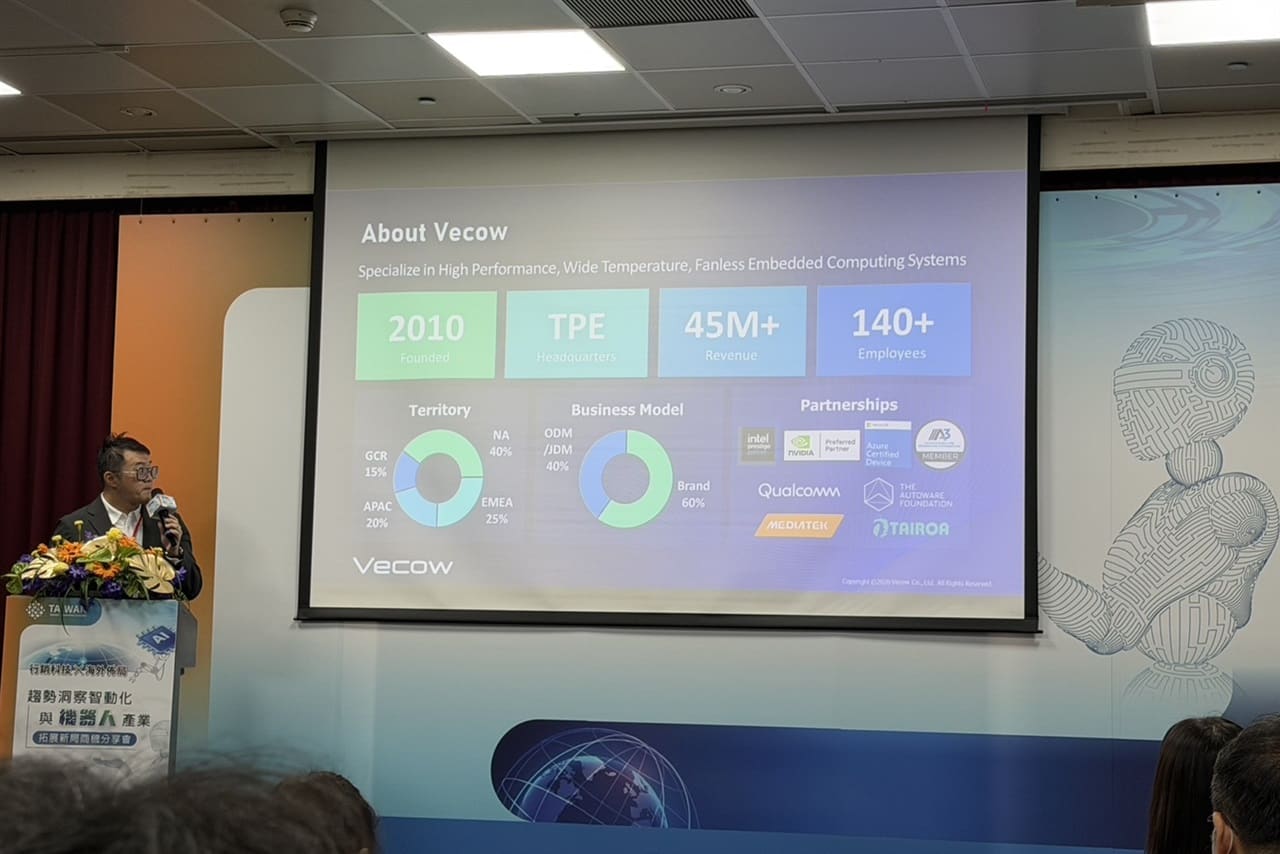
- ·Taiwanese industrial computer supplier Vecow disclosed that North America and EMEA together represent 65% of its revenue, marking a significant Western tilt for the Asia-based manufacturer.
- ·Executive Vice President Joseph Huang announced the figures at Automation Taipei 2026 while highlighting the company's strategic focus on robotics and edge artificial intelligence applications.
- ·The revenue split reflects broader automation demand in Western markets facing labor shortages, with Taiwan's industrial computing sector increasingly serving high-margin international clients.
Geographic Shift Signals Strategic Pivot
Taiwanese industrial computer supplier Vecow has disclosed a significant geographic concentration in its revenue base, with North America and the Europe, Middle East and Africa region collectively representing 65% of total business. Executive Vice President Joseph Huang shared the figures at Automation Taipei 2026 on August 21, underscoring the company's deepening footprint in Western industrial markets.
The revenue split marks a notable shift for Taiwan's industrial computing sector, which has historically maintained stronger ties to Asian manufacturing hubs. Vecow's Western-heavy customer base reflects broader demand patterns in automation-intensive economies where labor costs and regulatory frameworks favor robotic deployment.
Robotics and Edge AI at the Core
Huang emphasized that Vecow is intensifying its focus on robotics and edge artificial intelligence applications. The company manufactures ruggedized computing platforms designed to operate in factory floors, warehouses, and field environments where temperature extremes, vibration, and dust pose challenges for standard hardware.
Edge AI refers to computational workloads processed locally on devices rather than transmitted to centralized cloud servers. In robotics, this architecture reduces latency and enables real-time decision-making for tasks such as vision-guided picking, autonomous navigation, and predictive maintenance. Vecow's hardware sits at the intersection of these two trends, providing the processing backbone for intelligent machines operating in industrial settings.
Taiwan's Industrial Computing Landscape
Taiwan has built a robust ecosystem of industrial PC and embedded computing vendors serving global automation and manufacturing clients. Companies in this segment typically compete on customization capabilities, thermal management, and compliance with industrial standards rather than raw performance metrics.
Vecow's announced revenue mix suggests the company has successfully penetrated supply chains in North America and Europe, regions where automation adoption has accelerated in response to labor shortages and rising wage pressures. The EMEA market in particular has seen increased robotics spending driven by Germany's Industry 4.0 initiatives and broader European Union directives on manufacturing digitization.
What This Means for Asia's Tech Suppliers
The geographic distribution Vecow reported offers a lens into how Taiwanese hardware suppliers are navigating global demand shifts. While Asia remains the world's largest manufacturing center, the operational complexity and regulatory environment in Western markets often translate to higher margins for specialized industrial equipment.
For Vecow, maintaining 65% of revenue outside Asia likely requires localized support infrastructure, compliance with diverse industrial certifications, and partnerships with systems integrators familiar with regional customer requirements. The company's presence at Automation Taipei, one of Asia's largest industrial automation trade events, signals continued investment in regional brand visibility even as its revenue center of gravity tilts westward.
The robotics sector is entering a phase of rapid hardware commoditization, with open-source software frameworks and modular components lowering barriers to entry. Vecow's edge AI positioning suggests the company is betting that on-device intelligence will remain a differentiator, particularly in applications where network reliability or data sovereignty concerns limit cloud reliance.
Industry analysts expect global spending on industrial robotics to grow at a compound annual rate exceeding 10% through the end of the decade, with collaborative robots and autonomous mobile robots representing the fastest-growing segments. Taiwanese suppliers with proven track records in ruggedized computing stand to capture a meaningful share of this expansion, provided they can navigate certification requirements and customer qualification cycles that often span multiple years.
Huang's remarks at Automation Taipei did not include revenue figures or growth targets, leaving open questions about the absolute scale of Vecow's operations and its competitive positioning relative to larger industrial computing vendors. The company's strategic emphasis on robotics and edge AI, however, aligns with broader industry momentum toward distributed intelligence in manufacturing and logistics environments.
RELATED STORIES
Taiwan's Ennoconn Bets on Chip Expansion and Retail Tech for Growth
Cheng Wei-Lun · 2 min

DFI Reports Profit Jump as Embedded and Security Units Drive Q2 Gains
Cheng Wei-Lun · 2 min
Techman Unveils Heavy-Duty Dual-Arm Robot for AI Server Assembly
Cheng Wei-Lun · 3 min

Taiwan UPS Maker Eyes Record Quarter on Data Center Demand
Cheng Wei-Lun · 3 min
Spot something wrong? Email editor@briefasia.com. We log every correction publicly.