Technology · Products
Techman Unveils Heavy-Duty Dual-Arm Robot for AI Server Assembly
Taiwan-based robotics maker targets semiconductor and server production lines with 100kg combined lifting capacity, banking on non-China supply chain advantage
KEY TAKEAWAYS
- ·Techman Robot launched the TM45S dual-arm collaborative robot with 100kg combined lifting capacity, targeting AI server assembly and semiconductor handling with proof-of-concept deployments underway and commercial sales expected by year-end.
- ·The company positions its Taiwan manufacturing and non-China supply chain as a competitive advantage as US and Japanese customers seek alternatives to Chinese suppliers amid geopolitical tensions.
- ·Autonomous mobile robot products combined with collaborative robots accounted for 30 percent of Techman's NT$1.14 billion revenue in the first seven months of this year, with semiconductor applications driving 90 percent of mobile robot use.
Heavy Lifting for High-Stakes Production
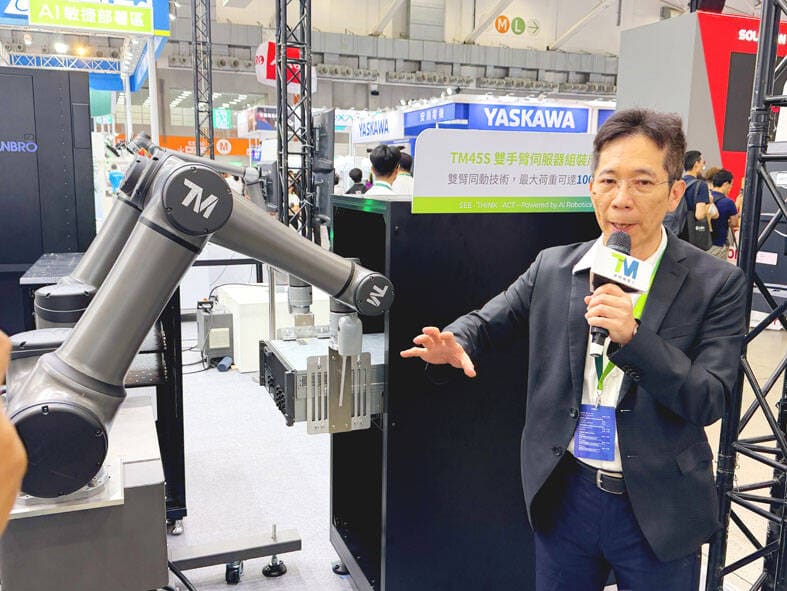
Techman Robot introduced its TM45S heavy-load dual-arm collaborative robot at the Taipei International Industrial Automation Exhibition this week, targeting AI server assembly and semiconductor handling applications. Each arm carries up to 50kg independently, enabling the combined system to manipulate AI servers and other components weighing 100kg total, according to chief operating officer Scott Huang.
The system integrates vision positioning technology that automatically adjusts pick-and-place operations when components shift during handling. The capability addresses a persistent challenge in high-precision manufacturing environments where even minor misalignment can disrupt assembly workflows.
Techman currently operates proof-of-concept deployments at server and chipmaking production lines. The company expects to begin commercial sales by year-end, with first customer deliveries scheduled for the first quarter of 2027.
Taiwan Manufacturing, Non-China Supply Chain
Techman operates as a subsidiary of Quanta Computer, running a manufacturing facility in New Taipei City's Linkou District. Its customer base spans semiconductors, automotive components, and traditional industries including textiles.
The company positions its Taiwan-based manufacturing and largely non-China supply chain as a competitive advantage. Huang noted that US and Japanese customers are actively seeking alternatives to Chinese suppliers, creating market opportunities for robotics manufacturers outside the mainland.
This positioning comes as geopolitical tensions reshape technology supply chains across Asia. Companies in democratic technology hubs including Taiwan, South Korea, and Japan are leveraging their regulatory alignment with Western markets to capture business from buyers prioritizing supply chain diversification.
Humanoid Robots and Technical Hurdles
Techman plans to provide its TM Xplore I humanoid robot, showcased in 2025, to select customers for development and testing in the second half of this year. Commercial sales are anticipated in 2027, though Huang acknowledged significant obstacles remain.
Safety and cybersecurity requirements present substantial hurdles for humanoid robots in factory environments, particularly in Europe and the United States where regulatory frameworks are more stringent. Training dexterous robotic hands continues to pose major technical challenges across the industry.
To address these limitations, Techman is developing a second-generation humanoid robot designed to improve safety features and better align with industrial requirements.
Market Positioning and Revenue Mix
Commenting on the recent listing of Chinese robotics maker Unitree on the Shanghai stock exchange, Huang emphasized that companies must build on distinct strengths. He characterized Unitree as strong in motion-control technology, while noting that US firms maintain leadership in higher-level AI capabilities.
Techman's approach centers on accumulating industrial know-how and addressing practical customer needs, Huang said. The company's president, Haw Chen, expects second-half business performance to exceed first-half results.
Semiconductor and electronics applications remain Techman's primary revenue sources. Approximately 90 percent of its autonomous mobile robot applications are semiconductor-related, according to vice president William Wang.
Products combining autonomous mobile robots with collaborative robots accounted for roughly 30 percent of Techman's NT$1.14 billion revenue in the first seven months of this year, Wang said. That translates to approximately US$35.7 million over the January-through-July period.
Asia's Robotics Race
The timing of Techman's product launch reflects broader momentum in Asia's industrial robotics sector. Server manufacturers face mounting pressure to automate assembly processes as AI infrastructure buildouts accelerate across the region. Data centers in Singapore, Tokyo, Seoul, and emerging markets including Jakarta and Mumbai are driving unprecedented demand for server hardware.
Taiwan's position in the global technology supply chain gives companies like Techman direct access to the world's largest server manufacturers and semiconductor foundries. That proximity enables iterative product development tied to real production floor requirements, rather than theoretical use cases.
The robotics industry in Asia is bifurcating along geopolitical lines, with Chinese manufacturers competing on cost and scale while Taiwan, Japan, and South Korean firms emphasize regulatory compliance, cybersecurity, and supply chain transparency. As Western buyers prioritize these factors, Asia's non-China robotics makers are positioning themselves to capture premium market segments willing to pay for alignment with democratic technology ecosystems.
Techman's bet on heavy-load collaborative robots addresses a specific bottleneck in AI server production, where manual handling of increasingly dense, heavy components slows throughput and poses ergonomic risks. Whether the company can translate proof-of-concept deployments into volume production contracts will test both its technology and its supply chain strategy over the coming quarters.
RELATED STORIES
Gigabyte Lifts Capital Spending as AI Server Orders Drive Record First Half
Cheng Wei-Lun · 2 min
Taiwan's Ennoconn Bets on Chip Expansion and Retail Tech for Growth
Cheng Wei-Lun · 2 min
DFI Reports Profit Jump as Embedded and Security Units Drive Q2 Gains
Cheng Wei-Lun · 2 min
Google Warns 48V Power Standard Reaches Limit as AI Racks Scale Toward Megawatts
Cheng Wei-Lun · 3 min
Spot something wrong? Email editor@briefasia.com. We log every correction publicly.