Finance · Deals
Taiwan Mobile Targets 14% ICT Market Share Through Systex Acquisition
Telco aims to double its information services footprint within six years, betting on AI-fueled enterprise IT demand rather than market-share battles
KEY TAKEAWAYS
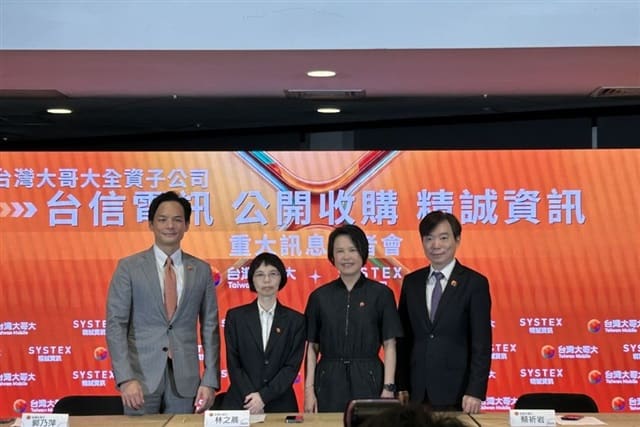
- ·Taiwan Mobile launched a tender offer for Systex, setting a goal to grow its share of Taiwan's information services market from 7% to 14% within six years.
- ·The telco's Chief Enterprise Business Officer emphasized the target relies on capturing AI-driven market expansion rather than competing for existing contracts.
- ·Success hinges on cross-selling integration services to telecom clients and bundling connectivity with Systex's ERP and cybersecurity consulting capabilities.
Expansion Through Acquisition
Taiwan Mobile has launched a tender offer for Systex, framing the move as a strategic bet on artificial intelligence reshaping corporate IT budgets across the island. The acquisition sets an ambitious target: doubling the telco's share of Taiwan's information services market from 7% to 14% within the next six years, according to Shing Chu, Chief Enterprise Business Officer at Taiwan Mobile.
The timeline positions Taiwan Mobile to capture growth from enterprises upgrading infrastructure, deploying generative AI tools, and migrating legacy systems to cloud platforms. Chu emphasized that the expansion plan does not rely on wrestling existing contracts from rivals. Instead, the company expects the overall market to grow substantially as AI adoption accelerates, creating fresh revenue pools that a combined Taiwan Mobile-Systex entity can tap.
Market Dynamics and AI Catalysts
Taiwan's information services sector has historically been fragmented, with dozens of systems integrators, software vendors, and consulting firms competing for corporate and government contracts. Taiwan Mobile currently holds roughly 7% of this market through its enterprise division, which sells connectivity, cloud services, and managed IT solutions to businesses.
The proposed increase to 14% would require capturing a significant portion of new spending rather than displacing incumbents. Industry observers note that Taiwanese firms across manufacturing, finance, and retail are budgeting for AI-related projects, including data center upgrades, edge computing deployments, and machine learning infrastructure. These initiatives often demand integration expertise, a domain where Systex has built a decades-long track record.
Systex specializes in enterprise resource planning systems, cybersecurity consulting, and IT outsourcing. By folding Systex into its portfolio, Taiwan Mobile gains deeper capabilities in software integration and a client roster spanning banks, factories, and government agencies. The combination also positions the telco to offer end-to-end solutions that bundle connectivity, cloud hosting, and application development under a single contract.
Revenue Growth Without Zero-Sum Competition
Chu's framing of the target as growth-driven rather than competitive is notable. In mature markets, doubling market share typically involves undercutting rivals on price or poaching key accounts. Taiwan Mobile's strategy instead hinges on the assumption that total addressable spending will expand faster than the company's own revenue growth, allowing it to claim a larger slice without triggering a price war.
This approach aligns with broader trends in Asia's enterprise IT sector. Spending on AI infrastructure, particularly GPU clusters and high-speed networking, has surged across the region. Taiwan, home to semiconductor fabs and electronics manufacturers, faces pressure to maintain competitiveness as factories adopt predictive maintenance, automated quality control, and supply chain optimization powered by machine learning.
Financial services firms are also increasing IT budgets to deploy fraud detection algorithms and personalized customer recommendation engines. Government agencies are exploring AI for traffic management, public health analytics, and administrative automation. Each of these use cases requires not just hardware and connectivity, but also integration work to link new AI tools with existing databases, ERP systems, and compliance frameworks.
Integration Challenges and Execution Risk
Merging a telco and a systems integrator presents operational complexity. Taiwan Mobile will need to harmonize sales teams, avoid channel conflict where both entities have competed for the same deals, and retain Systex's technical talent. The success of the 14% target depends on cross-selling effectiveness - whether Taiwan Mobile's sales force can pitch Systex's consulting services to existing telco clients, and whether Systex account managers can upsell connectivity and cloud products.
The six-year horizon suggests a phased rollout. Early milestones will likely focus on joint bids for large government IT projects, where bundled offerings can differentiate Taiwan Mobile from pure-play integrators. Later stages may involve developing proprietary AI platforms or vertical-specific solutions for sectors like logistics, healthcare, or smart manufacturing.
Regulatory approval and shareholder acceptance of the tender offer remain pending. If the deal closes, Taiwan Mobile will join a small group of Asian telcos that have successfully scaled enterprise IT divisions beyond basic connectivity. Competitors in Taiwan and neighboring markets are watching closely, as the playbook could be replicated by other carriers seeking growth beyond saturated consumer mobile segments.
Implications for Taiwan's IT Landscape
The tender offer arrives as Taiwan grapples with talent shortages in software engineering and data science. Combining resources under a single entity may help address this constraint by pooling recruiting budgets and offering employees a broader range of projects. It also signals confidence that AI adoption in Taiwan will follow a steep curve rather than a gradual uptick, a bet that hinges on both policy support and private-sector willingness to invest in unproven technologies.
For enterprises, a strengthened Taiwan Mobile could mean more competitive pricing on bundled IT services and faster project timelines, as a single vendor handles connectivity, cloud, and application layers. For smaller integrators, the deal raises questions about market concentration and whether the combined entity will crowd out niche players in specialized verticals.
The 14% target, if achieved, would rank Taiwan Mobile among the top three information services providers on the island. Whether that milestone materializes will depend on execution, market tailwinds, and the pace at which Taiwanese enterprises translate AI ambitions into actual spending.
RELATED STORIES
Foxconn Reports Record Quarterly Profit on AI Server Demand
Cheng Wei-Lun · 3 min

King Slide Founder Tops Taiwan Wealth Rankings on AI Server Boom
Cheng Wei-Lun · 3 min
Taiwan's Index Weight Climbs as MSCI Elevates Memory Makers
Cheng Wei-Lun · 3 min
E.Sun Financial to Complete Mercuries Life Merger With $684 Million Capital Injection
Cheng Wei-Lun · 2 min
Spot something wrong? Email editor@briefasia.com. We log every correction publicly.