Asia · Business
South Korea's Hanwha Secures First US Army Artillery Contract
Korean defense manufacturer wins prototype deal for Mobile Tactical Cannon program, marking Seoul's entry into Washington's core military procurement system
KEY TAKEAWAYS
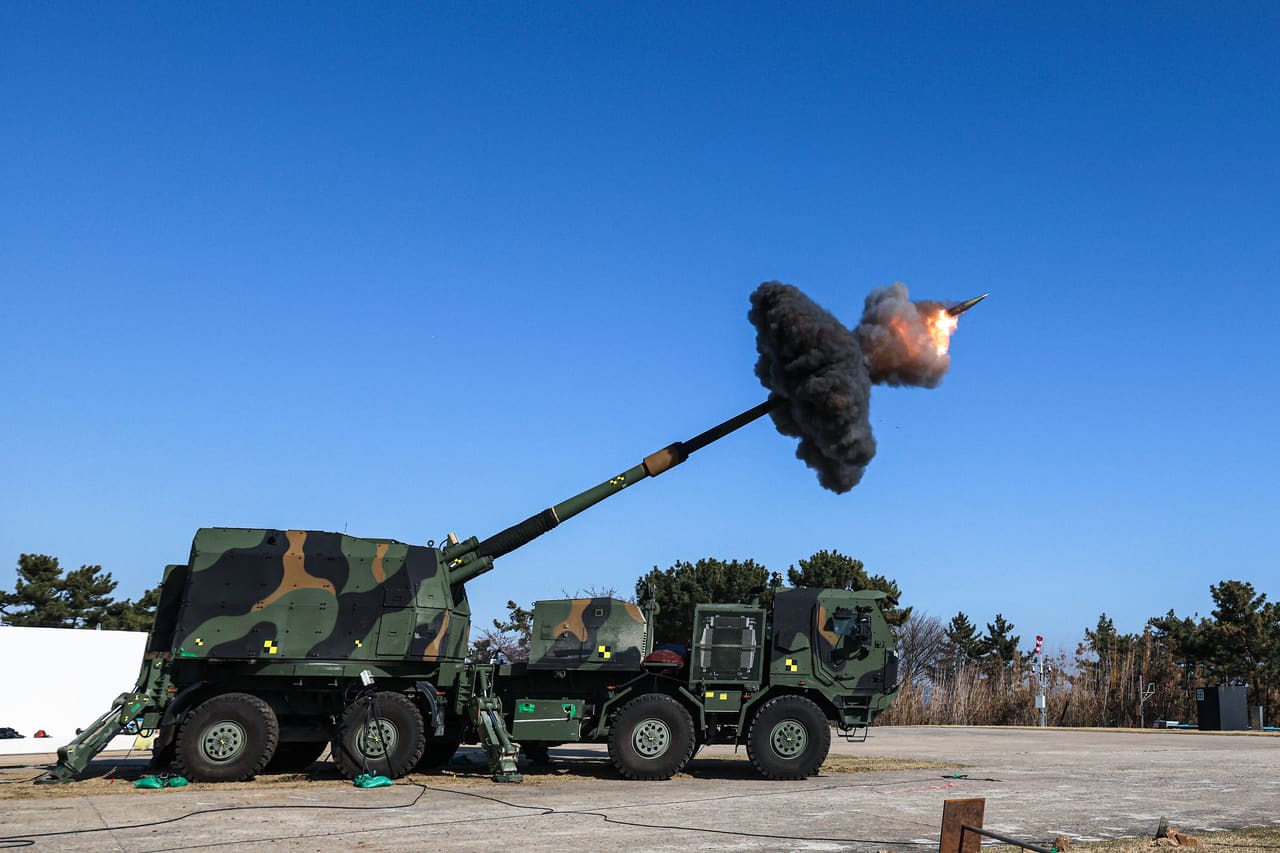
- ·Hanwha Aerospace won a US Army contract to deliver K9 Mobile Howitzer prototypes for the Mobile Tactical Cannon program, replacing aging M777 towed artillery systems.
- ·The deal marks South Korea's first direct entry into Pentagon ground-combat procurement, following $17.3 billion in defense exports in 2023 driven by European and Australian orders.
- ·If Hanwha clears Army testing by 2028, the program could reach full production by 2030, with potential value in the tens of billions over the M777 fleet replacement cycle.
Seoul Breaks Through Pentagon Procurement Wall
Hanwha Aerospace announced Wednesday that its American subsidiary has secured a contract to supply prototype artillery systems to the US Army, a development that positions South Korea as a direct supplier to Washington's core military apparatus for the first time in the self-propelled artillery segment.
The agreement, finalized Tuesday between Hanwha Defense USA and the US Army, covers delivery of K9 Mobile Howitzer prototypes under the service's Mobile Tactical Cannon initiative. That program aims to field a next-generation 155 mm artillery platform to replace the M777 towed howitzer, which has been in service since 2005 and lacks the mobility demanded by current doctrine.
The contract represents more than a commercial win for Hanwha. It validates South Korea's three-decade push to evolve from a defense importer into a Tier-1 exporter capable of meeting the technical and political requirements of the world's most demanding military procurement system. No Korean ground-combat platform has previously cleared the Pentagon's prototype phase for a major Army program of record.
Why the M777 Replacement Matters
The Mobile Tactical Cannon program responds to lessons from Ukraine, where towed artillery crews face counterfire within minutes of firing. The M777, while accurate and battle-tested, requires a crew to emplace and displace the gun, a process that takes several minutes and leaves units vulnerable to drone-directed strikes and precision counter-battery fire.
The Army wants a wheeled or tracked platform that can shoot and relocate in under two minutes, operate in contested electromagnetic environments, and integrate with the service's emerging Joint All-Domain Command and Control architecture. Maximum range, reliability in Arctic and desert conditions, and compatibility with extended-range munitions are non-negotiable.
Hanwha's K9 has been in serial production since 1999 and operates in nine countries, including NATO members Poland, Norway, and Estonia. The platform uses a 52-caliber barrel, automated loading, and a crew of five. It can fire three rounds in 15 seconds, then move within 30 seconds. Sustained rate is six rounds per minute; maximum range with rocket-assisted projectiles exceeds 40 kilometers.
Poland ordered 672 K9 variants in a $12.4 billion deal signed in 2022, the largest single export contract in South Korean defense history. That sale included technology transfer and in-country assembly, a model Hanwha has replicated in Australia, where the platform is designated AS9 Huntsman and produced under license by a local joint venture.
Asia's Defense Industrial Pivot
The Hanwha contract arrives as Washington recalibrates its defense supply chain. Congressional scrutiny of sole-source dependencies, bottlenecks in munitions production, and delivery delays from traditional European suppliers have pushed the Pentagon to diversify.
South Korea has emerged as the most credible alternative. Its defense industry operates at scale, maintains hot production lines, and can deliver systems on timelines that align with urgent operational needs. Korean manufacturers produced more than 2 million rounds of 155 mm artillery ammunition in 2023, compared to roughly 300,000 across all US factories that year before surge capacity kicked in.
Seoul's defense exports hit $17.3 billion in 2023, up from $7.2 billion in 2021, according to the Korea Defense Industry Association. Poland, Australia, and Romania account for the majority of that growth, but the US market has remained largely closed to Korean platforms outside of niche electronics and components.
The K9 prototype deal changes that calculus. If Hanwha clears the Army's test and evaluation phase, the program could enter low-rate initial production by 2028, with full-rate production starting in 2030. The Army has not disclosed how many Mobile Tactical Cannons it intends to field, but the M777 fleet numbers roughly 1,000 guns, suggesting a potential program value in the tens of billions over two decades.
Hanwha Defense USA operates a facility in Troy, Michigan, and has committed to establishing additional manufacturing capacity in the United States if the K9 wins the full production contract. That pledge addresses Buy American Act requirements and congressional pressure to create defense-manufacturing jobs in domestic districts.
Regional Implications and What Comes Next
The contract also reflects deepening defense-industrial integration within the US alliance structure in Asia. Japan recently lifted export restrictions on Patriot missile components co-produced with the United States, and Australia is co-developing long-range strike missiles with American firms. South Korea's entry into the US Army's artillery pipeline extends that trend to land systems.
For Hanwha, the prototype phase is the gateway, not the destination. The company will compete against other bidders, likely including a General Dynamics-led team and potentially a European consortium. The Army will evaluate mobility, survivability, lethality, maintainability, and cost over an 18-month test cycle.
Success in the Mobile Tactical Cannon program would position Hanwha to bid on adjacent Army modernization efforts, including robotic combat vehicles, integrated air and missile defense platforms, and future vertical-lift programs. The firm already supplies chassis and automotive components to US defense primes; a production artillery contract would elevate it to prime-contractor status.
The broader question is whether Washington's procurement doors will open wider to Korean platforms. The US Air Force and Navy remain largely closed markets, dominated by incumbents with deep congressional ties and security-clearance moats. Ground systems, however, are more contestable, especially when the industrial base cannot meet demand and operational timelines compress.
Hanwha's K9 prototype contract is the test case. If the platform performs and the politics align, South Korea's defense industry will have secured a foothold in the Pentagon's inner circle. If it stumbles, the breakthrough will remain symbolic rather than structural.
RELATED STORIES
Seoul Rejects Chip Investment Reports Amid Washington Trade Talks
Cheng Wei-Lun · 2 min

Seoul Races to Salvage $200 Billion US Investment Rollout
Cheng Wei-Lun · 3 min
Seoul Finance Chief Pitches Manufacturing and AI Strengths to US Executives
Cheng Wei-Lun · 3 min
Woori Financial Group Plans $39 Billion Insurance Merger in South Korea
Cheng Wei-Lun · 3 min
Spot something wrong? Email editor@briefasia.com. We log every correction publicly.