Asia · Trade
Taiwan's Machinery Sector Posts 18th Straight Month of Export Growth
Electronics equipment shipments surge 35.6 percent in July as AI demand and semiconductor manufacturing drive regional supply-chain momentum
KEY TAKEAWAYS
- ·Taiwan's machinery exports rose 18.4 percent year-on-year to $3.305 billion in July, the 18th consecutive monthly increase, with electronics equipment surging 35.6 percent to $709.5 million.
- ·The United States bought $5.439 billion of Taiwanese machinery in the first seven months, claiming a 25.8 percent share, while China took 21.1 percent and Singapore 7.5 percent.
- ·Exchange-rate pressures and new technology controls in key markets may limit order visibility and weigh on near-term export growth, particularly in the machine tool segment.
Electronics Equipment Leads the Rally
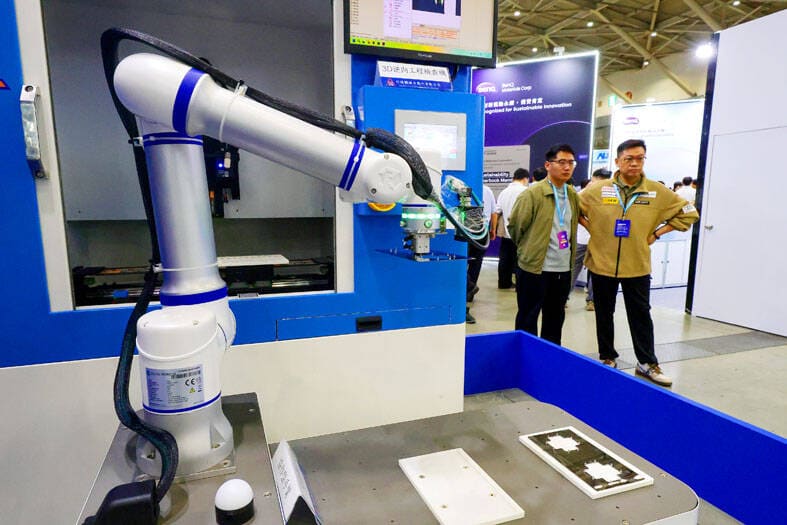
Taiwan shipped $3.305 billion worth of machinery overseas in July, an 18.4 percent jump from the same month last year, according to data from the Taiwan Association of Machinery Industry. The streak extends an unbroken run of monthly gains that now spans a year and a half, underscoring the island's deepening role in Asia's technology supply chains.
Electronics equipment accounted for the lion's share of momentum. Shipments in this category reached $709.5 million, up 35.6 percent year-on-year, as manufacturers raced to meet orders tied to artificial intelligence infrastructure and semiconductor fabrication. The surge reflects a broader pattern across Northeast Asia, where capacity expansions at foundries and memory makers have created ripple effects for suppliers of inspection tools, lithography peripherals, and automation systems.
Machine tool exports, by contrast, registered more modest growth. Sales totaled $178 million in July, up 8.8 percent from a year earlier. The association attributed the slower pace to exchange-rate headwinds: the New Taiwan dollar's appreciation against major currencies has eroded price competitiveness for Taiwan's precision-machinery exporters, many of which compete directly with German and Japanese rivals in Southeast Asian and North American markets.
Seven-Month Cumulative Performance
Cumulative exports for the January-to-July period reached $21.101 billion, a 19.1 percent increase over the same stretch in 2025. Electronics equipment and testing instruments drove the bulk of that gain, while machine tools slipped 1.5 percent to $1.156 billion over the seven months. The divergence highlights a structural shift: demand for high-precision automation and metrology gear tied to advanced-node chip production is outpacing orders for general-purpose metalworking machinery.
The United States remained the largest destination for Taiwanese machinery, absorbing $5.439 billion worth of shipments in the first seven months and claiming a 25.8 percent share of total exports. China ranked second with purchases of $4.453 billion, representing 21.1 percent of the total. Singapore followed at $1.587 billion, or 7.5 percent. The Singapore figure is notable because much of that volume consists of semiconductor capital equipment destined for the city-state's expanding fab ecosystem, including facilities operated by GlobalFoundries and several back-end assembly plants.
Regional Context and Supply-Chain Pressures
Taiwan's machinery sector occupies a strategic position within Asia's electronics manufacturing web. The island produces not only chips but also a significant share of the tools used to build, test, and package those chips. As foundries in Taiwan, South Korea, and increasingly Japan invest in leading-edge capacity, Taiwanese equipment makers benefit from geographic proximity and established relationships with anchor customers such as Taiwan Semiconductor Manufacturing Company and SK Hynix.
Yet the association flagged emerging risks. Regulatory measures in several jurisdictions, including controls on advanced semiconductors and rare-earth materials, are beginning to reshape logistics and order patterns. Export-license requirements can delay shipments, while customers in certain markets have grown cautious about committing to long-term purchase agreements. The association noted that these policy shifts could cloud order visibility and weigh on near-term export forecasts, though it stopped short of quantifying the potential impact.
Currency dynamics add another layer of complexity. The New Taiwan dollar has strengthened against the US dollar by roughly 4 percent since the start of the year, driven by portfolio inflows and a narrowing trade deficit. For machinery exporters, a stronger currency raises the effective price of goods sold abroad, making it harder to win contracts in price-sensitive segments such as conventional machine tools. By contrast, producers of highly differentiated equipment tied to AI and semiconductor applications have more pricing power and are less exposed to exchange-rate swings.
Outlook and Implications for Asia's Manufacturing Hub
The sustained export growth in Taiwan's machinery sector reflects two converging trends. First, the AI boom has triggered a wave of capital spending at data-center operators and cloud-service providers, which in turn has lifted orders for servers, networking gear, and the semiconductors that power them. Second, geopolitical concerns have prompted companies to diversify supply chains, leading to new fab construction in the United States, Japan, and Europe. Taiwanese machinery firms are well positioned to supply those projects, given their technical expertise and existing customer relationships.
At the same time, the sector faces headwinds that could temper growth in the coming quarters. Machine tool demand remains sluggish, and the strong New Taiwan dollar is unlikely to reverse in the near term given Taiwan's current-account surplus and stable monetary policy. Regulatory uncertainty in key markets, particularly around technology-transfer rules and export controls, adds to the challenge of forecasting demand beyond the next few quarters.
For Asia's broader manufacturing landscape, Taiwan's machinery export data serves as a real-time indicator of investment activity in the region's semiconductor and electronics industries. A sustained uptick in shipments of testing equipment and automation systems typically signals that foundries and assembly houses are ramping capacity, which in turn points to robust end-market demand for chips. Conversely, a slowdown in machine tool orders can foreshadow softer demand in automotive, industrial, and consumer-electronics segments.
The association's commentary on regulatory and currency risks also highlights the vulnerability of export-driven sectors to policy shifts beyond their control. As governments in the United States, China, and the European Union impose new restrictions on technology trade, Taiwanese manufacturers must navigate an increasingly fragmented global market. Those that can adapt by localizing production, diversifying customer bases, or moving up the value chain will be better positioned to sustain growth. Those that rely on a narrow set of products or markets may find the next few years more challenging.
RELATED STORIES

Taiwan Rehearses Digital Blackout Scenario Amid China Threat
Cheng Wei-Lun · 3 min

Taiwan Throttles Mobile Networks During War Games for the First Time
Cheng Wei-Lun · 3 min

Taiwan's AI Server Supply Chain Reports Record July Revenue
Cheng Wei-Lun · 2 min

TSMC Posts Record Monthly Revenue as AI Chip Demand Accelerates
Cheng Wei-Lun · 2 min
Spot something wrong? Email editor@briefasia.com. We log every correction publicly.