Finance · Banking
Standard Chartered Moves Credit Card Clients to Trust Bank in Wealth Push
The September transfer will see StanChart shift part of its retail portfolio to its digital bank subsidiary as it doubles down on affluent customers across Asia.
KEY TAKEAWAYS
- ·Standard Chartered will transfer part of its Singapore credit card and personal loan portfolio to Trust Bank in September, leaving deposit and wealth accounts unchanged.
- ·Trust Bank turned profitable in March 2026 after posting a narrowed loss of SGD 54 million in fiscal 2025, serving over one million customers.
- ·The move mirrors Standard Chartered's earlier USD 1 billion loan transfer to Mox in Hong Kong and aligns with its strategy to focus on affluent clients while scaling digital subsidiaries.
A Strategic Split
Standard Chartered will move a segment of its Singapore credit card and personal loan customers to Trust Bank starting in September, a restructuring that underscores the London-based lender's bet on high-net-worth clients in Asia.
The British bank announced the transfer on July 31, framing it as a way to deepen retail banking capabilities across both entities. Trust, the digital subsidiary jointly owned by Standard Chartered and FairPrice Group, will absorb the clients and continue building out its everyday banking platform. Standard Chartered, meanwhile, will concentrate capital and talent on wealth services for affluent customers.
Existing deposit accounts, wealth products, and insurance policies held by affected customers at Standard Chartered will remain untouched. Mortgage loans are not part of the portfolio shift. The bank declined to specify how many customers will be moved, though it confirmed that all affected account holders will receive direct notification ahead of the September cutover.
Digital Bank Economics
Trust posted a net loss of SGD 54 million in fiscal 2025, according to the bank, narrowing from SGD 93 million the previous year. The digital lender crossed into profitability in March 2026, becoming one of the fastest digital banks in Singapore to reach breakeven.
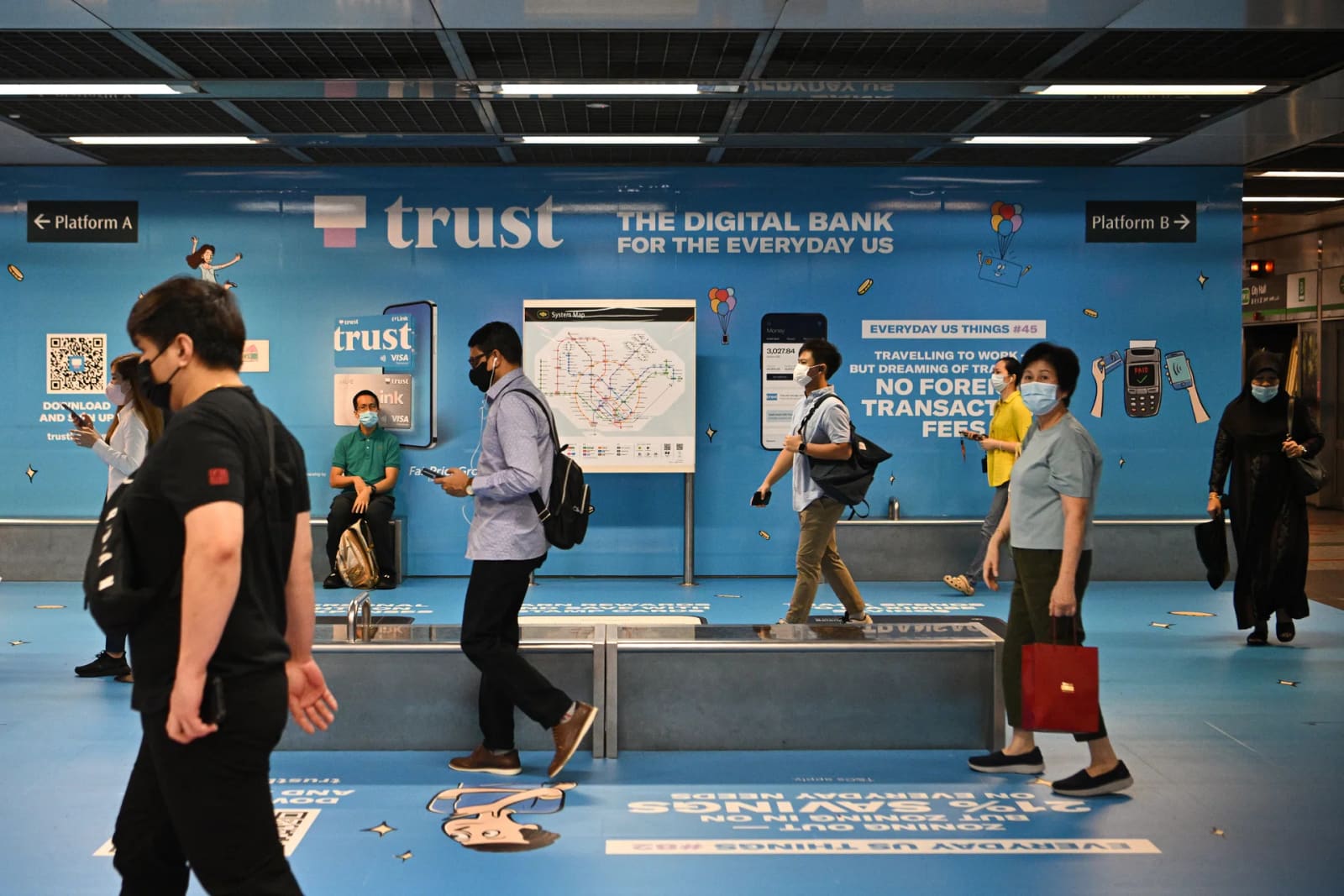
The unit now serves more than one million customers with products that include numberless cards combining debit and credit functions, zero foreign-exchange fees on overseas spending, and rewards integrated with FairPrice Group's retail ecosystem. FairPrice Group chief executive Vipul Chawla said Trust was designed to deliver banking services embedded in Singaporeans' daily routines.
The September transfer mirrors an earlier move by Standard Chartered in Hong Kong, where the parent bank shifted a USD 1 billion personal instalment loan book to Mox, its digital banking venture with HKT, PCCW, and Trip.com. Mox launched in 2020 and has since served as a testing ground for digital-first retail products in the Greater Bay Area.
Wealth Over Volume
Standard Chartered reported pre-tax profit of USD 2.33 billion for the second quarter of 2026, beating analyst expectations on the strength of its wealth and global banking divisions. In a strategy update in May, the bank said it would cut headcount and expand wealth capabilities to lift returns, a plan that has drawn scrutiny after chief executive comments about replacing lower-value roles with artificial intelligence sparked public backlash.
Kathy Chan, equity analyst at Morningstar, noted that the Trust transfer follows the same playbook as the Mox loan shift. Standard Chartered is building scale in its majority-owned digital subsidiaries while the parent sharpens its lens on affluent clients, she said.
Still, Chan does not see the move as a complete separation between mass retail and wealth management. Standard Chartered has previously described its digital banks as part of a client continuum, a pipeline that incubates future affluent customers as their financial needs grow.
Singapore's Digital Banking Landscape
Trust competes with GXS, backed by Grab and Singtel, and MariBank, owned by Sea Group, in Singapore's digital banking sector. All three received licenses in 2020 under a framework designed by the Monetary Authority of Singapore to spur competition and innovation in retail finance.
GXS and MariBank have both signaled plans to expand across Southeast Asia to reach profitability, leveraging regional ecosystems built by their parent companies. Trust, by contrast, has leaned on FairPrice's retail footprint and Standard Chartered's banking infrastructure within Singapore.
The September transfer will test whether Trust can absorb a portion of Standard Chartered's existing client base without friction, a challenge that hinges on digital onboarding, customer communication, and product parity. For Standard Chartered, the risk lies in whether the wealth pivot can generate sufficient revenue to offset the narrowing of its retail franchise in one of Asia's most competitive banking markets.
RELATED STORIES

Singapore Dollar Gains Ground as Currency Diversification Pick
Tran Quoc Bao · 2 min

DBS Doubles Down on Asia, Ruling Out Global Expansion
Anand Sundaram · 3 min

Singapore REITs Raise S$4.5 Billion in Nine Months as Fundraising Momentum Extends Into 2026
Priyanka V. Rao · 3 min

Blackstone's AirTrunk Lines Up S$2 Billion Loan for Singapore REIT IPO
Anand Sundaram · 3 min
Spot something wrong? Email editor@briefasia.com. We log every correction publicly.