Asia · Business
Singapore's GDP Surge Masks a Widening Productivity Divide
The city-state's AI-driven manufacturing and tech sectors are posting double-digit growth while retail, F&B and other domestic industries stagnate, raising questions about labor market inequality and concentration risk.
KEY TAKEAWAYS
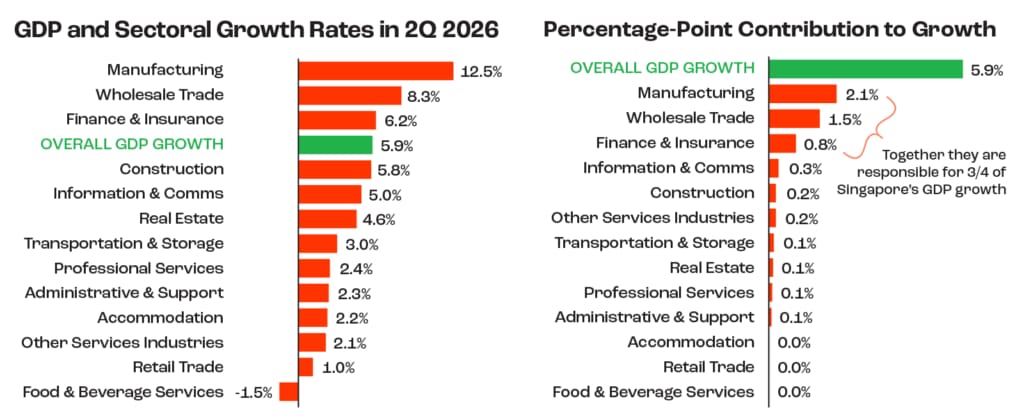
- ·Singapore's GDP grew 5.9% year-on-year in Q2 2026, with manufacturing, wholesale trade and finance accounting for three-quarters of the expansion driven by AI infrastructure spending.
- ·Productivity rose 15.4% in wholesale trade and 7.6% in manufacturing, while falling 0.1% across domestically oriented industries, creating a two-speed economy.
- ·Concentration risk is rising: if AI-related investment reverses, the simultaneous impact on semiconductors, trade and financial services could shift headline growth quickly.
A Bifurcated Expansion
Singapore's economy grew 5.9% year-on-year in the second quarter of 2026, following a 6.3% expansion in the first quarter, according to the Ministry of Trade and Industry. The strong performance prompted officials to revise the full-year GDP forecast upward to 4.5-5.5%, more than double the initial 1.0-3.0% projection.
The driver is clear: global artificial intelligence infrastructure spending has turbocharged demand for semiconductors, manufacturing equipment, cloud services and related technology. Singapore's established position as a regional hub for electronics production and financial services has allowed it to capture a disproportionate share of that capital flow.
But the distribution of growth is strikingly uneven. In the second quarter, manufacturing output climbed 12.5%, with electronics surging 33.8% and precision engineering rising 19.3%. Wholesale trade expanded 8.3%, while finance and insurance grew 6.2%. Together, those three sectors accounted for roughly three-quarters of the quarter's GDP growth, data from the Economic Survey of Singapore show.
Meanwhile, retail trade advanced just 1%, accommodation 2.2% and professional services 2.4%. Food and beverage services contracted 1.5%.
Productivity Tells a Sharper Story
The divergence becomes more pronounced when measured by productivity. Value added per hour worked rose 15.4% in wholesale trade, 9.4% in information and communications, 7.6% in manufacturing and 5.1% in finance during the quarter. Across outward-oriented industries as a group, productivity increased 6.9%.
Among domestically oriented industries, productivity fell 0.1%.
This explains why headline GDP growth near 6% does not translate into broad-based economic optimism. A semiconductor fabrication plant can double output with minimal additional headcount. Cloud computing infrastructure scales with software and capital, not labor. Restaurants and retail stores do not.
Unit labor costs fell 7.9% in manufacturing and 3.7% in wholesale trade in the second quarter, indicating that output is rising much faster than wage bills in those sectors. That gap creates room for higher compensation, but there is no mechanism ensuring the gains flow evenly across the workforce.
Who Benefits
Research by the Ministry of Trade and Industry on AI adoption found that early employment gains at firms deploying AI tools were concentrated among higher-earning local workers, mid-career employees and skilled foreign professionals. Only as companies developed deeper AI capabilities did benefits begin spreading to a wider employee base.
The implication is that engineers, semiconductor specialists, software developers, data scientists and workers in adjacent business services are the primary beneficiaries of the current cycle. A worker in retail or food service is participating in a fundamentally different labor market.
The risk is that wage growth becomes as bifurcated as productivity growth. If the sectors posting double-digit productivity gains capture most of the income upside, the government will face mounting pressure to address widening inequality even as aggregate economic statistics look robust.
Concentration Risk
The Monetary Authority of Singapore has flagged a separate concern: exposure. If AI-related investment now accounts for a large share of national growth, a reversal in that spending could hit multiple sectors simultaneously.
A slowdown in AI infrastructure investment would reduce semiconductor demand, affecting electronics manufacturing and precision engineering. Lower trade volumes would weaken wholesale and logistics activity. Technology and financial services could face headwinds from reduced investment flows and softer asset prices.
The question is whether such a pullback would tip the economy into recession. The answer depends on severity and duration. Construction activity remains strong, and domestic consumption continues to expand. Singapore's economy retains diversification across maritime, aviation, pharmaceuticals and other industries.
But when three sectors contribute three-quarters of quarterly GDP growth, losing momentum in those areas can shift the headline figure quickly. The same concentration that amplifies upside during a boom amplifies downside during a bust.
What Comes Next
Singapore is capturing substantial gains from the global AI investment wave. The city-state's infrastructure, regulatory environment and talent base have positioned it well. But the current growth profile is unusually narrow.
For policymakers, the challenge is twofold: managing labor market inequality as productivity gains concentrate in a subset of industries, and preparing for the possibility that AI-related capital spending moderates or contracts. Both issues are consequences of success, but they require attention before the cycle turns.
The semiconductor fabrication plants and data centers being built today will generate output for years. The question is whether the rest of the economy can find ways to participate in that productivity growth, or whether Singapore's bifurcated expansion becomes a permanent feature of its economic landscape.
RELATED STORIES
Singapore Electronics Exports Surge 112% on AI Chip Demand
Cheng Wei-Lun · 3 min
Singapore Export Growth Slows to 24% as AI Chip Boom Fails to Meet Expectations
Priyanka V. Rao · 4 min
Singapore Electronics Exports Surge 112% on AI Hardware Demand
Priyanka V. Rao · 3 min

Singapore Food Tenant Sues OG Over Taste Orchard Eviction
Lim Hui Ying · 3 min
Spot something wrong? Email editor@briefasia.com. We log every correction publicly.