Finance · Markets
Seoul Market Sheds 11 Percent as Chip Selloff Deepens
South Korea's benchmark index posted its worst two-day drop in years, with Samsung and SK hynix leading semiconductor rout
KEY TAKEAWAYS
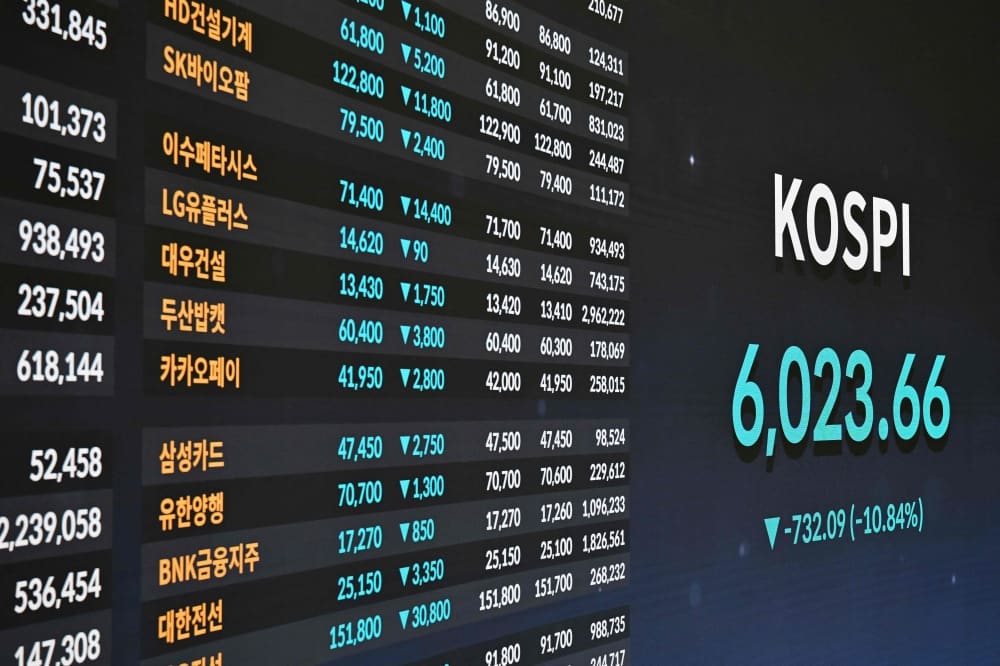
- ·South Korea's Kospi index fell 11.4 percent Wednesday to 5,338.56, with chipmakers SK hynix and Samsung dropping 18 percent and 12.5 percent respectively.
- ·The two-day selloff has erased hundreds of billions in market value as foreign funds withdrew over $4 billion from Korean equities in three weeks.
- ·Earnings reports from Samsung and SK hynix in early August will provide critical insight into memory chip pricing trends and inventory levels.
A Second Day of Heavy Losses
South Korea's equity market suffered its steepest single-day decline in years on Wednesday, with the benchmark Kospi index falling 11.4 percent to close at 5,338.56. The session marked the second consecutive day of severe losses, following a near-11 percent drop on Tuesday that had already rattled investors across the region.
The selloff concentrated heavily in semiconductor stocks, the sector that has powered South Korea's economic growth and dominated its equity market for the past two decades. SK hynix, the world's second-largest memory chipmaker, collapsed 18 percent during the session. Samsung Electronics, the nation's largest company by market capitalization, shed 12.5 percent.
The two-day rout has erased hundreds of billions of dollars in market value from Seoul-listed companies and triggered alarm among portfolio managers who had maintained overweight positions in Korean tech stocks throughout the first half of 2026.
Semiconductor Exposure Magnifies Impact
South Korea's equity market carries one of the highest concentrations of semiconductor exposure among major Asian bourses. Samsung and SK hynix together account for more than a quarter of the Kospi's total weighting, making the index acutely vulnerable to shifts in global chip sentiment.
The current selloff appears linked to a broader reassessment of semiconductor valuations that has swept through Taiwan, Japan, and the United States in recent weeks. Investors have grown increasingly concerned about inventory levels in the memory chip segment, where both Samsung and SK hynix generate the bulk of their revenue.
Memory chip prices, which had rallied strongly through late 2025 on expectations of sustained demand from artificial intelligence infrastructure and data center builds, have shown signs of softening in recent trading. Spot prices for certain DRAM specifications have declined approximately 8 percent since early July, according to industry trackers, while NAND flash pricing has remained under pressure.
Regional Context and Capital Flows
The magnitude of Wednesday's decline places South Korea's market among the worst performers in Asia this year. While other regional markets have experienced volatility tied to semiconductor stocks, Seoul's heavy sectoral concentration has amplified the downward pressure.
Foreign institutional investors, who had been net buyers of Korean equities for much of 2025, have reversed course sharply in July. Preliminary data indicates offshore funds have withdrawn more than $4 billion from the Kospi in the past three weeks, with the pace of outflows accelerating following Tuesday's session.
The withdrawal of foreign capital has coincided with a broader rotation out of high-beta technology positions across Asia. Fund managers based in Hong Kong and Singapore have cited concerns about stretched valuations in the chip sector, particularly after the rapid gains posted in 2024 and early 2025.
Market Mechanics and Volatility
Wednesday's session saw heightened volatility from the opening bell, with circuit breakers briefly triggered during morning trading as the index fell through key technical levels. Trading volumes surged to more than double the three-month average, reflecting a combination of forced selling, stop-loss orders, and tactical repositioning by algorithmic traders.
The speed and severity of the decline have raised questions about liquidity conditions in the Korean market, particularly for large-cap technology stocks. Some market participants have noted that the absence of meaningful buying interest at lower price levels suggests deeper concerns about near-term earnings trajectories for the major chipmakers.
Options market activity has also reflected heightened anxiety, with implied volatility measures for Kospi index options jumping to levels not seen since the pandemic-era turmoil of early 2020.
What Comes Next
Market participants will be watching closely for any signs of stabilization when trading resumes Thursday. Technical analysts have identified the 5,200 level as a critical support zone for the Kospi; a break below that threshold could trigger additional algorithmic selling and further undermine investor confidence.
Earnings reports from Samsung and SK hynix, both scheduled for early August, will provide critical insight into whether the current selloff reflects fundamental deterioration or simply a technical correction after extended gains. Guidance on memory chip pricing trends and inventory levels will be particularly scrutinized.
For now, Seoul's market remains at the center of the semiconductor volatility that has gripped Asian equities through the summer, with little indication that the turbulence will subside before investors gain greater clarity on demand patterns for the second half of the year.
RELATED STORIES

Samsung Electronics Drops 8% as Market Questions Buyback Strategy
Cheng Wei-Lun · 2 min
South Korea Extends Trading Hours to Attract Foreign Capital
Anand Sundaram · 2 min
Seoul Stocks Drop on Mideast Tensions and Oil Price Surge
Tran Quoc Bao · 3 min
Index Funds Face Hidden Concentration Risk From AI Boom
Cheng Wei-Lun · 3 min
Spot something wrong? Email editor@briefasia.com. We log every correction publicly.