Asia · Politics
Saudi Arabia, Turkey, and Pakistan Sign Trilateral Defense Pact in Makkah
The Makkah Joint Defense Agreement commits three Muslim-majority powers to treat an attack on one as an attack on all, marking a new alignment in regional security architecture.
KEY TAKEAWAYS
- ·Saudi Arabia, Turkey, and Pakistan signed the Makkah Joint Defense Agreement on August 7, committing to treat an armed attack on any signatory as an attack on all three.
- ·The pact functions as a strategic hedge rather than a revolutionary alliance, with no unified command structure or automatic intervention clauses, allowing signatories to maintain existing security partnerships.
- ·India will monitor closely as any enhancement of Pakistan's military capabilities through the agreement could accelerate New Delhi's own defense modernization efforts.
A New Security Triangle
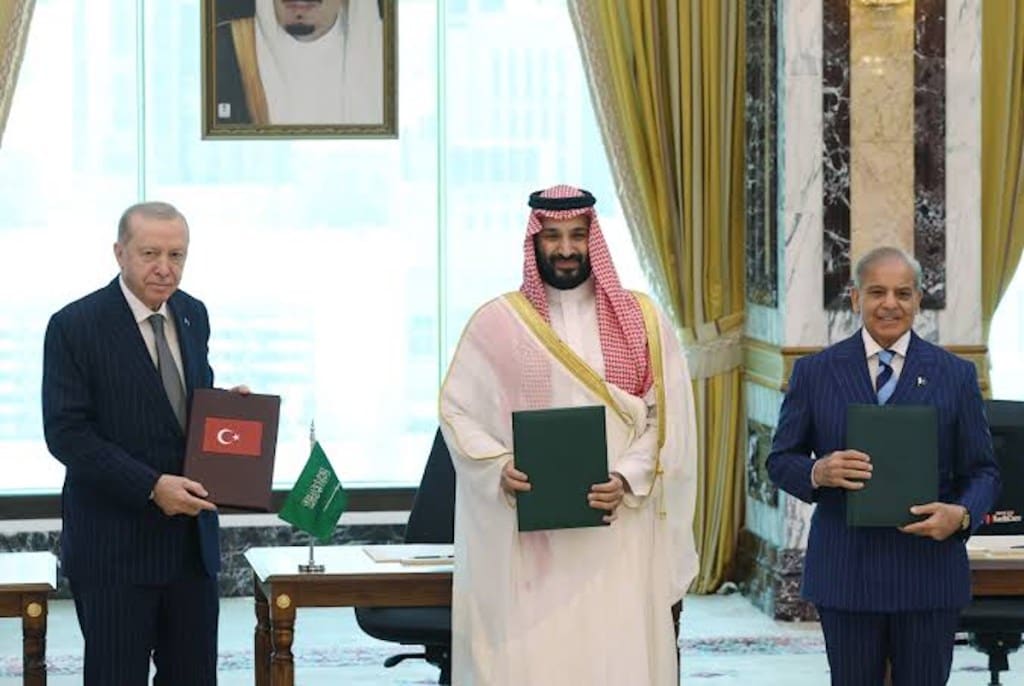
Crown Prince Mohammed bin Salman of Saudi Arabia, Turkish President Recep Tayyip Erdogan, and Pakistani Prime Minister Shehbaz Sharif convened at Al-Safa Palace in Makkah on August 7 to sign the Makkah Joint Defense Agreement. The trilateral pact establishes that an armed attack against any signatory will be considered an attack against all three nations.
The agreement links three Muslim-majority powers spanning West Asia, the Eastern Mediterranean, and South Asia. Saudi Arabia brings Gulf financial weight and energy infrastructure. Turkey contributes NATO-standard military capabilities and defense manufacturing. Pakistan adds nuclear deterrence and battle-tested ground forces. Together, the three states represent a combined population exceeding 330 million and military expenditures north of USD 85 billion annually.
The ceremonial signing at Al-Safa Palace, one of the royal residences in Islam's holiest city, carries symbolic resonance beyond the treaty text. The location signals an effort to frame the pact within a broader narrative of Islamic solidarity, though the operational mechanics remain firmly rooted in national interest calculations.
Strategic Hedging, Not Revolutionary Realignment
Despite the mutual defense language, the Makkah Agreement functions more as a strategic hedge than a transformative alliance structure. None of the three signatories is severing existing security ties. Saudi Arabia maintains its decades-long defense partnership with Washington, anchored in arms purchases and intelligence sharing. Turkey remains a NATO member, despite periodic friction with Brussels and Washington over Syria, Libya, and defense procurement. Pakistan continues its complex balancing act between Beijing, Washington, and Gulf capitals.
The pact offers each signatory distinct advantages without forcing a binary choice. For Riyadh, the agreement diversifies security options at a moment when American security guarantees face domestic scrutiny in Washington. It also deepens ties with Ankara after years of regional rivalry over political Islam, Libya, and the Abraham Accords. For Erdogan, the treaty elevates Turkey's profile as a bridge power and provides diplomatic cover for defense exports to the Gulf. For Islamabad, it formalizes military cooperation with two wealthy partners and offers potential economic lifelines at a time of fiscal strain.
The agreement does not establish a unified command structure, shared bases, or automatic intervention clauses. It leaves room for interpretation on what constitutes an armed attack and how collective response would be coordinated. This ambiguity is likely intentional, allowing each party to invoke or downplay the commitment depending on circumstance.
Regional Implications and the Great Power Context
The Makkah pact arrives amid shifting regional dynamics. Iran's nuclear program remains unresolved, Houthi capabilities in Yemen continue to threaten Red Sea shipping, and Israel's normalization with Gulf states has reordered old fault lines. The agreement signals that Saudi Arabia is exploring security arrangements beyond its traditional reliance on Washington, without abandoning that relationship outright.
China and Russia will watch closely. Beijing has deepened economic ties with all three signatories through Belt and Road investments, energy purchases, and infrastructure financing. Moscow has sold S-400 air defense systems to Turkey and pursued defense cooperation with Pakistan. Neither power is likely to view the Makkah pact as a threat, particularly if it operates as a flexible hedge rather than a hard bloc.
India represents the most sensitive variable. New Delhi maintains defense and intelligence cooperation with Riyadh and Abu Dhabi, but views any formalization of Pakistan's military partnerships with suspicion. If the Makkah Agreement facilitates joint exercises, intelligence sharing, or arms flows that enhance Pakistan's conventional capabilities, it will complicate India's strategic calculus and potentially accelerate its own defense modernization.
What Comes Next
The real test of the Makkah Agreement lies in implementation. Will the three parties establish working groups on defense procurement, joint training, or intelligence fusion? Will they coordinate positions in multilateral forums or on sanctions regimes? Or will the pact remain a high-level political statement with limited operational follow-through?
Early indicators will include ministerial-level meetings, joint military exercises, and any movement on defense industrial cooperation. Turkey's drone technology, Saudi capital, and Pakistani manufacturing could, in theory, support a trilateral defense production initiative. Such a venture would signal that the agreement has teeth beyond the signing ceremony.
For now, the Makkah pact represents a calculated bet by three capitals that diversifying security partnerships enhances flexibility without triggering rupture with existing allies. Whether it evolves into a durable security architecture or remains a symbolic gesture will depend on how regional crises unfold and whether the signatories find mutual benefit in deeper coordination. The next six to twelve months will reveal whether this is a new chapter in Asian security or a diplomatic hedge that quietly fades from view.
RELATED STORIES
Pakistan Secures Access to $10 Billion US Currency Facility After Iran Diplomacy
Rajesh K. Iyer · 3 min
Gwadar's Fishing Communities Face Livelihoods Crisis as Port Expansion Accelerates
Priyanka V. Rao · 4 min
Pakistan Signs $850 Million Pharmaceutical Deals With Chinese Companies
Priyanka V. Rao · 3 min
Pakistan's Solar Boom Creates Hundreds of Thousands of Jobs, Leaves Workers Exposed to Dangerous Heat
Priyanka V. Rao · 5 min
Spot something wrong? Email editor@briefasia.com. We log every correction publicly.