Finance · Deals
Samsung and SK Hynix Lock $950 Billion in AI Chip Supply Deals With US Tech Giants
Seoul's two memory leaders secure five-year commitments with Nvidia and Broadcom as President Lee's San Francisco visit underscores South Korea's bet on the AI semiconductor race.
KEY TAKEAWAYS
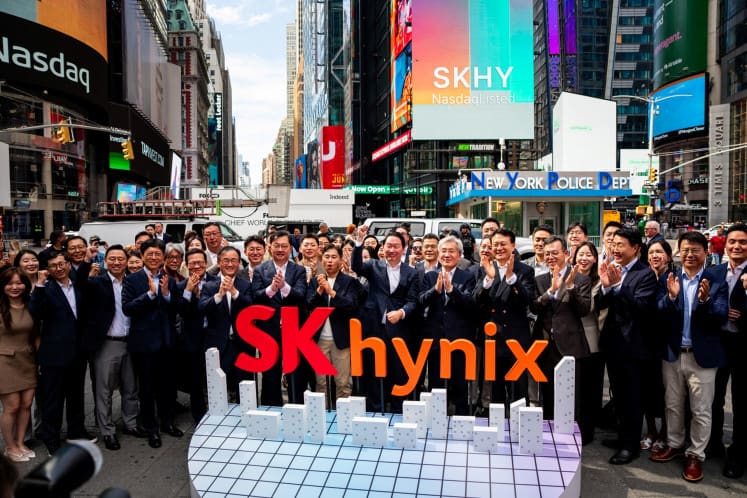
- ·Samsung Electronics and SK hynix secured $950 billion in five-year supply agreements with US firms including Nvidia and Broadcom for advanced AI memory chips.
- ·SK hynix will supply $750 billion worth of memory to clients including Nvidia, while Samsung signed a $200 billion memorandum with Broadcom covering HBM and foundry services.
- ·The deals were announced during President Lee Jae Myung's San Francisco visit and align with Seoul's plan to triple AI spending this year to compete with the US and China.
Seoul's Memory Giants Clinch Record Commitments
South Korea's two memory chip leaders have secured supply agreements worth $950 billion with US technology companies, marking one of the largest semiconductor commitments in the industry's history. Samsung Electronics and SK hynix disclosed the five-year deals during President Lee Jae Myung's meetings with senior executives from Nvidia, Broadcom, OpenAI, and Anthropic in San Francisco.
Presidential chief of staff for policy Kim Yong-beom confirmed the agreements on Saturday, detailing that SK hynix will supply $750 billion worth of memory chips over five years to clients including Nvidia. Samsung Electronics separately signed a $200 billion memorandum of understanding with Broadcom covering advanced memory chips and foundry services for AI chip production.
The announcements came as President Lee held discussions with OpenAI CEO Sam Altman, Nvidia's Jensen Huang, Anthropic's Dario Amodei, and Broadcom's Hock Tan. The timing reflects Seoul's intensifying push to position South Korea as a third pole in artificial intelligence, alongside the United States and China.
High-Bandwidth Memory at the Center
The deals center on high-bandwidth memory (HBM), the advanced chips that sit alongside graphics processing units in AI accelerators to power large language models and generative AI applications. Samsung and SK hynix hold two of the three global leadership positions in HBM production, with US-based Micron rounding out the trio.
According to Samsung, the collaboration with Broadcom will focus on "industry-leading memory solutions, including HBM, supporting Broadcom's next-generation AI accelerators." SK hynix described its partnership with Nvidia as targeting "large-scale AI infrastructure development," with plans to co-develop and optimize next-generation AI memory solutions for use cases ranging from large language model training to physical AI.
The AI boom has turned HBM into a bottleneck resource. Demand from hyperscalers and AI infrastructure builders has outpaced supply throughout the past year, and chipmakers have expanded production lines in response. These long-term commitments offer visibility for capacity planning and capital allocation over the next five years.
Seoul's Tripling of AI Spending
South Korea has committed to triple its AI spending this year, a policy shift that aligns government funding with the commercial momentum already visible in Samsung and SK hynix order books. The country's semiconductor industry contributes significantly to national GDP, and policymakers view AI chips as a strategic lever to maintain competitiveness in an era of intensifying US-China technology rivalry.
The AI chip supply chain has also brought labor tensions to the surface. Samsung averted a major strike in May by reaching an agreement on bonuses with its largest union, a reminder that rapid industry growth does not insulate companies from workforce demands over compensation.
Regional Implications
The scale of these agreements underscores the interdependence between US AI platform companies and Asian semiconductor manufacturers. Nvidia, which dominates the AI accelerator market, relies on partners in South Korea and Taiwan for memory and foundry capacity. Broadcom, a major supplier of custom AI chips to hyperscalers, similarly depends on advanced packaging and memory from the region.
For South Korea, the deals validate a decades-long investment in memory technology and offer a hedge against cyclical downturns that have historically plagued the DRAM and NAND markets. By locking in multi-year commitments tied to AI infrastructure, Samsung and SK hynix gain revenue stability that was rare in the commodity memory era.
The agreements also carry geopolitical weight. As Washington tightens export controls on advanced chips to China, US technology companies are deepening ties with allied semiconductor suppliers. South Korea's role as a trusted partner in the AI supply chain is reinforced by these commitments, even as Seoul navigates its own economic and diplomatic relationships with Beijing.
What Comes Next
Execution will be the test. Both Samsung and SK hynix must scale HBM production to meet the volumes outlined in these agreements while continuing to advance performance and energy efficiency. The industry is already moving toward sixth-generation HBM and exploring new packaging techniques to integrate memory more tightly with logic chips.
Capital expenditure in South Korea's semiconductor sector is expected to remain elevated, supported by both private investment and government incentives. The question is whether production capacity can keep pace with demand, particularly as new AI model architectures and inference workloads place fresh requirements on memory subsystems.
For now, the $950 billion in commitments signals confidence from US buyers and ambition from South Korean suppliers. The deals position Samsung and SK hynix at the center of the AI infrastructure build-out, with implications for the broader semiconductor ecosystem across Asia.
RELATED STORIES
Seoul Markets Tumble as Tech Selloff Ripples Across Asia
Cheng Wei-Lun · 3 min
Samsung Electronics Drops 8% as Market Questions Buyback Strategy
Cheng Wei-Lun · 2 min
Korean Stocks Retreat as Nvidia Earnings Loom
Cheng Wei-Lun · 2 min
SK Hynix Union Rejects Wage Deal in Razor-Thin Vote
Cheng Wei-Lun · 3 min
Spot something wrong? Email editor@briefasia.com. We log every correction publicly.