Sustainability · Energy
Oil Climbs as Trump Sanctions Threat Tightens Iran Supply Outlook
Brent and WTI post weekly gains above 5% as Washington pledges toughest financial penalties yet on Tehran's trading partners amid continued Strait of Hormuz disruptions
KEY TAKEAWAYS
- ·Brent crude settled at $94.39 and WTI at $87.06 Friday, with both benchmarks gaining over 5% for the week after Trump pledged sanctions on nations trading with Iran.
- ·Only seven commodity ships transited the Strait of Hormuz Thursday, half the prior day's count, as the waterway remains well below its pre-conflict capacity of handling 20% of global oil and LNG flows.
- ·Asian buyers face heightened risk as Iranian crude offers to Chinese refiners decline and prices jump, with no clarity yet on which countries will be targeted or granted sanctions waivers.
Sanctions Signal Tightens Supply Calculus
International crude benchmarks closed higher Friday following President Donald Trump's announcement that Washington will impose economic sanctions on countries continuing to trade with Iran. Brent settled at $94.39 per barrel, gaining 61 cents, while West Texas Intermediate added 23 cents to close at $87.06.
Both benchmarks notched weekly gains exceeding 5%, with Brent rising 6.39% and WTI climbing 5.66%. The session marked the highest settlement for both grades since late July, according to futures market data.
Trump's pledge to deploy what he termed the toughest financial penalties in history aims to force regime change in Tehran. Iran's government responded Friday that any new U.S. measures would provoke a "devastating" retaliation, escalating rhetoric between the two capitals as a previous peace agreement expired this week with no signs of renewed negotiation.
Asia Exposure Remains High Despite Workarounds
The sanctions threat carries particular weight across Asia, where Chinese refiners remain the primary destination for Iranian crude despite existing restrictions. Trade sources note that Iranian crude offers to Chinese buyers have declined sharply this week, with prices jumping as the U.S. naval blockade constricts shipment volumes.
Tehran's oil exports have operated under heavy constraints since the blockade intensified, but the formal sanctions framework targeting third-party nations raises the stakes for Asian importers. Singapore's role as a regional trading and blending hub, along with Malaysia's position in the tanker insurance and services chain, means the ripple effects of stricter enforcement will be felt across Southeast Asian maritime infrastructure.
John Kilduff, partner with Again Capital, noted that sanctions historically represent the most effective lever Washington has applied against Iran. Yet the immediate supply impact may prove limited given existing naval constraints, according to Crispus Nyaga, research analyst at Empire FX.
Strait Traffic Remains Well Below Normal
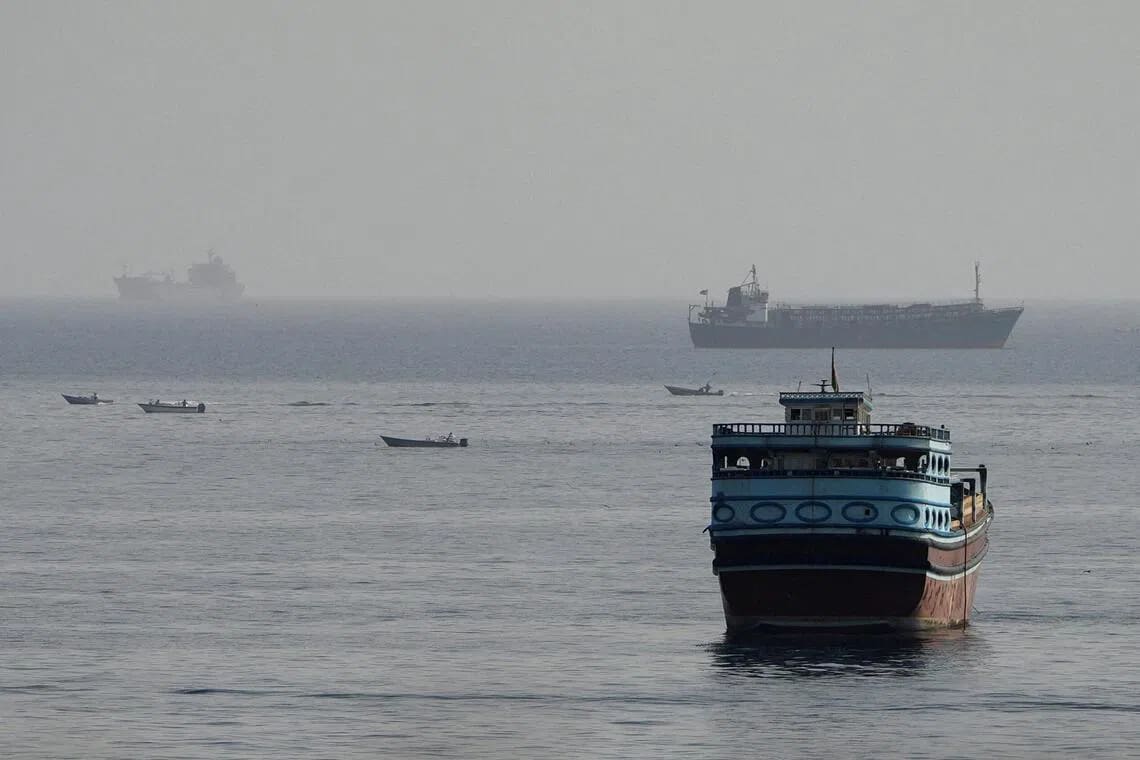
Shipping data from Kpler showed only seven commodity vessels transited the Strait of Hormuz on Thursday, half the previous day's count. Before U.S. and Israeli military operations against Iran began in late February, the waterway handled approximately 20% of global oil and liquefied natural gas volumes.
Nearly six months into the conflict, energy flows through the strait remain severely curtailed. The disruption has forced Gulf producers including Saudi Arabia, Iraq, the United Arab Emirates, and Kuwait to rely more heavily on alternative export routes, including overland pipelines and Red Sea terminals.
Phil Flynn, senior analyst with Price Futures Group, observed that while Hormuz bottlenecks persist, the market is finding relief through multiple channels. U.S. shale production continues to expand, Venezuela's output is recovering despite infrastructure constraints, and the UAE is operating without production limits, adding barrels to offset the shortfall.
Wider Conflict Adds Pressure
Beyond the Gulf, supply concerns are multiplying. Ukrainian forces struck a Russian oil refinery in Perm overnight, President Volodymyr Zelenskiy confirmed Friday. The facility sits more than 1,600 kilometers from the Ukrainian border, underscoring Kyiv's expanding reach into Russian energy infrastructure.
The twin pressures of constrained Middle Eastern exports and attacks on Russian refining capacity are tightening the global crude balance at a time when Asian demand remains robust. China's refining sector, despite slower economic growth, continues to operate at high utilization rates, while India's consumption has accelerated with infrastructure spending and manufacturing expansion.
The sanctions framework Trump outlined does not yet include specific countries or enforcement timelines, leaving traders to assess which Asian nations may face penalties and how aggressively Washington will pursue compliance. Previous sanctions regimes granted waivers to major importers including China, India, South Korea, and Japan, but the current administration has signaled a harder line.
For now, the market is pricing in tighter supply ahead, with the forward curve showing backwardation that suggests near-term barrels command a premium. Whether that tightness persists will depend on how quickly alternative supply can scale and whether diplomatic channels reopen before sanctions take full effect.
RELATED STORIES
Oil Climbs on US Blockade Threat to Iran as Strait of Hormuz Traffic Slows
Priyanka V. Rao · 3 min
US Naval Blockade Threat Pushes Oil Above $87 as Iran Tightens Strait Control
Priyanka V. Rao · 3 min
US Naval Blockade Threat Lifts Oil Prices Amid Iran Strait Tensions
Priyanka V. Rao · 3 min
Crude Prices Climb as Iran Tightens Grip on Hormuz Transit
Priyanka V. Rao · 3 min
Spot something wrong? Email editor@briefasia.com. We log every correction publicly.