Technology · AI
NXP Signals Physical AI Has Entered Long Adoption Cycle
The Dutch chipmaker's latest earnings commentary points to structural growth in edge processors, software-defined vehicles, and AI data-centre infrastructure.
KEY TAKEAWAYS
- ·NXP Semiconductors expects physical AI to enter a decade-long adoption cycle, driven by edge inference in automotive, industrial automation, and data-centre infrastructure.
- ·The company is shipping processors for software-defined vehicle architectures, with design wins across domain controllers and gateway chips that handle over-the-air updates and real-time systems.
- ·Asia remains the largest manufacturing base and fastest-growing market for NXP's platforms, with aggressive adoption in China's automotive sector and Southeast Asia's industrial automation.
A Decade-Long Build-Out
NXP Semiconductors used its recent earnings call to outline a structural shift it believes will define the next ten years: the rollout of physical AI. Unlike the hyperscale cloud deployments that have dominated the past two years of generative-AI investment, the Dutch chipmaker is betting on inference at the edge, where silicon meets metal, glass, and carbon fibre.
The company's management drew attention to three overlapping markets. First, automotive platforms are moving toward software-defined architectures that require far more compute than the embedded controllers of the past decade. Second, industrial automation is adopting vision and sensor-fusion capabilities that run locally rather than in the cloud. Third, and perhaps less expected, NXP is carving out a foothold in AI data-centre infrastructure, supplying connectivity and management processors that sit alongside Nvidia's GPUs and custom accelerators.
Software-Defined Vehicles Take Centre Stage
The automotive segment remains NXP's largest business, and the earnings commentary made clear that the transition to software-defined vehicles is no longer a roadmap slide. It is shipping silicon. The company highlighted design wins across multiple tiers of the vehicle architecture, from domain controllers that manage infotainment and advanced driver-assistance systems to gateway processors that handle over-the-air updates and secure boot.
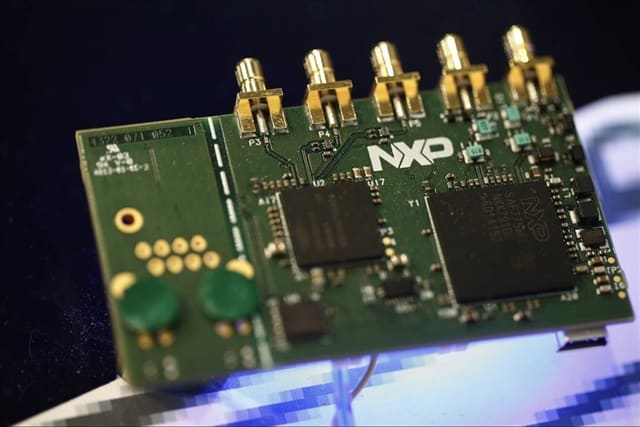
What sets this cycle apart from earlier automotive semiconductor booms is the processing density. A typical premium vehicle today may contain a dozen or more application processors, each running real-time operating systems and virtualisation layers. NXP's i.MX and S32 families are designed for exactly this environment, balancing performance, functional safety, and power efficiency in a way that general-purpose chips cannot match.
The company also noted that its automotive backlog remains healthy, even as the broader passenger-car market cools in Europe and China. That divergence suggests automakers are prioritising silicon spend on software platforms over volume, a shift that favours suppliers with deep integration expertise.
Physical AI Beyond the Car
Industrial and IoT applications represent the second leg of NXP's physical-AI thesis. The company pointed to deployments in factory automation, building management, and logistics, where edge inference is used for predictive maintenance, anomaly detection, and real-time optimisation. These workloads do not require the multi-teraflop performance of a cloud GPU, but they do demand low latency, deterministic behaviour, and the ability to run for years on constrained power budgets.
NXP's Crossover processors, which combine Arm cores with dedicated neural-processing units, are aimed squarely at this market. The company has also begun bundling reference designs with pre-trained models for common industrial tasks, lowering the barrier to adoption for system integrators who lack in-house AI expertise.
This approach mirrors the playbook that made NXP a leader in secure payments and NFC. Rather than selling raw compute, it sells turnkey solutions that solve specific problems. In a market where most AI inference still happens in the cloud, that focus on the edge is a calculated contrarian bet.
A Foothold in the Data Centre
Perhaps the most surprising element of the earnings call was the discussion of AI data-centre infrastructure. NXP does not build GPUs or AI accelerators, but it does supply the chips that manage power delivery, network connectivity, and system health in rack-scale deployments. As hyperscalers and enterprises build out AI clusters with hundreds or thousands of accelerators, the demand for high-reliability management silicon has grown in parallel.
The company described these components as the "plumbing" of AI infrastructure, unglamorous but essential. Its portfolio includes Ethernet PHYs, power-management ICs, and Arm-based service processors that run out-of-band management firmware. While these chips carry lower average selling prices than the headline AI accelerators, they ship in high volumes and carry strong gross margins.
NXP's management suggested that this business line could grow faster than the overall data-centre market, as AI workloads place greater demands on power efficiency and network bandwidth. The implication is that even if NXP never competes directly with Nvidia or AMD, it can still capture a meaningful share of AI infrastructure spending.
What the Numbers Show
The company's forward guidance was cautious, reflecting inventory adjustments in consumer and industrial end markets. Revenue for the current quarter is expected to come in flat to slightly down sequentially, with automotive and infrastructure offsetting weakness in mobile and IoT. Gross margin held steady in the mid-50s, a sign that pricing discipline has survived the post-pandemic correction.
Management emphasised that the physical-AI opportunity is a multi-year build, not a near-term revenue spike. Design cycles in automotive and industrial markets can stretch 18 to 36 months, and volume production often lags by another year. That timeline contrasts sharply with the rapid deployment cycles seen in cloud AI, but it also provides more predictable revenue streams once designs go into production.
The Asia Angle
Asia remains both the largest manufacturing base and the fastest-growing end market for NXP's physical-AI platforms. The company has design centres in Shanghai, Bangalore, and Tokyo, and its automotive customers include every major Japanese, Korean, and Chinese OEM. Software-defined vehicle architectures are being adopted most aggressively in China, where local brands are pushing feature parity with European luxury marques at half the price.
In industrial automation, Southeast Asia and India are seeing accelerated adoption of vision-guided robotics and predictive maintenance, driven by labour-cost inflation and government incentives for smart manufacturing. NXP's partnerships with regional system integrators and contract manufacturers give it distribution reach that larger but less specialised chipmakers struggle to replicate.
The data-centre story is also tilted toward Asia. Hyperscale operators in China, Singapore, and Japan are building out sovereign AI infrastructure, and many prefer suppliers with local design support and long-term supply commitments. NXP's ability to deliver high-mix, low-volume chips with short lead times has made it a preferred vendor for custom management and connectivity solutions.
The earnings call did not break out revenue by geography, but the commentary made clear that Asia is central to the physical-AI thesis. The region is where the volume is, and where the adoption cycle is moving fastest.
RELATED STORIES
Taiwan Think Tank Warns of China's National Push in Physical AI and Robotics
Cheng Wei-Lun · 3 min
NXP Semiconductor Beats Automotive Targets but Investor Sentiment Dims on China Competition
Cheng Wei-Lun · 3 min
ADLINK Posts 41% Revenue Jump as Industrial Automation Orders Surge
Cheng Wei-Lun · 2 min
China's PCB Industry Commits Over $10 Billion to Meet AI Server Demand
Cheng Wei-Lun · 3 min
Spot something wrong? Email editor@briefasia.com. We log every correction publicly.