Real Estate · Land
Malaysian Builders Confront Productivity Crisis Amid Record Project Pipeline
Surging infrastructure demand exposes capability gaps as CIDB warns lowest-price procurement threatens long-term competitiveness
KEY TAKEAWAYS
- ·Malaysia's construction sector completed RM178.6 billion in work during 2025, up 12.5 percent, with civil engineering contributing RM15.9 billion in the first quarter of 2026.
- ·CIDB chief Ahmad Farrin warns that lowest-price procurement and inadequate project preparation undermine productivity despite rising demand from infrastructure and private industrial investment.
- ·The Construction Industry Transformation Programme 2030 targets 50 percent green-rated buildings above RM40 million and 80 percent achievement scores for quality and safety systems by decade's end.
Record Activity Masks Structural Weaknesses
Malaysia's builders completed RM178.6 billion worth of work in 2025, a 12.5 percent increase that marks one of the sector's strongest years this decade, according to Statistics Department figures. The first quarter of 2026 extended that momentum with an 8.5 percent year-on-year gain to RM46.5 billion, civil engineering accounting for RM15.9 billion.
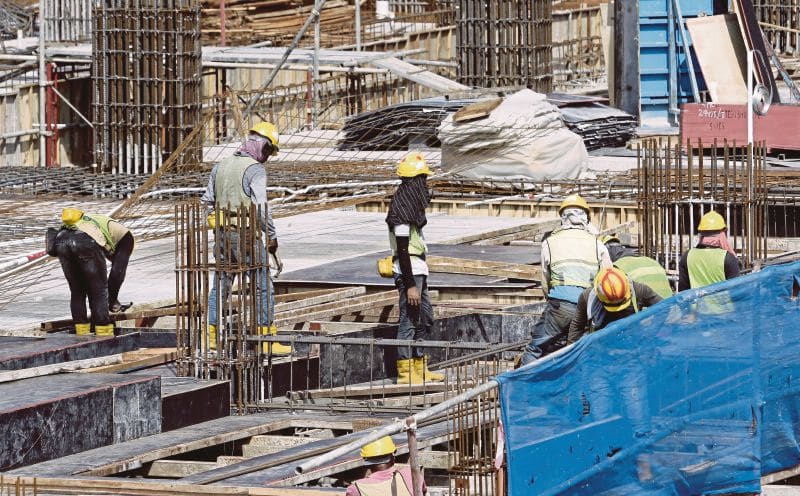
Yet Construction Industry Development Board chief executive Ahmad Farrin Mokhtar warns that expanding order books alone do not guarantee the industry can meet the next wave of demand. He points to thin profit margins, persistent reliance on manual labor, and a procurement culture that prioritizes upfront cost over lifetime value as barriers that threaten to stall progress even as opportunity accelerates.
The government plans to allocate approximately RM58 billion in development spending for 2027, with seven-tenths directed toward infrastructure. Private capital is amplifying that base: non-residential building activity climbed 12.7 percent in the first quarter of 2026, driven by data centers, logistics hubs, and advanced manufacturing facilities that demand precision engineering and digital coordination far beyond conventional building methods.
Private Investment Drives Complexity
Ahmad Farrin expects civil engineering and utilities to anchor growth, but industrial and non-residential segments are increasingly shaping the sector's profile. Malaysia's push into semiconductors, renewable energy, and digital infrastructure has attracted multinational investment that comes with exacting specifications and compressed schedules.
These projects require capabilities the industry has not historically needed at scale: integrated digital workflows, modular prefabrication, real-time progress monitoring, and tradespeople trained to operate automated equipment. Contractors accustomed to road and residential work now compete for projects that blur the line between construction and advanced manufacturing.
Affordable housing remains a policy priority, though Ahmad Farrin notes that expansion hinges on land release, financing structures, and coordination between federal and state agencies. He sees the pipeline as broad-based, with public infrastructure providing continuity while private industrial capital pushes diversification.
Climate and Supply Chains Add Volatility
External risks compound internal capability gaps. Global economic uncertainty and geopolitical friction disrupt material imports and investor confidence. Climate events are no longer outliers: extreme heat reduces on-site productivity, water shortages halt concrete pours, and severe weather damages unfinished structures.
Ahmad Farrin argues that contractors must embed resilience into both project planning and corporate strategy. That includes tighter cash-flow management, client and segment diversification, and rigorous pre-award risk assessment. Supply-chain planning should favor local materials that meet standards and procurement systems that flag price and delivery risks earlier.
Contracts need fairer risk allocation and mechanisms to handle exceptional shifts in material cost, scope, or delivery conditions. On-site, heat-stress protocols, flexible schedules, and weather-monitoring systems are becoming operational necessities rather than optional add-ons.
Technology Helps, But Preparation Matters More
Building Information Modeling, digital dashboards, drones, sensors, and artificial intelligence offer tools to detect design conflicts before groundbreaking, monitor milestones in real time, and spot cost overruns as they emerge. Yet Ahmad Farrin insists that technology cannot compensate for inadequate project preparation.
He emphasizes that clear scopes, sufficiently developed designs, realistic cost estimates, appropriate procurement strategies, and reliable site and utility data must be in place before contracts are awarded. Inadequate preparation triggers variations, disputes, delays, and cost escalation during execution, undermining even the most sophisticated digital tools.
For public-sector projects, strong governance with clear accountability and regular monitoring against agreed milestones can identify problems early. Digital platforms then provide the transparency and coordination needed to keep complex multi-party projects on track.
Procurement Reform Targets Whole-Life Value
One of the most contentious shifts Ahmad Farrin advocates involves moving away from lowest-price procurement. He argues that project owners should weigh contractor capability, track record, financial strength, safety performance, quality standards, and proposed delivery methods more heavily than initial bid price.
Whole-life value, encompassing operating, maintenance, and environmental costs over an asset's lifespan, should guide procurement decisions. The shift is particularly relevant as Malaysia builds infrastructure and facilities expected to perform efficiently for decades.
Fair and timely payment throughout the supply chain remains critical. Ahmad Farrin also highlights industrialized building systems, mechanization, and automation as productivity levers that reduce dependence on manual site labor, improve consistency, and give contractors tighter control over schedules and resources.
CIDB's Quality Assessment System for Building Construction Works and Safety and Health Assessment System in Construction provide objective measures of workmanship and safety performance, establishing more consistent benchmarks across the industry.
Construction as Economic Enabler
Ahmad Farrin frames construction as an enabling industry that underpins every major economic ambition. Data centers require reliable power, water, and connectivity. Manufacturing investment depends on factories, logistics networks, and supporting infrastructure. Economic corridors need roads, railways, utilities, and housing.
The efficiency and quality of the construction sector therefore influence the competitiveness of almost every other industry. That rationale drives CIDB's transformation agenda, which extends beyond traditional contractor registration and compliance to encompass digital maturity, skilled-personnel accreditation, sustainability, and international competitiveness.
The National Construction Policy 2030 and Construction Industry Transformation Programme 2030 set measurable targets. By decade's end, Malaysia aims for half of building projects valued above RM40 million to attain green ratings, an 80 percent achievement score for both quality and safety assessment systems, full accreditation of construction personnel, and stronger international recognition for Malaysian firms.
The Talent Bottleneck
Technology's effectiveness hinges on the people capable of deploying it. As projects grow more sophisticated, demand rises for BIM modelers, machinery operators, safety specialists, supervisors, technicians, and skilled tradespeople. Workforce development has become one of the most critical elements of the sector's transformation.
CIDB, through Akademi Binaan Malaysia and industry partners, supports technical and vocational education, accreditation, upskilling, and reskilling. The objective is not simply to fill vacancies but to create pathways into higher-skilled, better-paying construction careers.
The question facing Malaysia's construction industry is whether transformation can keep pace with demand. Record project pipelines and rising private investment offer a window of opportunity, but capturing it will require changes that go far deeper than adding more workers to sites. It will demand a fundamental rethinking of how projects are procured, prepared, executed, and measured.
RELATED STORIES
Malaysia Construction Sector Posts RM47.8 Billion in Q2 Work Value
Priyanka V. Rao · 3 min

Malaysia Regains Ground as Asia's Cocoa Processing Hub
Priyanka V. Rao · 2 min

Malaysia's Natural Rubber Output Jumps on Smallholder Strength
Priyanka V. Rao · 3 min

Malaysia Probes Former Tabung Haji Officials After $10 Billion Asset Deficit Revealed
Priyanka V. Rao · 4 min
Spot something wrong? Email editor@briefasia.com. We log every correction publicly.