Asia · Business
Malaysia's Natural Rubber Output Jumps on Smallholder Strength
Production climbed 31.5 percent month-on-month in June, driven almost entirely by smallholder estates as China continues to dominate export demand
KEY TAKEAWAYS
- ·Malaysia produced 26,553 tonnes of natural rubber in June 2026, up 31.5 percent from May, with smallholders supplying 88.7 percent of output.
- ·Exports jumped 35.2 percent to 38,862 tonnes, driven by rubber glove shipments worth RM1.4 billion and sustained demand from China, which took 55.8 percent of volume.
- ·Concentrated latex prices fell 3.6 percent while scrap rubber prices rose 6.0 percent, signaling divergent demand across medical and industrial segments.
Smallholders Drive Production Surge
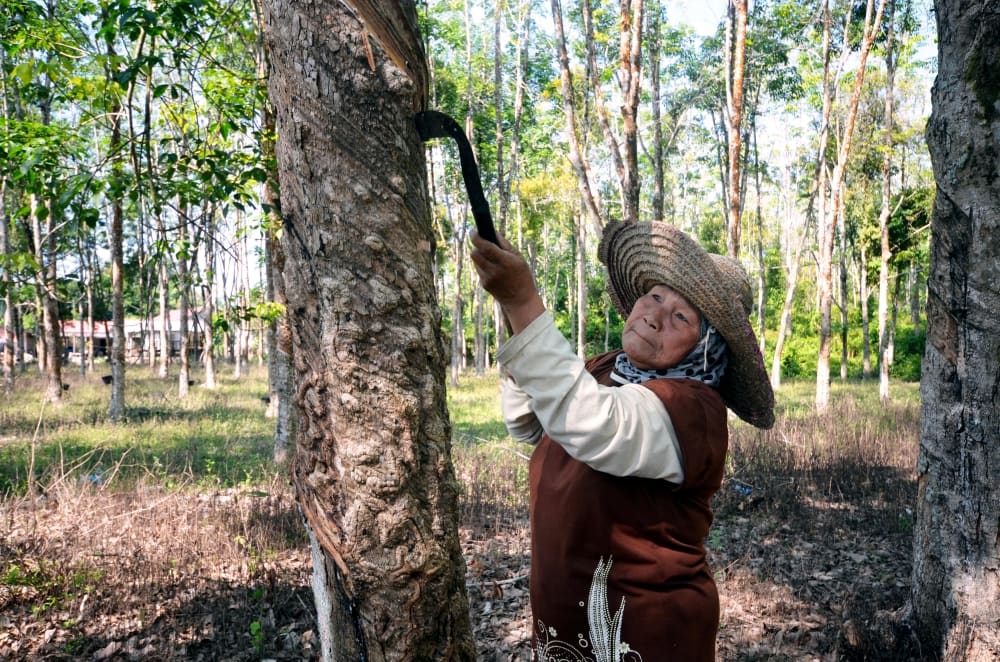
Malaysia's natural rubber production climbed to 26,553 tonnes in June 2026, a 31.5 percent increase from 20,198 tonnes the previous month, according to the Department of Statistics Malaysia. Smallholders accounted for 88.7 percent of the monthly output, while estate plantations contributed just 11.3 percent.
Year-on-year growth was more modest, with production inching up 1.2 percent from 26,249 tonnes in June 2025. The figures underscore the continued dominance of small-scale producers in Malaysia's rubber supply chain, even as the industry faces structural shifts in global demand.
Total natural rubber stocks rose 5.2 percent to 129,524 tonnes in June from 123,149 tonnes in May. Rubber processors held 77.8 percent of those inventories, with consumer factories accounting for 22.1 percent and estates the remaining 0.1 percent.
Export Volume Climbs as China Holds Market Share
Malaysia exported 38,862 tonnes of natural rubber in June, up 35.2 percent from 28,742 tonnes in May, data from DOSM show. China remained the primary destination, absorbing 55.8 percent of total shipments. Germany took 11.5 percent, followed by the United States at 6.7 percent, with Turkey and India each claiming 3.1 percent.
Rubber gloves were the standout export category among downstream products, valued at RM1.4 billion in June, a 19.7 percent increase from RM1.2 billion in May. Tyres, rubber tubes, and rubber thread also contributed to export performance, though the department did not break out separate figures for those segments.
The sharp month-on-month rise in glove exports reflects restocking cycles in key markets and sustained demand for medical and industrial-grade products. Malaysia competes directly with Thailand and Indonesia across the Southeast Asian rubber belt, where production timing and weather patterns can create short-term supply volatility.
Price Movements Signal Mixed Demand
The average monthly price of concentrated latex fell 3.6 percent to 735.82 sen per kilogram in June from 763.16 sen in May, according to DOSM. That decline suggests softer demand or improved supply conditions for the higher-grade product used in glove manufacturing and other precision applications.
In contrast, scrap rubber prices rose 6.0 percent to 792.76 sen per kilogram from 747.78 sen the prior month. Scrap rubber typically feeds into tyre production and lower-grade industrial uses, and the price uptick may reflect inventory tightening or rising input costs among processors.
The divergence between latex and scrap pricing points to segmented demand dynamics within Malaysia's rubber complex. Latex markets remain sensitive to medical-product cycles, while scrap rubber tracks automotive and construction activity more closely.
Regional Context
Malaysia ranks as the world's sixth-largest natural rubber producer, trailing Thailand, Indonesia, Vietnam, India, and China. The country's rubber sector has contracted over the past two decades as growers shifted to palm oil, which offers higher returns per hectare and shorter harvest cycles.
Smallholder dominance reflects the fragmented ownership structure that persists across much of peninsular Malaysia and Sarawak. Many plots are under five hectares, and labour shortages have limited replanting efforts even as prices have firmed in recent years.
China's outsized share of Malaysian exports underscores the mainland's role as both a manufacturing hub and a re-export gateway. Rubber processed in southern China often ends up in goods destined for Europe and North America, embedding Malaysian supply deep into global value chains.
The June data arrive as natural rubber futures on the Shanghai exchange have traded in a narrow band, with synthetic rubber prices capping upside potential. Analysts expect Malaysian production to remain flat or decline modestly through the rest of 2026 unless labour availability improves or weather patterns shift.
RELATED STORIES
Hong Kong Opens Kuala Lumpur Office in Asia Network Push
Cheng Wei-Lun · 4 min

Malaysia Probes Former Tabung Haji Officials After $10 Billion Asset Deficit Revealed
Priyanka V. Rao · 4 min
Penang Turns to Medical Devices as Chip Boom Matures
Priyanka V. Rao · 4 min
Malaysia Construction Sector Posts RM47.8 Billion in Q2 Work Value
Priyanka V. Rao · 3 min
Spot something wrong? Email editor@briefasia.com. We log every correction publicly.