Perspectives · Opinion
Why Korea's Won Weakness Tells a Different Story Than Japan's Yen
Seoul faces a capital flight problem driven by corporate behavior, while Tokyo remains trapped by decades of monetary policy choices
KEY TAKEAWAYS
- ·South Korean companies are increasingly retaining earnings offshore rather than repatriating profits, removing a key source of structural support for the won despite continued export strength.
- ·Japan's yen weakness stems from the Bank of Japan holding nearly half the government bond market after decades of quantitative easing, leaving it unable to raise rates without triggering fiscal instability.
- ·Both currency problems are structural rather than cyclical, requiring fundamental shifts in corporate investment incentives in Korea and years of careful monetary policy normalization in Japan.
- ·The divergence in currency drivers means betting on won strength depends on restoring domestic investment appeal, while yen strength requires a faster-than-expected Bank of Japan policy shift that looks increasingly unlikely.
Two Currencies, Two Crises
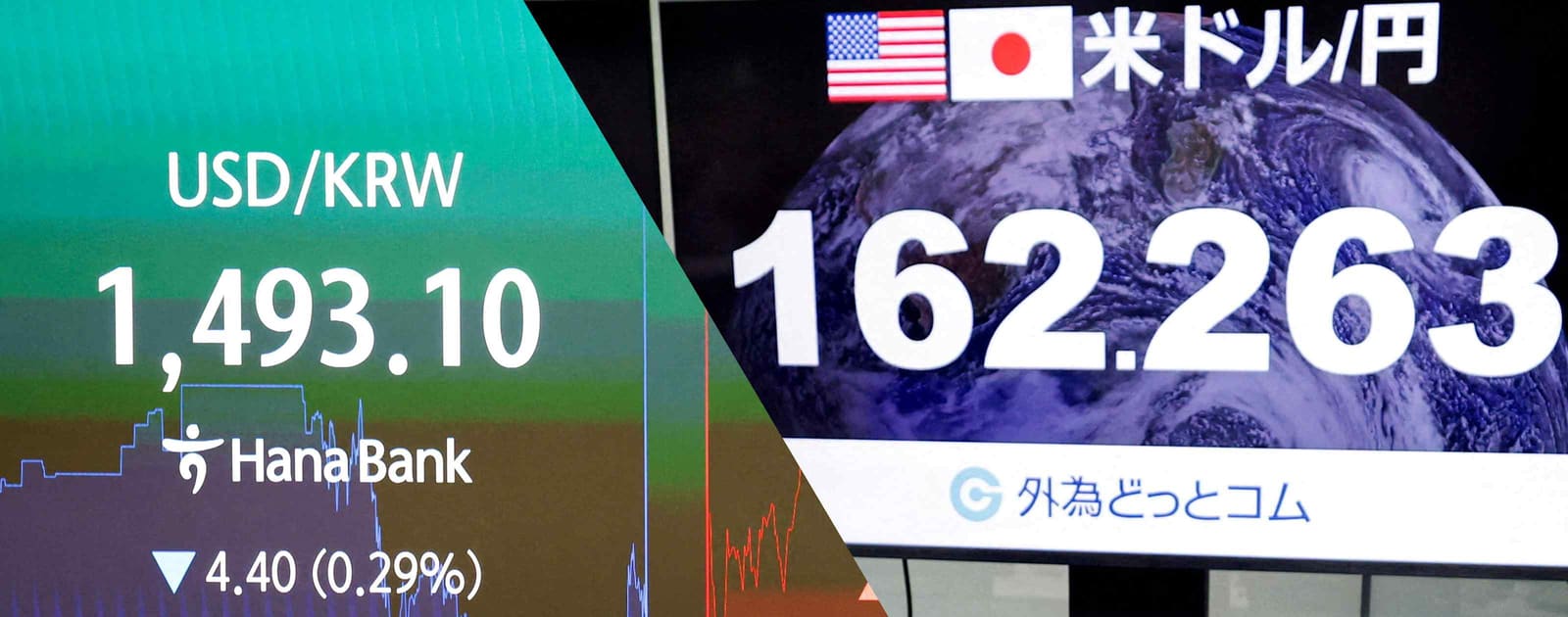
When currencies weaken, the reflex is to look at central bank policy, interest rate differentials, or trade balances. But the recent struggles of the South Korean won and Japanese yen against the dollar mask two fundamentally different structural problems, each revealing deeper fractures in how these economies operate.
On the surface, both Tokyo and Seoul have watched their currencies slide in recent quarters. Yet the mechanisms driving that weakness could not be more distinct. Japan's yen depreciation reflects the exhaustion of a monetary experiment that began decades ago and has left the country with limited room to maneuver. South Korea's won, by contrast, is weakening because the companies that built the nation's export miracle have quietly stopped bringing their money home.
The Repatriation Problem
South Korean conglomerates have historically been engines of foreign exchange inflows. Exporters earned dollars, euros, and yuan abroad, then converted those earnings back into won to pay workers, invest in domestic facilities, and distribute dividends. That cycle kept the won underpinned even during global downturns.
That pattern has broken. Over the past several years, major South Korean firms have increasingly retained earnings offshore, parking cash in foreign subsidiaries or reinvesting in overseas production capacity rather than repatriating profits. The reasons are varied: tax efficiency, hedging against domestic policy uncertainty, and the strategic desire to hold dollar-denominated assets in an era of US interest rate volatility.
The result is a structural shift in capital flows. Where once export revenues reliably cycled back into the domestic economy, they now sit in Singapore holding companies, US Treasury bonds, or Vietnamese manufacturing plants. The won no longer enjoys the automatic support it once did from Korea's trade surplus. Instead, the currency floats more freely on sentiment and speculation, vulnerable to swings in risk appetite and dollar strength.
This is not a crisis of competitiveness. Korean exporters remain formidable in semiconductors, batteries, and shipbuilding. It is a crisis of confidence in the domestic economy as a destination for capital. When even homegrown champions prefer to keep their winnings abroad, it signals a deeper unease about growth prospects, regulatory risk, or return on investment at home.
The Policy Trap
Japan's yen weakness, by contrast, stems from a problem of its own making: the accumulated burden of unconventional monetary policy. The Bank of Japan has spent more than two decades suppressing interest rates, expanding its balance sheet, and intervening in bond markets to keep borrowing costs near zero. The goal was to escape deflation and revive growth. The consequence has been a financial system addicted to cheap money and a central bank with vanishingly few tools left.
When the US Federal Reserve began raising rates aggressively in recent years, the divergence between American and Japanese yields widened into a chasm. Capital flowed out of yen and into dollars, chasing higher returns. The BoJ faced a choice: raise rates and risk destabilizing an economy built on low borrowing costs, or tolerate yen depreciation and watch import prices rise.
Tokyo chose depreciation, intervening sporadically in currency markets but refusing to fundamentally shift policy. The result has been a weaker yen that boosts nominal export revenues but squeezes households through higher energy and food costs. Japanese companies benefit from translation gains on overseas earnings. Japanese consumers pay more at the pump and the grocery store.
The deeper issue is that Japan has boxed itself in. Decades of quantitative easing have left the BoJ holding nearly half of the government bond market. Raising rates meaningfully would inflict losses on the central bank's own portfolio and spike borrowing costs for a government carrying debt worth more than twice GDP. The yen's weakness is not a policy choice so much as the inevitable outcome of a policy framework that has run out of road.
Structural, Not Cyclical
What unites these two currency stories is that neither is likely to be resolved by short-term fixes. South Korea cannot compel its conglomerates to repatriate earnings, nor should it try through capital controls that would undermine Seoul's status as an open financial center. Instead, the government must address why domestic investment has become less attractive: whether through regulatory reform, tax incentives, or infrastructure spending that raises expected returns at home.
Japan, meanwhile, cannot simply unwind two decades of monetary experimentation without triggering a bond market rout or a fiscal crisis. Normalizing policy will require years of careful adjustment, coordination with the Ministry of Finance, and acceptance that the yen may remain structurally weaker than it was in the pre-quantitative easing era.
Both countries are grappling with the limits of the models that brought them prosperity. South Korea's export-led growth worked when companies reinvested at home. Japan's low-rate, high-debt model worked when deflation was the enemy and borrowing costs could only go down. Those conditions no longer hold.
What It Means for Asia
Currency weakness in Tokyo and Seoul has implications beyond their borders. A cheaper yen makes Japanese exports more competitive, putting pressure on manufacturers across Asia. A weaker won does the same for Korean goods, intensifying rivalry in sectors like autos, electronics, and petrochemicals.
For investors, the divergence in currency drivers matters. Betting on yen strength requires a view that the BoJ will shift policy faster than markets expect, a scenario that looks increasingly unlikely given political and fiscal constraints. Betting on won strength, by contrast, depends on whether Seoul can convince its corporate sector that Korea is worth investing in again.
The broader lesson is that currency moves are symptoms, not diseases. The won and yen are weakening for reasons rooted in corporate behavior and policy choices made years ago. Fixing those underlying problems will take more than central bank intervention or jawboning. It will require rethinking the economic models that no longer deliver the growth and stability they once did.
Neither Tokyo nor Seoul has fully confronted that reality yet. Until they do, their currencies will continue to tell stories of structural strain, not temporary turbulence.
RELATED STORIES

Japan's Capital Repatriation Push Tests Global Portfolio Strategies
Cheng Wei-Lun · 3 min

WeRide Eyes Regional Push Across Australia and Asia-Pacific Markets
Cheng Wei-Lun · 2 min

Japanese Chipmakers and Infrastructure Giants Lift Earnings Outlook 14 Percent
Cheng Wei-Lun · 4 min
Japan's 10-Year Bond Yield Hits Highest Level Since 1996
Aiko Nakamura · 3 min
Spot something wrong? Email editor@briefasia.com. We log every correction publicly.