Asia · Business
Indonesia's Whoosh Railway Partners Face Mounting Losses
State-owned enterprises absorbed $279 million in operating deficits during 2025 as the Jakarta-Bandung high-speed line struggles with profitability
KEY TAKEAWAYS
- ·Indonesia's state railway operator and construction firm absorbed $279 million in losses from the Whoosh high-speed rail joint venture during 2025, with Wijaya Karya facing particularly severe financial strain.
- ·The Jakarta-Bandung line carried 6.2 million passengers in 2025, far below the 45 million on the Japanese-backed Jakarta MRT and 35 million on the Greater Jakarta LRT, both of which cost substantially less than Whoosh's $7 billion price tag.
- ·Indonesia's state investment fund Danantara is in talks with China to restructure project debt as the government prepares to merge struggling state construction firms, signaling the state will likely absorb a larger share of ongoing operating deficits.
Financial Strain Deepens for State Partners
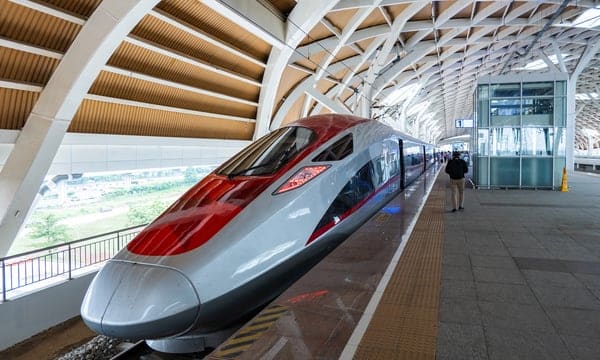
Indonesia's high-speed rail joint venture partners posted substantial losses in 2025, with state-owned enterprises absorbing IDR 5 trillion ($279 million) in deficits from the Whoosh line that opened in October 2023. The 143-kilometer Jakarta-Bandung route, which reaches speeds above 300 kilometers per hour, carried 6.2 million passengers last year while continuing to bleed cash.
The project operates through PT Kereta Cepat Indonesia China (PT KCIC), structured with 60 percent Indonesian ownership via PT Pilar Sinergi BUMN Indonesia and 40 percent held by Chinese firms. State railway operator Kereta Api Indonesia absorbed approximately $162 million of the total loss, up from $124 million in 2024, according to KAI's 2025 financial report. Construction firm Wijaya Karya reported losses of IDR 1.6 trillion, or roughly $90 million, from its stake in the venture.
Uneven Impact Across Partners
The financial burden falls unevenly across the Indonesian participants. KAI maintains a relatively healthy balance sheet with $5.9 billion in total assets and equity of $2.2 billion. The railway operator posted net income of $128 million in 2025 with positive operating cashflow around $400 million. Yet annual absorption of nearly $200 million in Whoosh losses gradually erodes that equity cushion.
Wijaya Karya faces a far more precarious situation. The state-owned contractor reported a net loss of $565 million in 2025 and holds equity of just $94 million, leaving assets barely exceeding liabilities. The company's thin financial position makes it poorly equipped to continue absorbing $90 million annual deficits from the rail venture, particularly as Indonesia's state construction firms struggle following years of debt-fueled expansion under the previous administration.
Ridership and Cost Comparisons
Whoosh's 6.2 million passengers in 2025 trail significantly behind other Jakarta transit projects. The Jakarta MRT, constructed and financed in partnership with Japan, recorded 45 million riders, while the Greater Jakarta LRT, built by Indonesian state firms using primarily domestic financing, carried 35 million passengers. Both systems cost substantially less than Whoosh's $7 billion final price tag, which exceeded initial projections after delays pushed back the opening.
The route connects two cities already served by buses, toll roads, and conventional rail, prompting ongoing debate about whether the investment justifies the scale of expenditure. The joint venture structure aimed to give Indonesian state enterprises active roles in construction and operation to build technical capabilities, though the financial distress now facing partners like Wijaya complicates assessment of that strategic objective.
Restructuring on the Horizon
Indonesia's state investment fund Danantara is reportedly in discussions with China to restructure debt associated with the project, which was financed primarily through the China Development Bank. Separately, the government appears likely to merge or restructure major state-owned construction companies, including Wijaya, in the near term.
The current arrangement, which places operating losses on the joint venture partners, appears increasingly untenable given Wijaya's fragile financial position. The government maintains fiscal capacity to cover the roughly $300 million in annual operating deficits, particularly given that other transportation modes including long-distance rail and Jakarta's commuter systems already receive heavy subsidies. However, the question of whether state resources should continue flowing to the project remains open as Indonesia faces tightening fiscal constraints across multiple sectors.
Debt Servicing Ahead
The Indonesian state will likely absorb a larger share of Whoosh's financial burden going forward, driven by the simple reality that current joint venture partners cannot sustain continued losses at this scale. While $300 million annually does not threaten Indonesia's broader fiscal solvency or foreign debt obligations, the allocation redirects resources that could support other infrastructure priorities or social spending as the government navigates narrowing budgetary room.
The railway's performance through 2025 reinforces early concerns about project economics and debt sustainability, even as Jakarta defends the strategic value of the line as Southeast Asia's first high-speed rail corridor and a demonstration of infrastructure ambition in the region's largest economy.
RELATED STORIES
Indonesia Faces Critical Choice Between Resource Control and Industrial Growth
Tran Quoc Bao · 3 min
Indonesia's Wildfires Push Air Quality to World's Worst Levels
Siti Nuraini · 2 min

Indonesia Charges Toba Pulp Lestari in $113 Million Tax Fraud Probe
Siti Nuraini · 3 min
Indonesia Unveils Bid to Become Global Commodity Price-Setter
Priyanka V. Rao · 3 min
Spot something wrong? Email editor@briefasia.com. We log every correction publicly.