Perspectives · Analysis
Indonesia Should Not Tax Retirement Savings
As Jakarta debates JHT tax rates, a deeper question emerges: why is the state taxing old-age security in a country where most workers lack formal protection?
KEY TAKEAWAYS
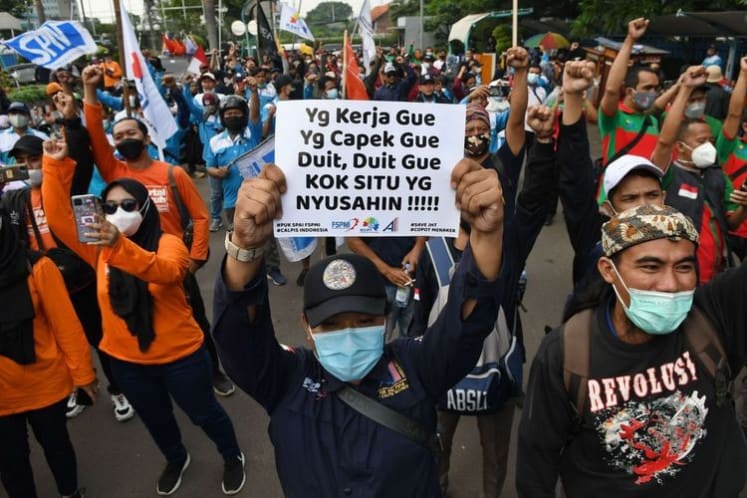
- ·Indonesia's renewed JHT debate centers on tax rates and thresholds while fewer than half of workers participate in formal social security systems.
- ·Taxing retirement withdrawals penalizes formal-sector workers exclusively, widening the gap with informal workers and discouraging system participation.
- ·Retirement savings represent deferred consumption for old-age security, not taxable wealth, and should be exempt from taxation entirely.
- ·Broader tax reforms like expanding VAT base and closing corporate loopholes offer larger fiscal returns without compromising social protection commitments.
The Wrong Conversation
Indonesia's policy circles are once again circling around the Old-Age Savings program, known locally as JHT. Ministers debate percentage points. Lawmakers haggle over income thresholds. Tax officials sketch out revenue projections on whiteboards. Yet the entire conversation rests on a flawed premise: that retirement savings constitute taxable income rather than deferred security.
The numbers tell a more urgent story. Fewer than half of Indonesia's workforce participates in any formal social security arrangement. That figure drops precipitously in the informal economy, where street vendors, motorcycle taxi drivers, and small-scale farmers operate entirely outside institutional safety nets. For these workers, old age arrives without pension statements or actuarial tables, only the hope that children will provide or that physical stamina will somehow persist past reasonable limits.
Against this backdrop, the question of whether to tax JHT withdrawals at 5 percent or 10 percent, whether to exempt the first 50 million rupiah or 100 million, feels like rearranging deck chairs. The state is debating how much to take from a pool that should not be touched in the first place.
What Retirement Savings Actually Are
Retirement funds represent consumption deferred, not wealth accumulated. A factory worker in Tangerang who contributes a portion of monthly wages to JHT is not building an investment portfolio. She is setting aside purchasing power for a time when labor income ceases. The money is hers, held in trust, meant to buy rice and medicine and rent when she can no longer operate a sewing machine for eight hours a day.
Taxation implies a claim by the state on value created or transactions completed. Income tax targets earnings. Value-added tax captures exchange. Property tax reflects ownership of appreciating assets. But retirement savings occupy a different category entirely. They are not profit. They are not consumption. They are survival capital, warehoused across decades.
When the Indonesian government taxes JHT withdrawals, it is effectively penalizing citizens for the act of planning ahead. It sends a perverse signal: spend your wages now, because saving for old age will cost you later. In an economy already struggling with low financial inclusion and inadequate pension coverage, this is precisely the wrong incentive structure.
The Social Contract Argument
Governments exist, in part, to pool risk and provide security that individuals cannot achieve alone. Social protection programs like JHT are meant to embody this principle. Workers and employers contribute to a collective fund, managed by the state-backed BPJS Ketenagakerjaan, with the promise that those contributions will be available when working years end.
Introducing taxation into this arrangement breaks the compact. It transforms a social insurance mechanism into a revenue extraction point. The state becomes both guarantor and creditor, promising security with one hand while diminishing it with the other.
Compare this to how many advanced economies treat retirement accounts. Singapore's Central Provident Fund, often cited as a model for the region, does not tax ordinary withdrawals. The United States exempts Roth IRA distributions. Australia's superannuation system taxes contributions and earnings at concessional rates but leaves most retirement-phase withdrawals untouched. The logic is consistent: once the state has encouraged or mandated retirement saving, it should not then penalize access to those savings.
Indonesia's approach moves in the opposite direction. It mandates participation in BPJS programs for formal-sector workers, then contemplates taxing the benefits. This creates a particularly bitter outcome for workers who have no choice but to contribute and no alternative savings vehicles available.
Coverage Gap Makes Taxation Worse
The case against taxing JHT becomes even stronger when considering Indonesia's coverage problem. Roughly 140 million workers operate in the informal economy, beyond the reach of mandated social security. They drive ojek, sell nasi goreng from pushcarts, harvest palm oil in Sumatra, weave textiles in home workshops. None of them accumulate JHT balances. None of them will face taxation on retirement withdrawals, because they have no formal retirement savings to withdraw.
Taxing JHT thus creates a penalty that falls exclusively on formal-sector workers, the very population the state should be encouraging. It widens the gap between those inside the system and those outside it. A bank teller in Jakarta who diligently contributes to JHT for 30 years will see her savings taxed upon retirement. Her cousin who runs a warung and saves informally, if at all, faces no such levy.
This is not merely inequitable. It actively undermines the policy goal of expanding social security coverage. Why would an informal worker formalize employment if doing so means subjecting future retirement income to taxation? The incentive runs backward.
Revenue Distraction
Proponents of JHT taxation often point to fiscal needs. Indonesia's tax-to-GDP ratio hovers below 11 percent, one of the lowest in the region. Infrastructure demands are immense. Social spending is growing. Every rupiah counts.
But retirement savings are the wrong place to look for revenue. The amounts involved are modest compared to broader tax reform opportunities. Expanding the VAT base, closing corporate loopholes, improving collection efficiency, digitalizing customs, enforcing transfer pricing rules for multinationals - all of these offer far larger fiscal returns without compromising social protection.
Taxing JHT withdrawals would generate revenue, certainly, but at a steep cost to public trust and retirement security. It tells workers that the social contract is negotiable, that the state's commitment to old-age protection is conditional. These are not messages a government should send when it is simultaneously trying to expand pension coverage and build a more robust welfare system.
The Path Forward
Indonesia should exempt JHT withdrawals from taxation entirely. Not at a threshold, not at a reduced rate, but completely. Treat retirement savings as what they are: deferred consumption, not taxable income. Make this exemption explicit in law, so workers can plan with certainty and so future administrations cannot easily reverse it.
At the same time, the government should focus energy on expanding JHT participation. Pilot programs for informal workers, portable accounts that follow gig-economy laborers across platforms, subsidized contributions for low-income households - these are the interventions that will matter in 20 years when Indonesia's demographic profile shifts decisively older.
Taxation and social protection are both legitimate functions of the state, but they should not be confused. JHT exists to ensure that Indonesians can live with dignity after their working years end. The moment the state begins to view it as a revenue source is the moment it stops functioning as social insurance. Indonesia's workers deserve better. The country's future retirees deserve better. And the principle of retirement security, fragile as it already is, deserves protection from the tax collector's ledger.
RELATED STORIES

Indonesia's Defense-First Economy Overlooks Its Real Engine of Growth
Anand Sundaram · 7 min
Indonesia's Graduate Unemployment Crisis Signals Broken Promise of Education
Priyanka V. Rao · 6 min
Indonesia's Carbon Market Needs Tighter Rules to Reach $40 Price Target
Lim Hui Ying · 3 min
Indonesia's Renewable Energy Capacity Faces AI Data Centre Test
Tran Quoc Bao · 3 min
Spot something wrong? Email editor@briefasia.com. We log every correction publicly.