Sustainability · Climate
Indonesia's Carbon Market Needs Tighter Rules to Reach $40 Price Target
The energy ministry's eightfold price increase hinges on establishing mandatory emission caps and credible enforcement mechanisms, analysts say
KEY TAKEAWAYS
- ·Indonesia's Energy and Mineral Resources Ministry targets a carbon price of $40 per tonne, up from the current $4-5 range, requiring stronger market fundamentals to achieve.
- ·Reaching the target depends on mandatory emission caps, expanded regulatory coverage and credible enforcement penalties rather than government price-setting, according to analysts.
- ·High-integrity international credits may reach $40 sooner than domestic units, creating a two-tier pricing structure common in emerging carbon markets.
The Gap Between Ambition and Reality
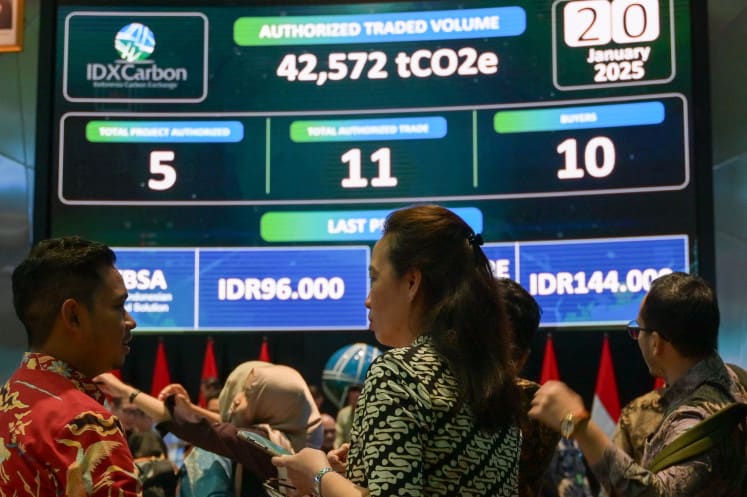
Indonesia's Energy and Mineral Resources Ministry wants to see carbon prices climb to $40 per tonne of CO2, an eightfold jump from the current $4-5 range. Yet the path to that figure depends less on government decree and more on constructing a functioning market with real consequences for non-compliance.
The target sits well below Europe's $100 per tonne under the EU Emissions Trading System, where two decades of strict caps and controlled allowance supply have created sustained price pressure. Indonesia's challenge is different: the country is still assembling the basic architecture of demand and liquidity that makes a carbon market work.
Demand Must Come First
Imaduddin Abdullah, director of international collaboration at the Institute for Development of Economics and Finance, frames the issue plainly. The price target should emerge from market formation, not be set in advance. "The most crucial factor is the creation of strong, consistent and mandatory demand," he said. "This requires increasingly stringent emission caps, an expansion of entities required to meet those caps and credible levies or consequences for non-compliance."
Without binding obligations on emitters, carbon credits remain optional purchases rather than necessities. That distinction determines whether prices rise on fundamentals or stall in a voluntary market where buyers can walk away.
Indonesia's current carbon trading activity remains thin. Prices in the $4-5 range reflect a market where few entities face hard limits on emissions and fewer still face penalties for exceeding them. Expanding the pool of regulated emitters and tightening the caps they operate under would shift that dynamic.
Two-Tier Pricing Likely
Imaduddin cautioned against expecting a uniform $40 price across all carbon units. High-integrity international credits or those carrying specific government authorisations might reach that level sooner, while domestic credits of varying quality could trade at a discount.
This segmentation is common in emerging carbon markets. Buyers pay premiums for credits tied to verifiable emission reductions or removals, especially when those credits can be used for international compliance or corporate net-zero claims. Domestic offsets without third-party validation or clear additionality tend to fetch lower prices.
Indonesia's ability to command higher prices will depend on the credibility of its supply. That means robust measurement, reporting and verification systems, transparent registries and safeguards against double-counting. The country has made progress on these fronts, but gaps remain, particularly in forestry and land-use projects where baseline emissions are harder to establish.
Europe's Model, Indonesia's Context
Direct comparisons with the EU market have limited value. Europe built its system over 20 years, weathering initial over-allocation, price crashes and multiple rounds of reform before reaching current price levels. Indonesia is in year two of mandatory carbon trading for power plants.
The EU's high prices reflect tight caps that decline each year, a market stability reserve that absorbs surplus allowances and political commitment to deeper emission cuts. Indonesia has yet to demonstrate the same level of regulatory consistency or willingness to impose costs on key industries.
Power generation, cement, steel and petrochemicals will need to face real compliance obligations if the domestic market is to develop. Voluntary corporate purchases and forestry offsets alone will not generate the liquidity or price discovery needed.
What Comes Next
Indonesia's carbon market trajectory will be shaped by decisions made in the next 18 months. The government must choose whether to expand the scope of regulated sectors, tighten existing caps and enforce penalties for non-compliance. Each step adds friction and cost for emitters, which is precisely the point.
The $40 target is achievable, but only if policymakers are willing to make carbon emissions expensive enough that companies invest in abatement rather than pay for credits. That requires political will and tolerance for short-term economic disruption in exchange for long-term climate and fiscal benefits.
Regional peers are watching. Thailand, Malaysia and the Philippines are all exploring carbon pricing mechanisms. Indonesia's experience, whether successful or stalled, will inform their designs. A credible Indonesian market could accelerate regional adoption; a weak one may discourage it.
For now, the gap between $5 and $40 remains wide. Closing it depends less on ministerial announcements and more on the unglamorous work of regulatory design, enforcement capacity and market oversight.
RELATED STORIES
Indonesia's Village Cooperatives Lack Capacity for Carbon Market Role
Siti Nuraini · 3 min
Indonesia's Palm Oil Zones Account for Bulk of Fire-Ravaged Land This Year
Siti Nuraini · 4 min

Indonesia Faces Tension Between Petrochemical Growth and Plastic Reduction Goals
Siti Nuraini · 4 min
Indonesia's Renewable Energy Capacity Faces AI Data Centre Test
Tran Quoc Bao · 3 min
Spot something wrong? Email editor@briefasia.com. We log every correction publicly.