Asia · Politics
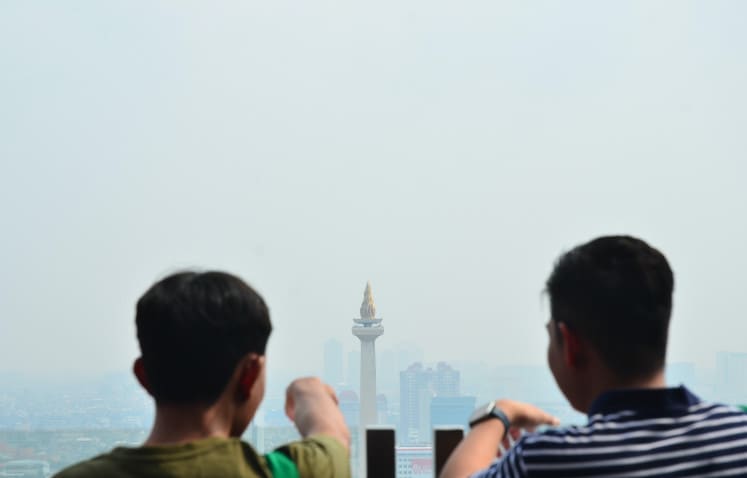
Greater Jakarta's Air Quality Crisis Exposes Regional Coordination Gap
As pollution crosses municipal boundaries, authorities struggle to implement unified response to escalating health and economic threats
KEY TAKEAWAYS
- ·Air pollution flows freely across Greater Jakarta's municipal boundaries while regulatory authority remains fragmented among separate local governments, leaving 35 million residents without coherent mitigation strategy.
- ·Rising respiratory illness rates and mounting economic losses from productivity declines, healthcare costs, and reduced business activity highlight the escalating toll of sustained poor air quality.
- ·Weak enforcement, incomplete monitoring networks, and absence of a regional air quality authority prevent effective response despite growing public pressure for integrated action across jurisdictions.
A Regional Problem Without Regional Solutions
Greater Jakarta's air quality has deteriorated into a cross-border crisis that local governments remain ill-equipped to address. Pollutants drift freely between Jakarta and neighboring cities in West Java and Banten provinces, yet administrative boundaries continue to fragment policy responses at precisely the moment coordination matters most.
The challenge stems from a fundamental mismatch between environmental reality and political structure. Air pollution recognizes no municipal limits, but regulatory authority does. Jakarta's environmental policies stop at its borders, while industrial emissions from Bekasi, vehicle exhaust from Tangerang, and construction dust from Bogor flow unimpeded into the capital's airshed.
This jurisdictional fragmentation leaves roughly 35 million residents across the metropolitan region exposed to hazardous air without a coherent mitigation strategy. Each local government operates within its own regulatory framework, setting different emission standards, enforcement priorities, and monitoring protocols.
The Health and Economic Toll
The consequences extend well beyond hazy skylines. Respiratory illness rates have climbed across the region, with hospital admissions for asthma and other pulmonary conditions showing sustained increases. Children and elderly residents face the highest risk, while outdoor workers endure prolonged exposure during peak pollution episodes.
Economic impacts compound the public health burden. Productivity losses from pollution-related illness, increased healthcare expenditures, and reduced labor efficiency impose costs that ripple through regional supply chains. The tourism sector registers declining visitor numbers during severe pollution events, while international businesses cite air quality as a factor in location decisions.
Agricultural areas on the metropolitan fringe report crop damage from airborne pollutants, adding rural economic stress to the predominantly urban crisis. The absence of comprehensive economic impact assessments leaves the full cost uncertain, but available data points to substantial and growing losses.
Sources and Drivers
Greater Jakarta's pollution stems from multiple, overlapping sources that vary by season and location. Vehicle emissions dominate in the urban core, where traffic congestion concentrates exhaust particulates. Industrial facilities clustered in Bekasi and Tangerang contribute heavy metals and chemical compounds. Construction activity across the expanding metropolitan footprint generates fugitive dust.
Seasonal factors amplify baseline pollution. The dry season reduces natural atmospheric cleansing, allowing pollutants to accumulate. Agricultural burning in surrounding rural areas periodically spikes particulate levels. Meteorological conditions trap emissions close to ground level during certain weather patterns.
The rapid pace of urbanization adds new sources faster than authorities can regulate them. Each year brings more vehicles, more factories, more construction sites, and more residents burning fuel for cooking and heating. Population density intensifies exposure even when absolute emission levels remain constant.
Policy Fragmentation and Enforcement Gaps
Efforts to address the crisis have foundered on administrative complexity and political inertia. Greater Jakarta spans multiple provincial and municipal jurisdictions, each with separate environmental agencies, budgets, and priorities. Attempts at voluntary coordination have produced memoranda of understanding but little operational integration.
Enforcement remains weak even where regulations exist. Monitoring networks provide incomplete coverage, making it difficult to identify violation sources or track pollution trends with precision. Penalties for exceeding emission limits rarely materialize, reducing deterrent effects. Industrial facilities and vehicle owners face minimal consequences for non-compliance.
The absence of a regional air quality management authority means no single entity holds responsibility for metropolitan-wide outcomes. Jakarta can restrict vehicle use within city limits, but cannot prevent polluting trucks from circling through neighboring jurisdictions before entering the capital. Bekasi can permit new factories that degrade air quality in Jakarta without bearing political accountability for the cross-border impact.
Pressure for Integrated Action
Public awareness has risen sharply as pollution episodes grow more frequent and severe. Social media amplifies real-time air quality data, making the problem harder to ignore or downplay. Middle-class residents increasingly demand action, while environmental advocacy groups push for systemic reform.
International attention adds external pressure. Jakarta's poor air quality rankings draw unfavorable comparisons to other Southeast Asian capitals and complicate efforts to attract foreign investment. Regional economic integration initiatives highlight the need for harmonized environmental standards.
The window for incremental adjustments may be closing. Without a fundamental shift toward integrated regional governance, Greater Jakarta risks becoming trapped in a cycle where pollution worsens faster than fragmented authorities can respond. The technical solutions exist, but implementation requires political will to transcend administrative boundaries and subordinate local prerogatives to regional imperatives.
Neighboring metropolitan regions offer potential models. Bangkok's air quality management board coordinates across provincial lines, while Singapore's transboundary haze agreements demonstrate the feasibility of cross-border environmental cooperation. Adapting such frameworks to Greater Jakarta's complex governance landscape represents the next critical test for Indonesian environmental policy.
RELATED STORIES
Indonesian Investment Climbs as Trade War Reshapes Asian Capital Flows
Siti Nuraini · 5 min
Indonesia Cuts State Funding for Nusantara as Private Investors Take Lead
Siti Nuraini · 3 min
Indonesia Plans to Restrict Subsidized Fuel by Vehicle Type
Siti Nuraini · 3 min
Indonesia Pushes for EU Trade Deal Signing Ahead of Year-End Tariff Cliff
Priyanka V. Rao · 3 min
Spot something wrong? Email editor@briefasia.com. We log every correction publicly.