Asia · Politics
Singapore and Vietnam Launch Strategic Dialogue on Talent and Technology
First bilateral forum under Comprehensive Strategic Partnership brings together senior officials to chart cooperation on innovation and capacity building
KEY TAKEAWAYS
- ·Singapore and Vietnam will hold their first strategic dialogue on August 25, co-chaired by Chan Chun Sing and Tran Cam Tu, focusing on talent development and technology cooperation.
- ·Vietnam's delegation includes five Politburo members, signaling high-level commitment to the partnership established in March 2025.
- ·Two agreements will emerge: a renewed study-visit arrangement for CPV officials and a joint statement on the Singapore-Vietnam Technology Connectivity Strategy.
High-Level Forum Anchors Bilateral Cooperation
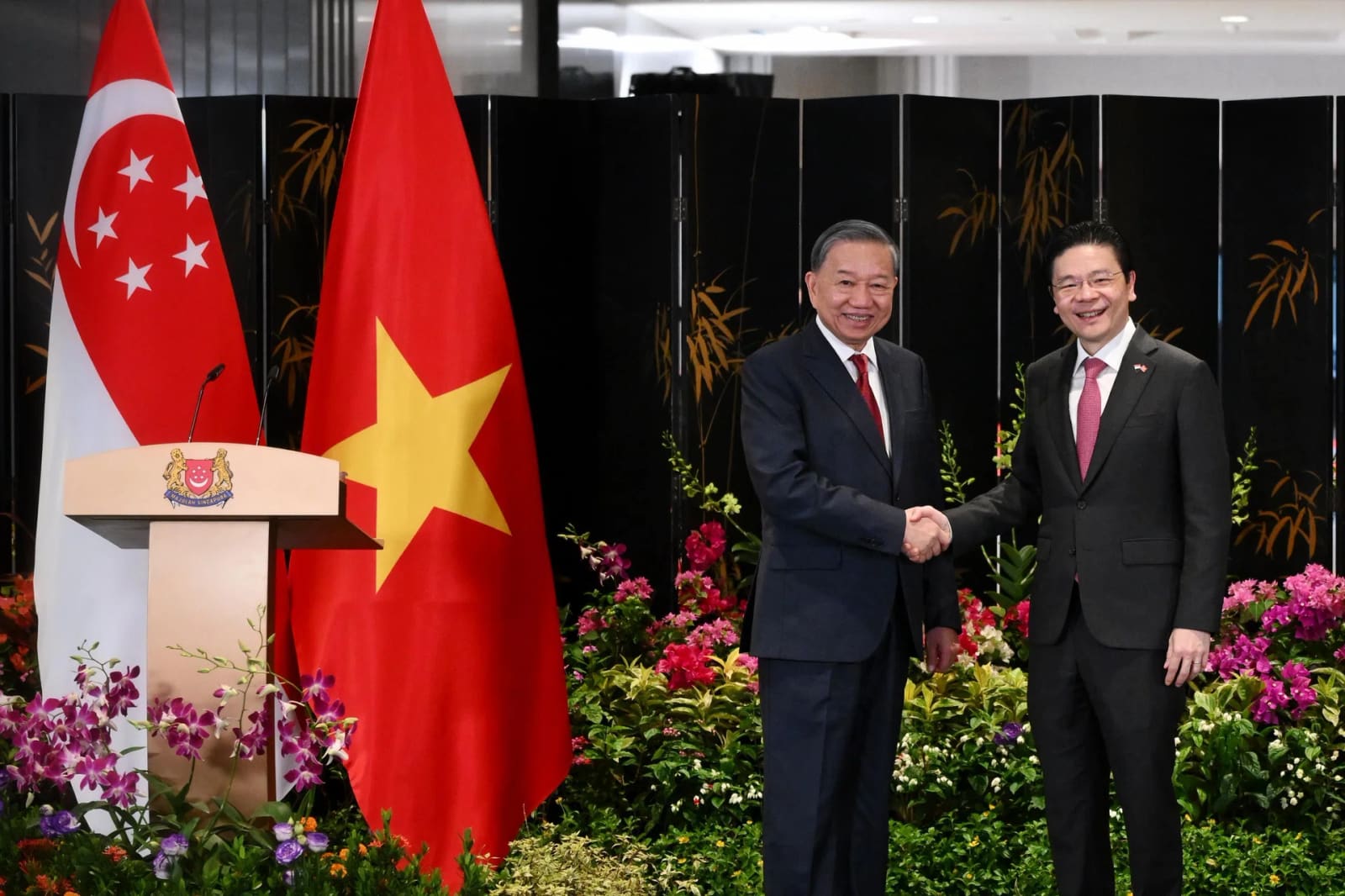
Singapore and Vietnam will hold their first strategic dialogue on August 25, bringing together political leaders and senior officials to discuss governance, leadership development, and public service transformation. The forum marks a concrete step in operationalizing the Comprehensive Strategic Partnership both countries established in March 2025.
Chan Chun Sing, Singapore's Coordinating Minister for Public Services and Defence, will co-chair the dialogue with Tran Cam Tu, Permanent Member of the Communist Party of Vietnam Central Committee Secretariat. The Public Service Division of Singapore and Vietnam's foreign affairs ministry are jointly organizing the event.
The dialogue theme centers on resilience and elevation of partnership for technology and capacity building. Discussions will unfold across two tracks: developing future-ready talent and building a new model for technology cooperation toward a shared innovation space.
Delegation Signals Priority
Vietnam's delegation underscores the importance Hanoi places on this engagement. Accompanying Tu will be five Politburo members and senior party officials, including Nguyen Duy Ngoc, head of the CPV Central Committee Organisation Commission, and Le Hoai Trung, Foreign Affairs Minister. Also attending are Nguyen Thanh Nghi, who leads the Policies and Strategies Commission, Doan Minh Huan from the Ho Chi Minh National Academy, and Vu Hai Quan, Minister of Science and Technology.
Singapore's contingent includes Foreign Affairs Minister Vivian Balakrishnan, Digital Development and Information Minister Josephine Teo, and Senior Minister of State Janil Puthucheary, who oversees education and sustainability portfolios. Minister of State for Defence Desmond Choo rounds out the team.
Tu will arrive in Singapore on August 24 for a two-day visit. His schedule includes separate meetings with President Tharman Shanmugaratnam and Prime Minister Lawrence Wong, as well as calls on Senior Minister K Shanmugam and Speaker of Parliament Seah Kian Peng.
Formalizing Cooperation Frameworks
Two agreements will emerge from the dialogue. The foreign affairs ministries of both countries will renew an existing arrangement on study visits by CPV officials, extending a program that facilitates knowledge exchange on governance and policy. A joint statement on the Singapore-Vietnam Technology Connectivity Strategy is also expected, though details on scope and implementation timeline have not been disclosed.
The technology connectivity strategy represents a shift from project-based collaboration to systemic integration. Both governments recognize that achieving scale in innovation requires harmonizing regulatory frameworks, aligning research priorities, and creating pathways for cross-border talent mobility.
Bilateral Momentum Since 2025
The strategic dialogue arrives amid sustained momentum in Singapore-Vietnam relations. Ties were elevated to Comprehensive Strategic Partnership status in March 2025 when To Lam, then general secretary and now president, visited Singapore. He returned in May 2026 for a state visit and delivered the keynote address at the Shangri-La Dialogue, becoming only the second Vietnamese leader to do so.
The partnership upgrade reflected convergence on multiple fronts. Both nations face pressure to move up the value chain in manufacturing, navigate technology competition between major powers, and manage transitions to digital economies. Singapore brings expertise in urban planning, financial services, and smart-city infrastructure, while Vietnam offers a large domestic market, a growing pool of engineering talent, and strategic location along critical supply chains.
The dialogue format allows both sides to address cooperation at a strategic level rather than through ad-hoc ministerial exchanges. By institutionalizing regular consultations, Singapore and Vietnam aim to align long-term planning cycles and identify opportunities that require multi-year commitments.
Regional Context
The timing of the dialogue is notable. Southeast Asian economies are recalibrating relationships with technology suppliers as geopolitical tensions reshape investment and trade flows. Vietnam has emerged as a beneficiary of supply-chain diversification, attracting semiconductor assembly, electronics manufacturing, and data-center investment. Singapore, meanwhile, positions itself as a hub for regional headquarters, research and development, and advanced services.
The focus on talent development acknowledges a shared constraint. Both countries face skills gaps in emerging technologies such as artificial intelligence, cybersecurity, and advanced manufacturing. By coordinating training programs and facilitating exchanges, they can pool resources and reduce duplication.
For Vietnam, deeper engagement with Singapore offers a template for public-sector modernization. Singapore's experience in digitalizing government services, managing large-scale infrastructure projects, and building meritocratic institutions holds appeal for Vietnamese officials navigating reform pressures. For Singapore, Vietnam represents a critical partner in ensuring regional stability and access to growth markets.
The strategic dialogue framework is designed to be iterative. Outcomes from this inaugural session will inform the agenda for subsequent meetings, creating a feedback loop that keeps cooperation aligned with evolving priorities.
RELATED STORIES
Singapore Pushes Back on US Tariff Expectations as Trade Tensions Reshape Global Order
Priyanka V. Rao · 3 min
Singapore Backs Autonomous Vehicle Rollout Despite Taxi Industry Disruption
Lim Hui Ying · 3 min
Singapore Plans Western Island Megaproject to Anchor Next-Generation Industries
Lim Hui Ying · 4 min
Singapore Rolls Out Expanded Benefits as Fertility Hits Record Low
Lim Hui Ying · 5 min
Spot something wrong? Email editor@briefasia.com. We log every correction publicly.