Technology · Products
Compal Bets on AI Servers With Triple-Digit Growth Target
Taiwan's contract manufacturer expects AI servers to reach 30-40% of revenue by next year as it expands capacity across Taoyuan, Vietnam, and Texas facilities
KEY TAKEAWAYS
- ·Compal Electronics expects AI servers to reach 30 to 40 percent of revenue by next year, up from 10 percent in 2026, with first-quarter server revenue at NT$10 billion.
- ·The company is expanding production across Taoyuan, Vietnam, and two Texas plants, targeting triple-digit annual growth in AI-related business for 2026 and 2027.
- ·Compal's new Taoyuan facility will produce Level 10 and Level 11 systems, with Level 11 shipments starting next quarter and full utilization expected by mid-2027.
Aggressive Expansion Across Three Markets
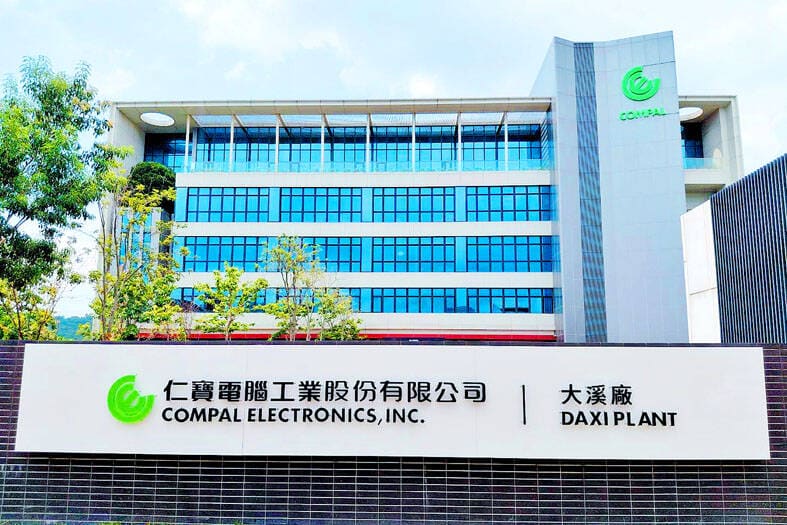
Compal Electronics inaugurated a new Taoyuan facility designed specifically for AI server research, development, and production, marking a sharp pivot toward high-margin infrastructure business. The plant features fully automated lines capable of producing Level 10 server systems and Level 11 rack assemblies, with revenue contribution expected from the fourth quarter of this year.
Chairman Ray Chen told reporters the company anticipates AI servers will represent 30 to 40 percent of total revenue by next year, a dramatic leap from roughly 10 percent in 2026. First-quarter server revenue reached NT$10 billion, accounting for just 5 percent of the company's overall sales.
The Taoyuan site is projected to hit full capacity utilization by the second half of next year, driven by strong demand from neocloud providers including GMI Cloud and Verda. Compal is evaluating additional capacity expansion within the Taoyuan area, though specifics on location and scale remain undecided.
Vietnam and Texas Plants Come Online
Beyond Taiwan, Compal is scaling operations in Vietnam and the United States. The company currently operates four surface-mount technology lines in Vietnam focused on Level 6 server node production, with plans to add six more lines. Construction of a second Vietnamese factory is nearing completion.
In Texas, Compal is building two facilities in Taylor and Georgetown designed to handle production from Level 6 through Level 11 rack-level integration. Trial runs are scheduled for the fourth quarter, with mass production beginning in the first quarter of 2027.
The Texas plants will primarily serve US hyperscalers and enterprise clients, while Taiwan-based production targets neocloud customers. Chen noted that some US clients are pushing for more localized manufacturing, prompting Compal to add Level 6 capacity in Texas rather than relying on shipments from Vietnam for final assembly.
Product Mix Shifts Toward Higher Tiers
Compal's AI server business currently centers on Level 10 products, but the company plans to begin Level 11 shipments next quarter. The shift toward higher-tier rack systems reflects growing customer demand for integrated solutions that can handle increasingly complex AI workloads.
The company is targeting triple-digit annual growth for AI-related business in both 2026 and 2027, a projection that underscores the rapid transformation of its revenue mix. This expansion comes as traditional PC demand faces headwinds from tight DRAM supply and rising component costs.
PC Business Navigates Supply Constraints
Global PC shipments are forecast to decline 10 to 12 percent year-on-year in 2026, according to International Data Corp. Chen acknowledged that DRAM supply constraints are likely to persist into next year, but noted that rising component costs are pushing up average selling prices. As a result, Compal's PC revenue may not fall at the same rate as unit shipments.
The company's multi-region manufacturing strategy allows it to serve different customer segments with tailored production models. Taiwan handles neocloud orders requiring faster iteration cycles, while the Texas facilities position Compal to meet localization requirements from US hyperscalers concerned about supply chain resilience.
Compal's capacity buildout reflects a broader trend among Taiwan's contract manufacturers, which are diversifying revenue streams away from traditional PC and notebook assembly toward higher-value infrastructure products. The AI server market remains supply-constrained, with lead times stretched as customers compete for limited production slots at a handful of qualified suppliers.
The company's ability to deliver integrated rack-level systems, rather than just individual server nodes, provides a competitive advantage in capturing orders from hyperscalers that prefer turnkey solutions. As AI model training and inference workloads continue to scale, demand for specialized server infrastructure is expected to outpace broader IT hardware markets through the end of the decade.
RELATED STORIES
Taiwan's AI Server Supply Chain Reports Record July Revenue
Cheng Wei-Lun · 2 min
Foxconn's Foxtron Lands Mitsubishi EV Deal, Expands Taiwan Manufacturing Footprint
Cheng Wei-Lun · 5 min

British Semiconductor Delegation Heads to SEMICON Taiwan Seeking Strategic Partnerships
Cheng Wei-Lun · 2 min
Sony and TSMC Plot $6.3 Billion Image Sensor Plant in Southern Japan
Cheng Wei-Lun · 3 min
Spot something wrong? Email editor@briefasia.com. We log every correction publicly.