Technology · AI
Chinese Humanoid Robots Now Jump Higher and Run Faster Than Olympic Athletes
Unitree's Superman model clears two meters and sprints at 12.66 m/s, but commercial viability still hinges on AI breakthroughs expected within five years
KEY TAKEAWAYS
- ·Unitree Robotics' Superman humanoid model jumps two meters high and runs at 12.66 meters per second, exceeding human athletic records ahead of the company's Shanghai IPO this week.
- ·A senior Unitree executive estimates the robotics industry's AI breakthrough moment is still two to five years away, limiting current applications to pre-programmed tasks in research and education.
- ·Asian manufacturing sites are identified as the most immediate deployment opportunity, with longer-term applications extending to logistics warehouses and caregiving services as physical AI capabilities mature.
Physical Prowess Meets the AI Gap
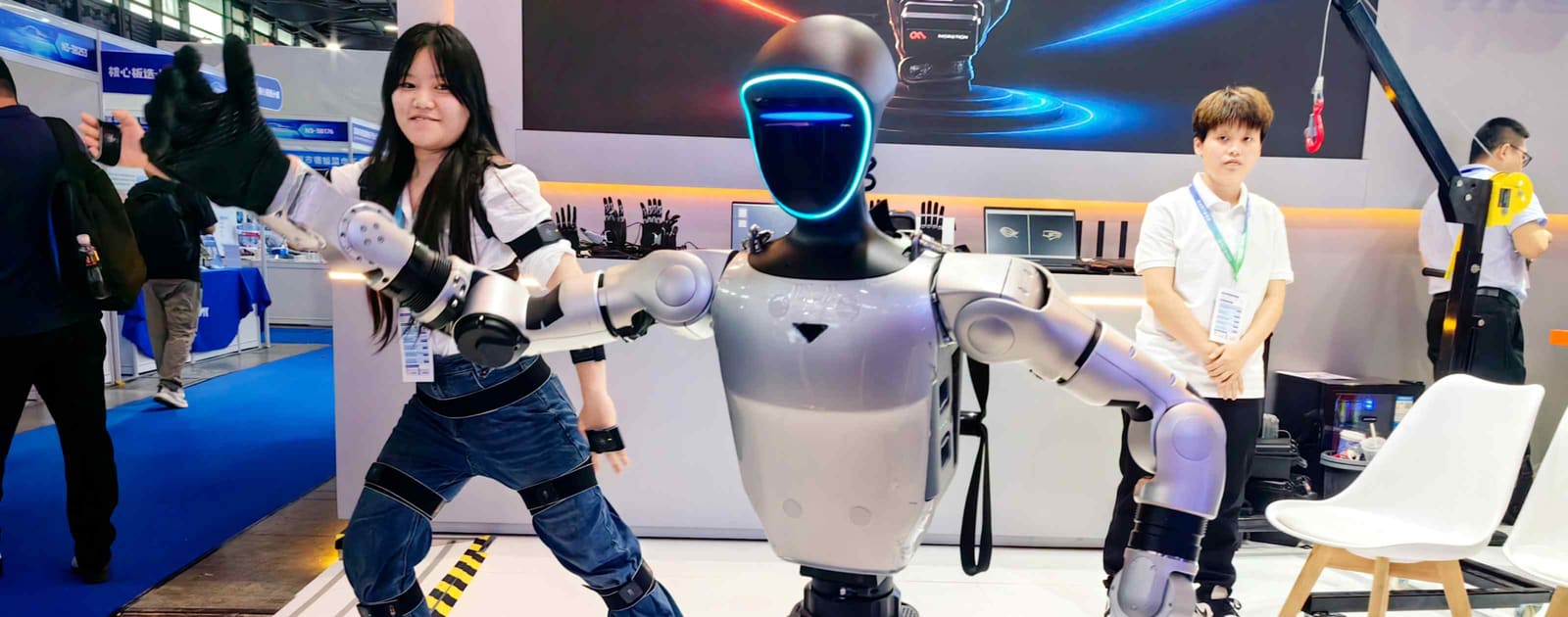
Unitree Robotics unveiled its Superman humanoid model this week, demonstrating a vertical jump of approximately two meters and a top running speed of 12.66 meters per second. Both figures exceed human world records for standing high jump and running velocity. The Hangzhou-based company disclosed the specifications ahead of its initial public offering on the Shanghai Stock Exchange, scheduled for Wednesday.
The Superman model represents the latest milestone in a rapid escalation of humanoid robot capabilities concentrated among Chinese manufacturers. AgiBot Innovation, another domestic startup, recently deployed a humanoid to perform choreographed dance routines at an industry forum in Bangkok last month. Unitree's performance benchmarks signal that robotics development has moved beyond replicating basic human motion to surpassing elite athletic thresholds.
Yet the hardware advances have outpaced the software required to make them useful. A senior Unitree executive told attendees at a Tokyo industry event last month that the robotics sector has not yet experienced its "GPT moment," the breakthrough that would allow artificial intelligence to control physical machines with the fluency ChatGPT demonstrates in virtual environments. The executive estimated that timeline at two to five years.
Revenue Concentrated in Research, Not Industry
Unitree's current revenue streams reflect the commercial limitations of pre-programmed robotics. The company generates the majority of its income from research institutions and educational customers, with industrial sales remaining a minor share. Without adaptive AI capable of responding to unpredictable real-world conditions, humanoid applications remain confined to controlled environments and scripted tasks.
The dual challenge facing Chinese humanoid manufacturers is clear: drive down hardware costs through volume production while simultaneously accelerating the development of intelligent control systems. Mass production can reduce per-unit costs, but without capable AI, demand will stay constrained to niche academic and demonstration use cases.
AgiBot executives identified Asian manufacturing facilities as the most immediate deployment opportunity. The region's labor-intensive production lines, combined with rising wage pressures in economies like China and Thailand, create economic incentives for automation. Humanoid form factors offer advantages in environments designed for human workers, eliminating the need for facility redesigns that specialized industrial robots often require.
From Warehouses to Caregiving
Beyond factory floors, logistics centers represent another near-term application. Humanoids could handle picking, sorting, and packing tasks in fulfillment warehouses, where e-commerce growth continues to strain human workforce capacity. The ability to navigate spaces built for people, manipulate diverse objects, and climb stairs or ladders makes humanoid robots more versatile than wheeled or fixed automation.
Longer-term scenarios extend into caregiving and companionship services. Japan and South Korea face acute demographic pressures, with aging populations and shrinking workforces creating demand for elder care support. Humanoids capable of assisting with mobility, medication management, and daily living tasks could address labor shortages in care facilities and private homes.
The World Robot Conference, which opened in Beijing on Wednesday, featured demonstrations across these application categories. Exhibitors showcased robots performing assembly tasks, navigating obstacle courses, and interacting with human participants through natural language interfaces. The annual event has become a barometer for China's robotics ambitions, with both state-backed research institutes and private startups competing to demonstrate technical progress.
The AI Integration Timeline
Physical AI, the convergence of robotics hardware with advanced machine learning, remains the critical bottleneck. Current humanoid robots execute pre-programmed sequences or operate within narrow parameters defined by human operators. True autonomy requires perception systems that interpret visual and sensor data in real time, decision-making algorithms that adapt to novel situations, and control systems that translate high-level intentions into precise motor commands.
The comparison to large language models is deliberate. ChatGPT and similar systems achieved breakthrough performance by training on massive datasets and leveraging transformer architectures that capture complex patterns. Physical AI requires analogous training regimes, but in three-dimensional space with consequences for errors. Simulation environments can accelerate learning, but transferring skills from virtual training to real-world deployment remains an active research problem.
Unitree's two-to-five-year estimate for a robotics GPT moment aligns with broader industry timelines. Companies including Tesla, Figure AI, and Boston Dynamics are pursuing similar integration efforts, combining proprietary hardware with foundation models adapted for embodied intelligence. The race is both technical and commercial: the first company to achieve reliable, general-purpose humanoid intelligence will capture early-mover advantages in manufacturing, logistics, and service sectors.
Regulatory and Social Dimensions
As humanoid capabilities approach and exceed human performance across physical and cognitive dimensions, regulatory frameworks will need to address liability, safety standards, and labor market impacts. Asian governments have taken varied approaches: China has prioritized industrial policy support and export promotion, Japan emphasizes safety certification and human-robot collaboration standards, and South Korea focuses on public acceptance and ethical guidelines.
The manufacturing deployment pathway favored by Chinese robotics firms sidesteps some consumer safety concerns by targeting industrial environments with trained personnel. However, as applications expand into public-facing roles, questions about accountability for robot actions, data privacy in sensor-rich environments, and employment displacement will intensify.
Unitree's IPO will provide a market test of investor appetite for humanoid robotics at scale. The company's valuation and post-listing performance will signal whether capital markets believe the AI integration timeline is credible and the addressable market is large enough to justify current development costs. For now, Superman can outjump and outrun humans, but it still needs a human to tell it where to go.
RELATED STORIES

Alibaba Profit Drops 76% as AI Infrastructure Push Drives Capex to $9.3 Billion
Cheng Wei-Lun · 4 min

Nissan Streamlines Development to Match Chinese Rivals' Speed
Cheng Wei-Lun · 3 min
Alibaba Advances In-House Chip Push with Second-Generation T-Head Production Timeline
Cheng Wei-Lun · 3 min
Chinese Automakers Pivot to Humanoid Robots as EV Subsidies Fade
Cheng Wei-Lun · 2 min
Spot something wrong? Email editor@briefasia.com. We log every correction publicly.