Asia · Trade
Thailand and New Zealand Set $8 Billion Trade Target Under New Partnership
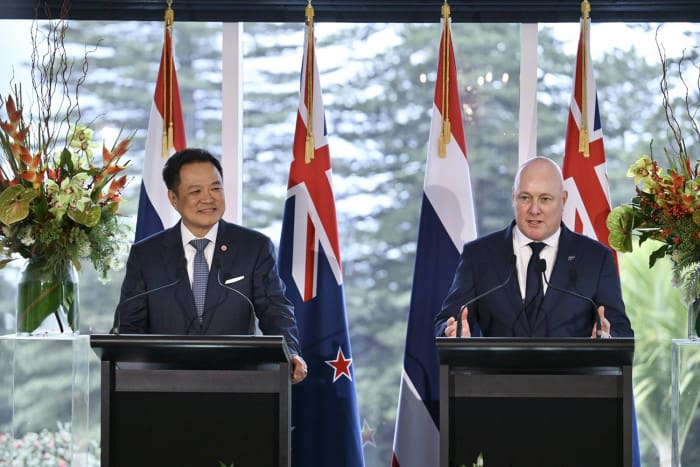
Prime ministers Anutin Charnvirakul and Christopher Luxon formalize strategic ties with plan to triple bilateral trade by 2045
KEY TAKEAWAYS
- ·Thailand and New Zealand formalized a strategic partnership with a target to triple bilateral trade to $8 billion by 2045.
- ·Prime Minister Anutin Charnvirakul met with New Zealand Prime Minister Christopher Luxon in Auckland to finalize the agreement.
- ·The partnership reflects Thailand's strategy to diversify trade relationships beyond mainland Asia and strengthen ties with Pacific economies.
A Pacific-Rim Pivot
Thailand and New Zealand formalized a strategic partnership on Friday that sets an ambitious goal of tripling two-way trade flows to $8 billion by 2045, according to a joint statement issued following talks in Auckland between Prime Minister Anutin Charnvirakul and his New Zealand counterpart Christopher Luxon.
The agreement signals Bangkok's continued effort to diversify its trade relationships beyond traditional partners in mainland Asia, tapping into the Pacific economies as geopolitical realignments reshape supply chains across the region. For New Zealand, the partnership offers deeper access to Southeast Asian markets at a time when its agricultural and dairy exporters are seeking alternatives to Chinese demand volatility.
The Numbers Behind the Ambition
Current bilateral trade between the two countries sits well below the $8 billion target, meaning the partnership envisions a threefold expansion over the next two decades. Thailand's exports to New Zealand have historically centered on automotive parts, electronics, and processed food, while New Zealand ships dairy products, meat, and timber in the opposite direction.
The 2045 timeline reflects a patient approach, allowing both governments to build infrastructure, harmonize regulatory frameworks, and cultivate business networks without the pressure of short-term benchmarks. It also acknowledges that significant trade expansion requires more than political declarations; it demands investment in logistics, standards alignment, and market access reforms that take years to mature.
Regional Context
The partnership arrives as Thailand recalibrates its foreign policy under the Anutin administration, which has prioritized economic pragmatism and hedging strategies. While Thailand remains embedded in ASEAN supply chains and maintains close ties with China, the government has signaled interest in strengthening relationships with middle-power democracies in the Indo-Pacific, including Japan, South Korea, Australia, and now New Zealand.
New Zealand, for its part, has been active in Southeast Asia through the Comprehensive and Progressive Agreement for Trans-Pacific Partnership and various bilateral free trade agreements. The strategic partnership with Thailand builds on that foundation, adding a political dimension to existing economic links.
What the Partnership Entails
Details of the strategic partnership beyond the trade target remain sparse, but such frameworks typically encompass cooperation in multiple domains: trade facilitation, investment promotion, education exchanges, and occasionally defense and security dialogues. The joint statement issued in Auckland did not specify sectoral priorities or immediate policy changes, suggesting the partnership will unfold through working groups and ministerial consultations in the coming months.
Thailand's delegation to Auckland included officials from the Commerce Ministry and the Board of Investment, indicating that the government views the partnership as an economic growth lever rather than a purely diplomatic gesture. New Zealand's trade ministry has long sought to deepen engagement with ASEAN's second-tier economies, where growth potential remains high and competition from larger exporters is less intense.
Market Implications
For Thai exporters, the partnership could ease non-tariff barriers and streamline customs procedures, making New Zealand a more attractive destination for value-added goods. New Zealand's dairy and agricultural sectors, already competitive globally, stand to benefit from clearer market access rules and potential reductions in regulatory friction.
The $8 billion target also sets a benchmark that both governments will use to measure progress, creating accountability and a focal point for business lobbying. Whether the figure is realistic depends on factors largely outside the control of either government, including global commodity prices, currency fluctuations, and the trajectory of regional trade agreements.
Next Steps
The partnership will be tested by implementation. Thailand and New Zealand will need to translate the Auckland announcement into concrete policy measures, investment treaties, and sectoral agreements. The involvement of private-sector stakeholders, particularly chambers of commerce and industry associations, will determine whether the threefold trade expansion is achievable or remains an aspirational headline.
Both countries have a track record of steady, incremental trade diplomacy. The strategic partnership formalizes that approach and gives it a longer time horizon, betting that sustained engagement over two decades can reshape bilateral economic ties in ways that short-term deals cannot.
RELATED STORIES

Thailand Targets Four Strategic Priorities Amid Global Trade Volatility
Priyanka V. Rao · 3 min

Delta Electronics Thailand Hits $100 Billion Market Cap Milestone
Priyanka V. Rao · 4 min

Thailand Posts Slowest Growth Among Southeast Asia's Six Largest Economies
Cheng Wei-Lun · 2 min

Thailand Must Prioritize Speed and Focus to Compete for Global Investment
Priyanka V. Rao · 3 min
Spot something wrong? Email editor@briefasia.com. We log every correction publicly.