Asia · Trending
Thailand Posts Slowest Growth Among Southeast Asia's Six Largest Economies
Energy shocks and subdued consumption dragged GDP expansion to 1.9% in Q2, trailing Vietnam, Singapore, Malaysia, Indonesia, and the Philippines despite emergency stimulus measures.
KEY TAKEAWAYS
- ·Thailand's GDP expanded 1.9% year-on-year in Q2 2026, the slowest among Southeast Asia's six largest economies and down from 2.8% in Q1.
- ·Vietnam led regional growth at 8.39%, followed by Singapore at 5.9%, Malaysia at 5.8%, Indonesia at 5.29%, and the Philippines at 2.3%.
- ·Energy price shocks linked to Middle East supply disruptions and subdued domestic demand offset the impact of 400 billion baht in government stimulus spending.
Regional Divergence Widens
Thailand recorded the weakest economic expansion among Southeast Asia's six largest economies in the second quarter, as energy market volatility and cautious consumer spending undermined government attempts to accelerate recovery.
GDP rose 1.9% year-on-year in the three months through June, a sharp deceleration from the 2.8% pace recorded in the first quarter, according to the National Economic and Social Development Council. The figure placed Thailand firmly at the bottom of the regional growth table, trailing even the Philippines' 2.3% expansion.
Vietnam led the pack with 8.39% growth, followed by Singapore at 5.9%, Malaysia at 5.8%, and Indonesia at 5.29%. The performance gap underscores Thailand's struggle to regain momentum in a region otherwise enjoying robust post-pandemic trajectories.
Stimulus Fails to Counter Headwinds
The slowdown arrived despite Prime Minister Anutin Charnvirakul's administration deploying 400 billion baht in emergency borrowing to fund direct cash transfers and energy-transition infrastructure projects. The stimulus package, designed to jumpstart household consumption and accelerate the shift away from fossil fuels, has yet to translate into measurable growth.
Thailand's heavy reliance on imported oil and gas, much of it sourced from the Middle East, left the economy exposed to supply chain disruptions linked to the Iran conflict. Energy prices climbed during the quarter, squeezing both household budgets and business margins.
Domestic demand, traditionally a pillar of Thai economic activity alongside tourism, remained subdued. Higher energy costs filtered through to consumer spending patterns, dampening retail activity and service sector performance. Tourism receipts, while recovering, failed to offset the drag from elevated operating costs across hospitality and transport industries.
Policy Rate Held Steady
The Bank of Thailand kept its benchmark policy rate unchanged at a near four-year low in June, signaling confidence that the economy had reached its trough in the second quarter. Central bank officials pointed to easing Middle East tensions and the phased rollout of government stimulus as factors likely to support a rebound in the third quarter.
The National Economic and Social Development Council maintained its full-year growth forecast at 2% to 2.5% for 2026, a projection that places Thailand well below its regional peers. Vietnam is targeting 10% GDP growth this year, while Singapore recently revised its outlook upward to 4.5%-5.5%, lifted by stronger-than-expected second-quarter manufacturing and financial services activity.
Structural Questions Resurface
Thailand's persistent underperformance relative to its neighbors has renewed scrutiny of structural constraints beyond cyclical energy shocks. The kingdom has grappled with sluggish productivity gains, uneven infrastructure investment, and political uncertainty that has historically deterred long-term capital commitments.
While emergency fiscal measures can provide short-term relief, the current growth gap suggests deeper challenges in competitiveness and economic dynamism. Regional manufacturing hubs like Vietnam and Malaysia have attracted supply chain diversification flows, while Singapore continues to consolidate its position as the financial and logistics nerve center of Southeast Asia.
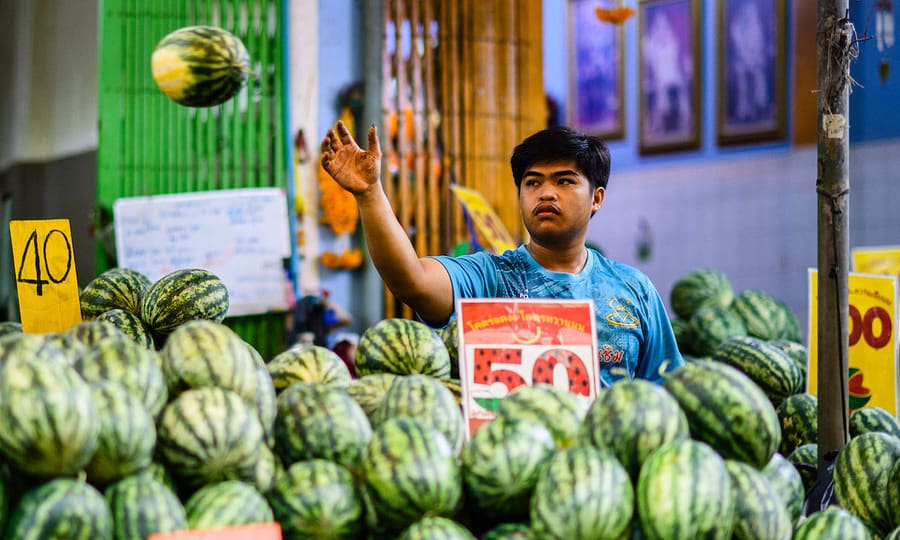
Thailand's agriculture and wholesale sectors, visible in Bangkok's bustling markets, have faced margin pressure as input costs rise faster than output prices. The combination of external energy dependence and limited export diversification leaves the economy vulnerable to commodity price swings and geopolitical disruptions.
Investors and policymakers will be watching third-quarter data closely to assess whether the central bank's optimism proves justified, or if Thailand's growth malaise extends into the latter half of the year.
RELATED STORIES
Thailand's Economy Faces Sharp Deceleration Amid Consumption Crunch
Priyanka V. Rao · 3 min

Thailand Targets Four Strategic Priorities Amid Global Trade Volatility
Priyanka V. Rao · 3 min
Thailand Regulator Drafts 20 Measures to Curb Retail Power Over Suppliers
Priyanka V. Rao · 3 min

Thailand Must Prioritize Speed and Focus to Compete for Global Investment
Priyanka V. Rao · 3 min
Spot something wrong? Email editor@briefasia.com. We log every correction publicly.