Asia · Business
Chinese Agriculture Equipment Makers Eye Vietnam Mechanization Push
Business leaders highlight efficiency gains and competitive advantages as Vietnam's farming sector accelerates shift away from manual labor
KEY TAKEAWAYS
- ·Chinese agricultural equipment manufacturers are targeting Vietnam's mechanization push, which aims to reach 80 percent mechanization in rice cultivation by 2030 from 60 percent currently.
- ·Machinery adoption cuts harvest time from weeks to days and reduces grain losses from 10-15 percent to below 3 percent while addressing rural labor shortages.
- ·Chinese equipment makers offer combine harvesters priced at $15,000-25,000 compared to $40,000-60,000 for Japanese models, with government subsidies covering 30-50 percent of costs for cooperatives.
Growing Mechanization Demand
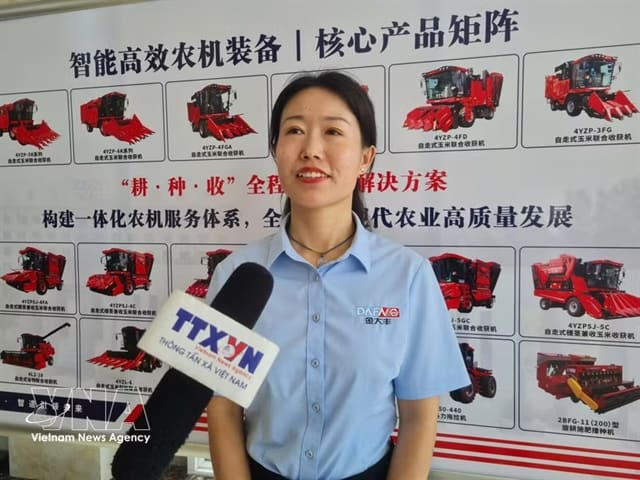
Chinese agricultural equipment manufacturers are identifying Vietnam as a priority market for mechanization partnerships, driven by the Southeast Asian nation's need to modernize rice production and reduce dependence on manual farm labor.
Industry executives emphasize that machinery adoption delivers tangible operational improvements across Vietnam's agricultural value chain. Equipment deployment cuts labor requirements while simultaneously raising output per hectare, compressing the time between planting and harvest, and minimizing crop losses during post-harvest handling.
Vietnam's position as one of Asia's largest rice exporters creates particular urgency around mechanization. The country shipped approximately 8 million metric tons of rice in 2025, making it the world's third-largest exporter after India and Thailand. Maintaining and expanding that export position requires productivity gains that manual farming methods cannot deliver at scale.
Efficiency Imperatives
The business case for mechanization centers on measurable productivity metrics. Mechanical transplanters can cover five to seven hectares per day compared to manual planting rates of 0.1 to 0.2 hectares per worker. Combine harvesters reduce rice harvest time from weeks to days while cutting grain losses from 10-15 percent to below 3 percent.
Labor availability adds pressure to the mechanization equation. Vietnam's rural workforce is aging, with younger generations migrating to manufacturing and service sectors in urban centers. The average age of Vietnamese farmers now exceeds 50 years, creating structural labor shortages during peak planting and harvest seasons.
Chinese equipment makers bring relevant experience from their home market, where mechanization rates in rice production reached 85 percent by 2024. That expertise translates into machinery designs suited to Asian smallholder farm sizes, typically between 0.5 and 2 hectares in Vietnam's Mekong Delta rice belt.
Quality and Competitiveness
Product quality improvements represent another mechanization dividend. Uniform planting depth and spacing enabled by machinery produce more consistent crop stands, while precision harvesting equipment reduces grain damage and foreign matter contamination. These quality enhancements matter for export markets where Vietnamese rice competes on specifications and price.
Vietnam's Ministry of Agriculture and Rural Development has set a target for 80 percent mechanization in rice cultivation by 2030, up from approximately 60 percent in 2025. Achieving that goal requires significant equipment investment, estimated at $2-3 billion over the five-year period.
Chinese manufacturers hold competitive advantages in price positioning relative to Japanese and South Korean equipment brands that currently dominate Vietnam's premium machinery segment. Chinese-made combine harvesters typically retail at $15,000-25,000 compared to $40,000-60,000 for comparable Japanese models, making them accessible to farmer cooperatives and medium-scale operators.
Regional Agricultural Technology Flows
The Vietnam opportunity fits within broader Chinese agricultural equipment export growth across Southeast Asia. Chinese machinery exports to ASEAN countries grew 23 percent year-on-year in 2025, reaching $1.8 billion, according to China Chamber of Commerce for Import and Export of Machinery and Electronic Products data.
Thailand, Indonesia, and the Philippines represent additional markets where Chinese firms are pursuing similar mechanization partnerships. Regional rice production dynamics create common challenges around labor costs, climate resilience, and export competitiveness that mechanization addresses.
Vietnam's government provides purchase subsidies covering 30-50 percent of equipment costs for registered farmer cooperatives, creating favorable conditions for machinery adoption. Provincial authorities in the Mekong Delta have established demonstration farms showcasing mechanized cultivation techniques to encourage broader uptake.
The mechanization trajectory carries implications for Vietnam's agricultural trade balance. Higher productivity and quality consistency could support premium positioning in export markets, while reduced production costs improve margins for farmers and exporters facing price competition from India and Pakistan.
Chinese equipment manufacturers are establishing service networks and spare parts distribution channels in Vietnam to support post-sale maintenance, addressing a historical weakness that limited earlier Chinese machinery adoption. Local partnerships with Vietnamese agricultural input distributors provide market access and customer relationships that pure export models cannot match.
The shift toward mechanized farming represents a structural transition in Vietnam's agricultural economy, with implications for rural employment patterns, land consolidation trends, and the country's position in regional rice trade. Chinese firms positioning themselves as technology partners in that transition are betting on sustained demand growth over the coming decade.
RELATED STORIES
Shein Retreats From Vietnam Warehouse Bet as China Manufacturing Proves Irreplaceable
Cheng Wei-Lun · 4 min
Shein Scales Back Vietnam Expansion, Reinforces China Manufacturing Base
Cheng Wei-Lun · 3 min

Manila Eyes Nickel Processing to Escape China's Price Control
Priyanka V. Rao · 4 min
China's Consumer Prices Rise at Slowest Pace in Seven Months
Cheng Wei-Lun · 4 min
Spot something wrong? Email editor@briefasia.com. We log every correction publicly.