Asia · Trade
Manila Eyes Nickel Processing to Escape China's Price Control
Philippine ambassador argues Pax Silica membership could end raw ore exports and shift value capture onshore, as China buys 92% of the country's nickel at near-dictated rates.

KEY TAKEAWAYS
- ·The Philippines exports 92% of its nickel ore to China, where buyers set prices with limited negotiation power for Manila.
- ·Philippine Ambassador Romualdez estimates Pax Silica could bring $200 billion to $300 billion in investment over 20 to 30 years if the country processes ore domestically.
- ·Economists warn that low mining taxes and lack of technology transfer guarantees may limit the benefits even if processing moves onshore.
Breaking the Ore Export Trap
The Philippines sends roughly 92% of its nickel ore to China, where buyers set prices with little pushback from Manila. That lopsided relationship is now the central economic argument for joining Pax Silica, the US-led technology and critical minerals coalition that has drawn both interest and skepticism across Southeast Asia.
Philippine Ambassador to the United States Jose Manuel Romualdez framed the issue in stark terms during a television interview. China holds what he described as a near-monopoly on Philippine nickel, purchasing the bulk of shipments at prices the country has limited power to negotiate. Pax Silica, he argued, would enable the Philippines to process ore domestically rather than ship it raw, capturing more value and reducing dependence on a single buyer.
Romualdez estimated the initiative could attract between $200 billion and $300 billion in investment over the next two to three decades, generating millions of jobs in processing and downstream manufacturing. The proposed hub at New Clark City in Tarlac province would anchor semiconductor and mineral supply chains, with nickel processing as a key pillar.
Shipment data covering 2020 to 2024, compiled by Climate Rights International and Empower, confirms the scale of the imbalance. More than nine in ten nickel ore cargoes leaving Philippine ports during that period were bound for China, underscoring the concentration risk in the country's export structure.
A Step Forward, With Caveats
The shift from raw ore exports to onshore processing is not a new aspiration. Indonesia banned raw nickel exports in 2020 to build its own refining capacity, though that pivot has brought its own dependencies, particularly on Chinese capital and technology. Vietnam followed suit in late 2025, prohibiting raw rare earth exports to strengthen its position in the supply chain.
The Philippines has moved more slowly. A Senate bill that would have phased out raw ore exports by 2030 was stripped of that provision in mid-2025 after mining industry groups objected. The country remains one of the world's largest nickel ore exporters but processes almost none of it at home.
Economist Cielo Magno, a former undersecretary at the Department of Finance, has cautioned that processing alone will not solve the problem if the government continues to charge some of the region's lowest mining taxes and royalties. Without stronger fiscal terms, Manila risks ceding value even as it moves up the supply chain, she argued.
Scientists' group AGHAM has raised a separate concern, noting that the Pax Silica framework includes no explicit guarantees of technology transfer to Filipino engineers or firms. That could leave the country reliant on foreign operators for both capital and expertise, limiting the long-term industrial benefits.
Geopolitical Pressure and Domestic Opposition
Farm groups have voiced opposition to the proposed New Clark City hub, warning that the 4,000-acre footprint could displace agricultural and fishing communities. The site selection has become a flashpoint in a broader debate over land use and the trade-offs between industrial development and food security.
Romualdez acknowledged the geopolitical dimension but rejected the idea that Pax Silica forces a binary choice between Washington and Beijing. He described the framing as a "misnomer," though he conceded there is truth to the view that the initiative is part of a broader US strategy to counter China's dominance in artificial intelligence and semiconductor supply chains.
Pressed on whether the Philippines can maintain an independent foreign policy, the ambassador said the country has "very little choice" but to align with the United States, citing ongoing territorial disputes in the West Philippine Sea. He contrasted China's assertiveness in the maritime domain with the historical partnership between Manila and Washington.
The agreement will likely require legislative approval, meaning full congressional debate before implementation. Romualdez said he has seen only a broad outline of the deal so far, with key details still under negotiation.
Regional Competition for Investment
The ambassador also signaled urgency, noting that Vietnam, Malaysia, and Indonesia are all positioning themselves to host elements of the Pax Silica network. He suggested that competing governments may have already offered more attractive terms to Washington and warned that the Philippines risks being left behind if it moves too slowly.
That competitive dynamic reflects a broader pattern in Southeast Asia, where governments are racing to attract investment in semiconductors, battery materials, and other critical technologies. The region's mineral endowments, relatively lower labor costs, and proximity to key markets make it a natural candidate for supply chain diversification, but policy execution remains uneven.
For the Philippines, the calculus hinges on whether Pax Silica can deliver tangible benefits in processing capacity, job creation, and fiscal revenue, or whether it simply reconfigures dependence without addressing the structural issues that have kept the country locked into raw material exports. The debate is far from settled, and the legislative process ahead will test how much political capital the government is willing to spend on a deal that is as much about geopolitics as it is about economics.
RELATED STORIES
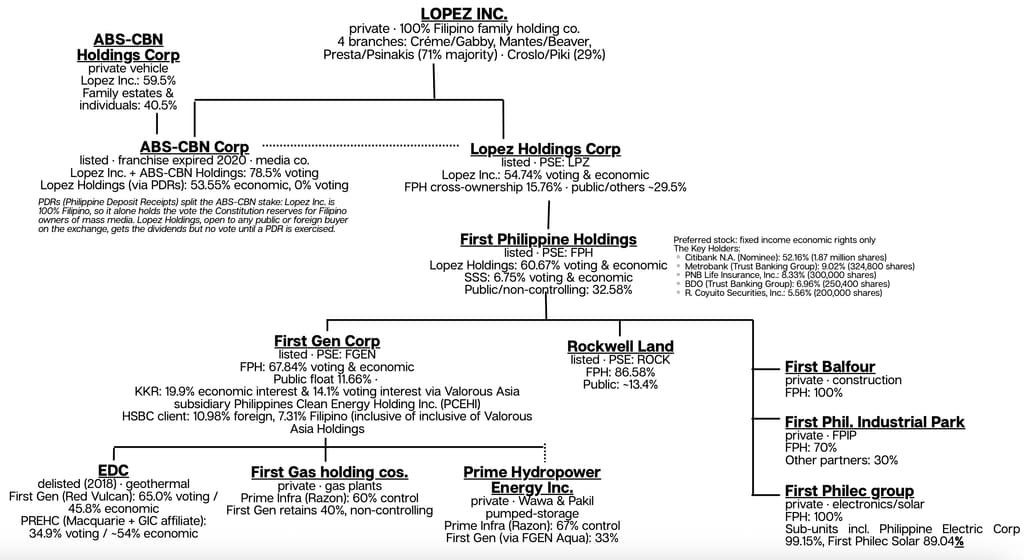
San Miguel's Ramon Ang Takes Quarter Stake in Lopez Holding Company
Priyanka V. Rao · 5 min
San Miguel's Ramon Ang Enters Lopez Family Holding Amid Boardroom Battle
Priyanka V. Rao · 3 min
Philippines SEC and BIR Launch Unified Filing Portal to Cut Compliance Burden
Priyanka V. Rao · 4 min
Philippines Halts Meat Imports from Seven Middle East and Mediterranean Nations
Priyanka V. Rao · 3 min
Spot something wrong? Email editor@briefasia.com. We log every correction publicly.