Asia · Business
San Miguel's Ramon Ang Takes Quarter Stake in Lopez Holding Company
After years of chasing media deals that never closed, the Philippine tycoon quietly acquired 25.68% of the private entity controlling ABS-CBN, First Gen, and Rockwell Land.
KEY TAKEAWAYS
- ·Ramon Ang purchased 25.68% of Lopez Inc. on August 10 from the branch led by Eugenio Lopez III, securing his first entry into the Lopez Group after a decade of unsuccessful media acquisition attempts.
- ·San Miguel Global Power and First Gen operate competing power strategies, with Ang's 5,057 megawatts skewing toward coal and gas while First Gen adopted a formal no-coal policy in 2016 and targets 13 gigawatts of renewable capacity by 2030.
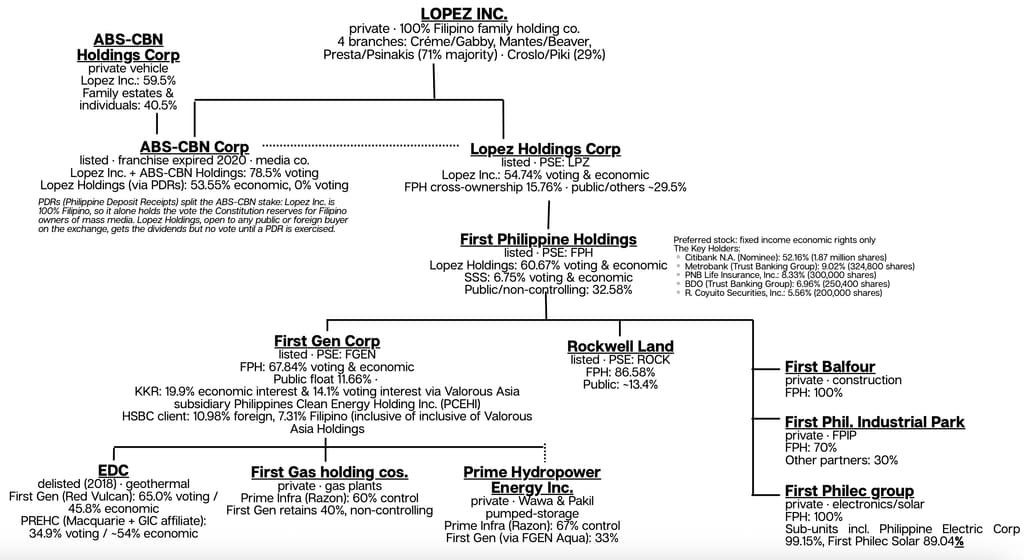
- ·Lopez Inc. retains voting control across its subsidiaries despite economic dilution to roughly 10% in EDC and 22% in First Gen, with institutional investors including KKR, Macquarie, GIC, and Prime Infra holding majority economic stakes.
The Deal That Closed
Ramon Ang purchased a 25.68% interest in Lopez Inc. on August 10, buying from the branch led by Eugenio "Gabby" Lopez III. The transaction marks the San Miguel Corporation president's first successful entry into the ownership structure of the Lopez Group after more than a decade pursuing various media properties without completing a single acquisition.
Lopez Inc. functions as the apex holding company for a sprawling conglomerate that includes broadcaster ABS-CBN, renewable energy developer First Gen Corporation, geothermal operator Energy Development Corporation, and luxury developer Rockwell Land. The private entity exercises voting control over these subsidiaries despite holding diminished economic stakes after successive capital raises brought in institutional investors.
Ang's purchase did not involve negotiation with any media company directly. Instead, he acquired the position from one of the family's internal branches, sidestepping the regulatory and political scrutiny that shadowed his previous media pursuits.
A History of Near-Misses
Ang initiated talks with GMA Network's founding families in January 2014, proposing to acquire at least 30% at a premium. Those discussions extended beyond a year before collapsing in June 2015, with each side blaming the other for shifting terms after apparent agreement.
Before GMA, Ang expressed interest in Radio Philippines Network in 2012. That initiative produced no transaction. He later built a personal investment in Solar TV Network, a block-timer operation that eventually became a minority owner of RPN, though the structure kept his involvement at arm's length.
When Solar TV rebranded as Nine Media Corporation and secured rights to carry CNN programming in the Philippines starting 2015, market observers speculated Ang financed the venture. Corporate filings showed no direct link; the parent company belonged entirely to five individuals with no visible connection to San Miguel or Ang personally.
The Philippine Daily Inquirer came closest to completion. The Prieto family confirmed sale talks in July 2017, and Ang told reporters four months later that the deal was done pending competition clearance. Due diligence revealed receivables Ang's advisers deemed uncollectible. Price renegotiations followed. The Prietos withdrew real estate assets from the package, further reducing the offer. The family rejected the revised terms in 2018, and the newspaper group remained under Prieto and Pangilinan-linked ownership.
Then-president Rodrigo Duterte attacked the Inquirer repeatedly in 2017 over its coverage of extrajudicial killings during his drug war. Ang had publicly acknowledged his friendship with Duterte and disclosed campaign donations, which intensified attention on the near-transaction even after it failed.
Overlapping Empires
San Miguel Global Power Holdings and Petron Corporation together control approximately 5,057 megawatts of installed and contracted generating capacity, representing close to one-fifth of the Philippine grid. The portfolio skews heavily toward coal-fired plants at Masinloc, Limay, and Mariveles, supplemented by the Ilijan gas facility now running on imported liquefied natural gas and a 1,000-megawatt-hour battery storage program across 32 locations.
First Gen and EDC operate from the opposite fuel strategy. First Gen adopted a formal "No to Coal" policy in 2016 under Federico "Piki" Lopez, Gabby's cousin who managed the energy side. EDC operates 1,302.8 megawatts of geothermal capacity, which the company describes as the world's largest vertically integrated geothermal operation, alongside roughly 300 megawatts of conventional hydro. First Gen has stated a target of 13 gigawatts of renewable capacity by 2030.
The two groups also compete in real estate, where Rockwell Land and First Philippine Industrial Park occupy the same luxury and industrial segments as San Miguel Properties and SMC's large-scale reclamation and aerotropolis projects in Bulacan. In construction, First Balfour and ThermaPrime's drilling operations sit opposite Eagle Cement, Northern Cement, and SMC's tollway and airport portfolio, which includes Skyway, South Luzon Expressway, and Tarlac-Pangasinan-La Union Expressway.
San Miguel previously held Liberty Telecoms and Vega Telecom before selling those assets to PLDT and Globe. ABS-CBN and Sky Cable remain under Lopez control, though ABS-CBN lost its broadcast franchise in 2020 and now operates primarily through digital and cable platforms.
Control Versus Economics
Lopez Inc. commands 78.5% of ABS-CBN's voting shares through direct holdings and ABS-CBN Holdings Corp., which it owns 59.5% of. Lopez Holdings carries a separate 53.55% economic claim on ABS-CBN through Philippine Deposit Receipts, non-voting instruments that comply with constitutional restrictions reserving media voting control for Filipino citizens.
On the energy side, Lopez Holdings owns 60.67% of First Philippine Holdings. Lopez Inc.'s indirect economic stake in FPH runs to approximately 33% after dilution through its 54.74% position in Lopez Holdings. FPH owns 67.84% of First Gen, reducing Lopez Inc.'s effective economic interest in First Gen to roughly 22% to 23%.
First Gen's Red Vulcan vehicle holds 65% voting and 45.8% economic interest in EDC. After four layers of dilution, Lopez Inc.'s ultimate economic claim on EDC lands near 10%. Institutional capital fills most of the remainder: PREHC, a Macquarie-and-GIC-linked vehicle, holds close to 55% of EDC's economics; KKR holds 19.9% economic and 14.1% voting interest in First Gen; and Enrique Razon's Prime Infra controls 60% of First Gen's gas businesses and 67% of its pumped-storage hydro venture.
The structure preserves board control at every level while distributing most economic exposure to outside investors. EDC has drawn multibillion-dollar offers from an Indonesian conglomerate, according to market participants, though no transaction has been announced.
What the Stake Buys
Ang's 25.68% position in Lopez Inc. grants him indirect exposure to all Lopez Group subsidiaries without giving him operational authority over any individual company. He gains no seat on First Gen's board and no direct say over its renewable energy strategy, which explicitly rejects the coal-dependent model that anchors his own power business.
The purchase does place him inside the ownership registry of a conglomerate whose public identity in the energy sector has been built in opposition to the fuel mix San Miguel Global Power depends on. It also positions him one layer above ABS-CBN, the broadcaster he pursued indirectly for years without success, though constitutional restrictions on foreign and corporate media ownership mean his influence remains several steps removed from editorial decisions.
The transaction adds another chapter to a relationship that has included open competition in power generation, a shared board table at Meralco in 2008 after San Miguel bought the government's stake, and at least one prior rejected offer for a Lopez asset when Ang's late bid for Manila North Tollways was dismissed as insufficiently serious. The two groups have operated as neighbors across nearly every major sector of the Philippine economy for years. Now they share a shareholder registry as well.
RELATED STORIES
San Miguel's Ramon Ang Enters Lopez Family Holding Amid Boardroom Battle
Priyanka V. Rao · 3 min

Philippines SEC and BIR Launch Unified Filing Portal to Cut Compliance Burden
Priyanka V. Rao · 4 min
Philippine Economy Stalls as Investment Collapse Drags Growth to Pandemic Lows
Priyanka V. Rao · 3 min
Philippines Debt Service Surges 60% in First Half on Higher Amortization
Priyanka V. Rao · 2 min
Spot something wrong? Email editor@briefasia.com. We log every correction publicly.