Asia · Business
China's Auto Industry Faces Sharp Domestic Decline as Exports Surge
Domestic vehicle sales dropped 20 percent in July while exports jumped 88 percent, forcing Chinese carmakers to accelerate their global expansion amid weak home demand.
KEY TAKEAWAYS
- ·Chinese domestic vehicle sales fell 20 percent to 1.47 million units in July, marking the tenth consecutive month of decline driven by weak consumer demand and high fuel prices.
- ·Vehicle exports from China surged 88 percent in July to 923,000 units, with Chinese brands now holding 16 percent of Europe's passenger vehicle market compared to 3 percent four years earlier.
- ·Chinese automakers lead in European EV deliveries with nearly 25 percent market share, leveraging advantages in battery technology and software while Japanese brands hold under 5 percent.
Ten Months of Contraction
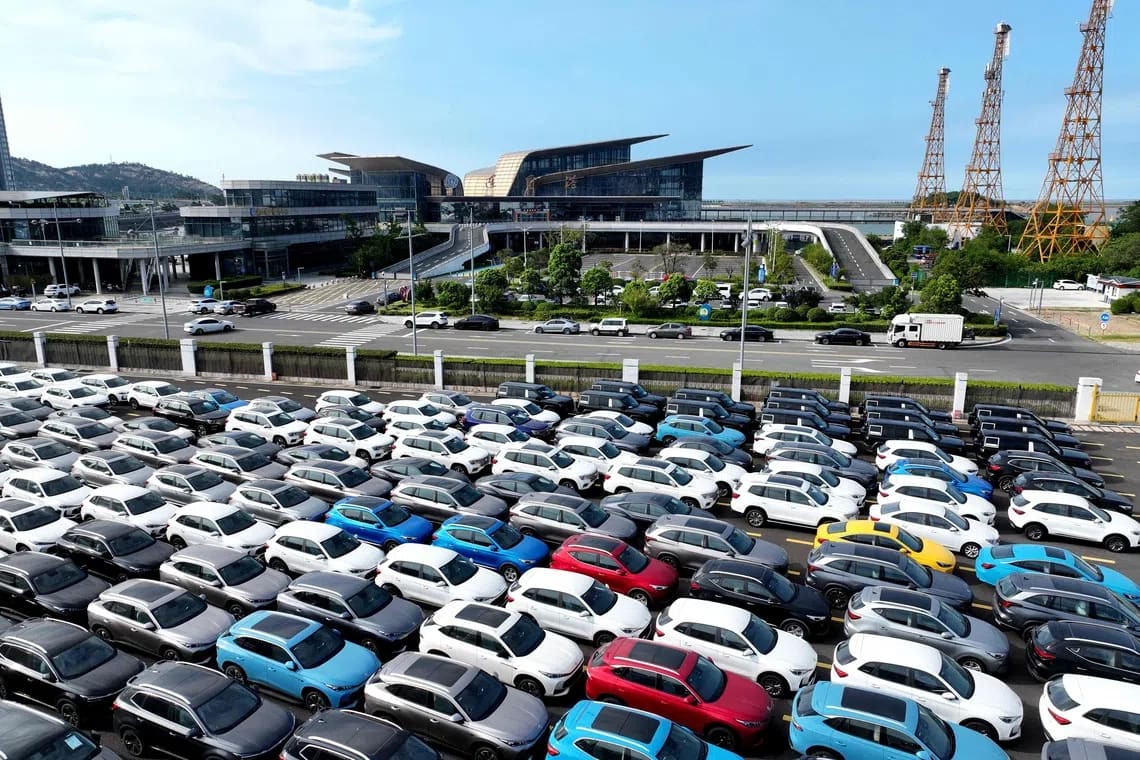
China's automotive market contracted for the tenth consecutive month in July, with domestic vehicle sales falling 20 percent year-on-year to 1.47 million units, according to data from the China Passenger Car Association released August 11. The sustained decline reflects broader economic headwinds, including subdued consumer spending and a struggling property sector that continue to weigh on the world's largest auto market.
High fuel prices have particularly dampened demand for gasoline-powered vehicles, while the entry-level sedan segment remains persistently weak. The first half of 2026 saw domestic sales drop by 2.3 million vehicles compared to the same period in 2025, a volume equivalent to Japan's entire new car market during those six months.
Export Engine Accelerates
While home sales contract, Chinese manufacturers are finding growth abroad. Vehicle exports surged 88 percent in July to 923,000 units. For the first half of 2026, exports jumped 71 percent year-on-year, offsetting much of the domestic shortfall.
BYD illustrates this pivot: despite a 35 percent slump in domestic sales through July 2026, the company's overseas deliveries rose 79 percent. Brazil and Britain have become its largest single-country markets outside China this year. Although export data includes non-Chinese brands manufactured domestically, the pattern of double-digit domestic declines paired with double-digit export growth holds across most Chinese automakers.
The shift is driven by economic necessity as much as ambition. Years of price competition have left China's automotive sector with significant excess capacity. Faced with a saturated home market, manufacturers including Geely and Chery are treating overseas expansion as essential rather than aspirational.
Europe in the Crosshairs
Chinese automakers have made rapid inroads in European markets. In the first quarter of 2026, Chinese brands held 16 percent of Europe's passenger vehicle market, up from just 3 percent four years earlier, according to Counterpoint Research. Japanese automakers, by contrast, have remained static at around 12 percent over the same period.
The gap widens dramatically in electric vehicles. Chinese brands account for nearly a quarter of Europe's EV deliveries, compared to under 5 percent for Japanese manufacturers. Counterpoint forecasts that by 2030, Chinese brands will command more than 20 percent of Europe's overall passenger vehicle market and 29 percent of its EV segment.
Chinese manufacturers are moving beyond exports to establish local production. Multiple Chinese automakers have announced European factory projects, a strategy designed to mitigate tariff risks and build deeper market presence. Counterpoint analysts note that while tariffs may slow market share gains, they are unlikely to reverse the trajectory.
Technological Edge
China's competitive advantage extends beyond price. Chinese automakers have built strengths in electrification, battery technology, software integration, and rapid product development cycles. Supply chain scale and increasingly sophisticated vehicle features add to their appeal in markets where consumers prioritize technology and value.
This contrasts with Japan's historical automotive export success, which rested on manufacturing efficiency, quality control, and fuel economy. The shift to electric powertrains has reshuffled competitive dynamics, with Chinese manufacturers holding structural advantages in key components and software capabilities.
Outlook and Stabilization
HSBC analysts expect domestic demand may stabilize and begin recovering from late August through September as new model launches accelerate. However, a sharp V-shaped recovery appears unlikely given persistent economic headwinds.
The automotive sector mirrors broader dynamics in China's economy: robust manufacturing and export growth offset by weak domestic consumption. For Chinese automakers, overseas markets have transitioned from opportunity to necessity. That calculation is reshaping global automotive competition, particularly in Europe and Southeast Asia, where established players face mounting pressure from Chinese rivals equipped with technological advantages and urgent economic incentives to expand.
RELATED STORIES
Volkswagen China Sales Drop Casts Shadow on Recovery Plan
Priyanka V. Rao · 2 min
China's Automakers Face Shrinking Margins as Battery Strategy Backfires
Cheng Wei-Lun · 3 min
Washington Names Singapore in Tariff Circumvention Probe
Priyanka V. Rao · 3 min
China's Central Bank Unveils First Standalone Five-Year Plan in a Decade
Cheng Wei-Lun · 3 min
Spot something wrong? Email editor@briefasia.com. We log every correction publicly.