Asia · Business
Volkswagen China Sales Drop Casts Shadow on Recovery Plan
German automaker deepens reliance on local partnerships while cutting capacity and workforce amid market headwinds
KEY TAKEAWAYS
- ·Volkswagen's China sales decline challenges its recovery strategy while the company considers mass layoffs in Germany.
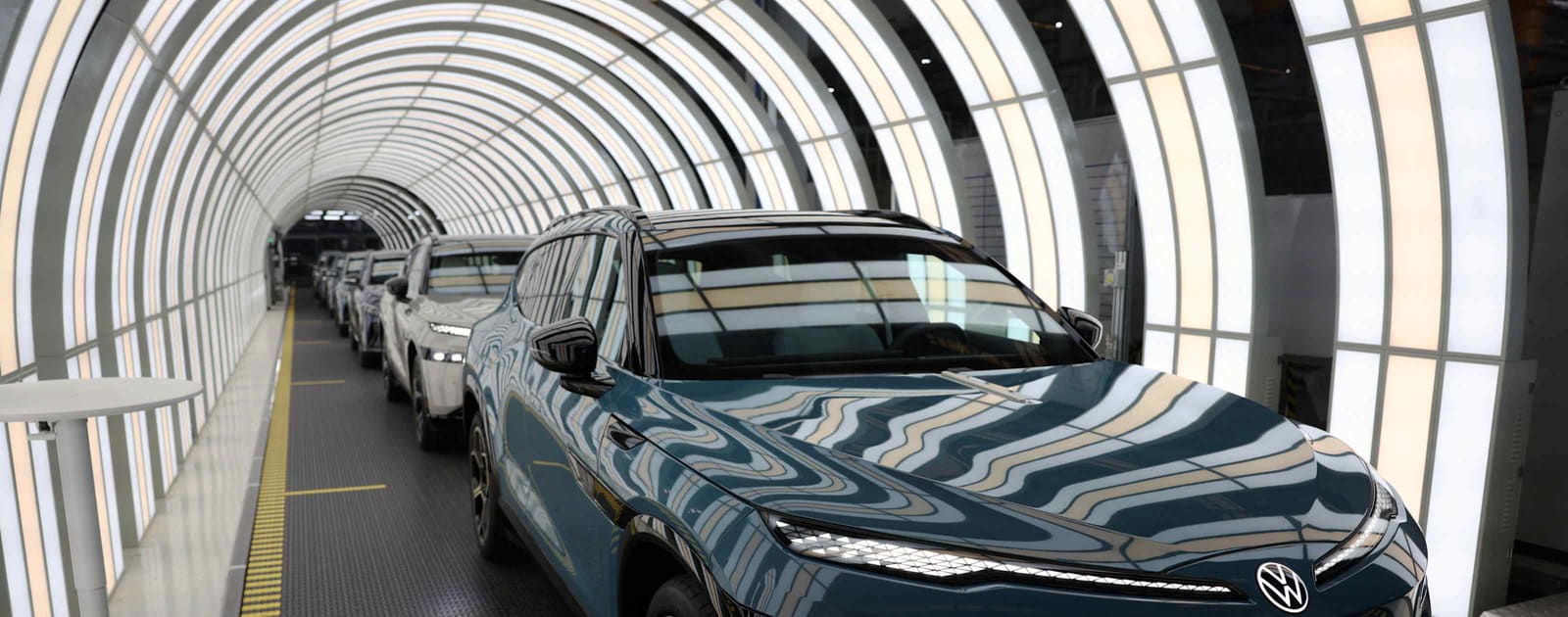
- ·The automaker now produces the ID. UNYX 08 EV through a joint venture with Xpeng at its Anhui factory in Hefei.
- ·Chinese domestic brands have captured market share with competitive pricing and advanced EV features, pressuring legacy automakers.
Comeback Strategy Stumbles
Volkswagen's push to reclaim its position in China is meeting renewed skepticism as sales figures slide, complicating the German automaker's recovery blueprint. The setback comes at a delicate moment, with the company simultaneously weighing significant job cuts in its European operations.
The automaker has deepened its dependence on Chinese partners to navigate the world's largest automotive market. In February, Volkswagen began producing the ID. UNYX 08 electric vehicle at its Anhui facility in Hefei, a model co-developed with Xpeng. The partnership represents a strategic shift for a company that once dominated China's passenger vehicle market through its own engineering prowess.
Capacity Adjustments at Home and Abroad
The sales decline in China is forcing Volkswagen to recalibrate its manufacturing footprint. The company is trimming production capacity while exploring workforce reductions in Germany, where labor costs and structural challenges have squeezed margins. These adjustments reflect a broader reckoning for legacy automakers struggling to compete with nimble local manufacturers in electric vehicles.
China's automotive landscape has transformed dramatically over the past three years. Domestic brands, led by BYD, Geely, and NIO, have captured market share by offering competitively priced electric models with advanced connectivity features. Volkswagen's traditional strengths in combustion engines and brand prestige have proven less decisive in a market where software integration and battery performance drive purchasing decisions.
Partnership Model Under Pressure
The collaboration with Xpeng is part of a wider pattern among European and American automakers seeking local expertise to accelerate EV development. Volkswagen's Anhui joint venture aims to combine the German company's manufacturing scale with Xpeng's software capabilities and understanding of Chinese consumer preferences.
Yet the partnership model carries risks. By relying on local partners for critical technology and market insights, Volkswagen cedes some control over product development and brand positioning. The ID. UNYX 08, while benefiting from Xpeng's digital architecture, must compete in a crowded field where price wars have compressed profit margins across the industry.
Market Dynamics Shift
China's automotive market is no longer the reliable growth engine it was a decade ago. Domestic demand has weakened as economic uncertainty weighs on consumer spending. At the same time, Chinese manufacturers are redirecting focus toward exports, seeking new customers in Southeast Asia, Europe, and Latin America.
For Volkswagen, the sales slide in China compounds difficulties in other key markets. The company faces intensifying competition in Europe from Chinese imports and regulatory pressure to accelerate its transition away from internal combustion engines. In the United States, the automaker continues to rebuild trust following the diesel emissions scandal that damaged its reputation.
What Comes Next
Volkswagen's China challenge is emblematic of a broader inflection point for global automakers. The company must balance investment in electric platforms with the need to maintain profitability from its existing lineup. In China specifically, success will hinge on whether its partnerships can deliver vehicles that resonate with local buyers and whether it can streamline operations to remain cost-competitive.
The coming quarters will test whether Volkswagen's strategy of leaning on local partners and trimming overhead can stabilize its position, or whether the company will need a more fundamental reset in how it approaches the world's most competitive automotive market.
RELATED STORIES
China's Auto Industry Faces Sharp Domestic Decline as Exports Surge
Cheng Wei-Lun · 3 min
European Automakers Are Losing Control of Their Battery Supply Chains
Cheng Wei-Lun · 7 min
Washington Names Singapore in Tariff Circumvention Probe
Priyanka V. Rao · 3 min
China's Central Bank Unveils First Standalone Five-Year Plan in a Decade
Cheng Wei-Lun · 3 min
Spot something wrong? Email editor@briefasia.com. We log every correction publicly.