Asia · Business
China's Automakers Face Shrinking Margins as Battery Strategy Backfires
Vertical integration plans collide with structural supply-chain imbalances, leaving carmakers squeezed while upstream lithium producers and battery suppliers capture industry profits.
KEY TAKEAWAYS
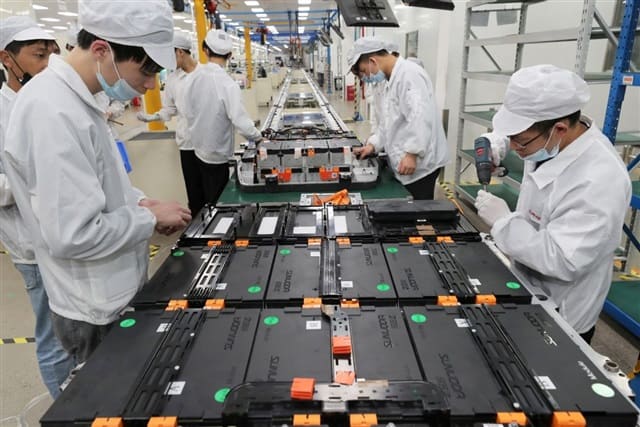
- ·Chinese automakers are pursuing in-house battery production to control costs, but profit margins continue to slide as upstream lithium miners and refiners capture most supply-chain gains.
- ·Over 100 electric vehicle brands compete in China's domestic market, driving relentless price cuts and eroding margins even as manufacturers invest heavily in battery capacity.
- ·Vertical integration into battery production requires massive capital and scale to achieve competitive unit costs, with no guarantee of profitability in a structurally unbalanced supply chain.
The Vertical Integration Gamble
Chinese vehicle manufacturers are doubling down on a costly ambition: bringing battery production in-house to secure supply and control costs. The logic is straightforward. Batteries represent roughly 40 percent of an electric vehicle's total cost, and owning that capability should theoretically deliver competitive advantage in a market where price wars have become standard operating procedure.
Yet the execution is proving far more difficult than the strategy suggests. Profit margins across the sector continue to erode even as production scales up, and the hoped-for cost savings remain elusive. The problem is not capacity or technology. It is the underlying economics of the battery supply chain itself.
Where the Money Flows
The financial pain is concentrated at the vehicle assembly level, while the gains accrue further upstream. Lithium miners, refiners, and established battery cell manufacturers have maintained pricing power even as raw material costs fluctuate. This structural dynamic leaves automakers in a bind: they must invest heavily in manufacturing infrastructure while competing fiercely on vehicle pricing.
Data from industry reports show that upstream players in the lithium supply chain have sustained healthier operating margins than vehicle producers over the past two years, despite periodic swings in lithium carbonate prices. The imbalance reflects both market concentration in critical materials and the technical complexity of large-scale cell production, which remains dominated by a handful of specialized suppliers.
Chinese automakers have responded by accelerating plans to backward-integrate. Several major manufacturers have announced joint ventures with mining firms or direct investments in refining capacity. Others are expanding partnerships with battery makers to secure long-term supply agreements at fixed prices. But these moves require significant capital outlays at a time when vehicle margins are already under pressure.
Competition Intensifies on Multiple Fronts
The margin squeeze is compounded by relentless competition within China's domestic market. More than 100 electric vehicle brands are vying for market share, and price cuts have become a weekly occurrence. Subsidies have tapered off, leaving manufacturers to absorb cost pressures without government support. Export markets offer some relief, but tariffs and regulatory barriers in Europe and North America limit the upside.
At the same time, legacy automakers and new entrants alike are racing to launch new models with longer range, faster charging, and advanced driver-assistance features. This innovation treadmill demands continuous R&D spending, further straining balance sheets. The result is a sector caught between the need to invest for the future and the immediate imperative to stay profitable.
Supply Chain Realities
The supply chain for lithium-ion batteries is not easily reshaped. Mining and refining lithium, cobalt, and nickel require years of lead time and specialized expertise. Cell manufacturing involves precision engineering and stringent quality control. Building these capabilities from scratch is expensive, and achieving competitive unit costs requires massive scale.
Even companies that have moved aggressively into battery production have found the economics challenging. Vertical integration reduces dependence on external suppliers, but it does not automatically translate into lower costs or higher margins. In many cases, automakers end up competing with the very battery manufacturers they once relied on, adding another layer of complexity to an already crowded market.
The Path Forward
For now, Chinese automakers remain committed to the in-house battery strategy, viewing it as essential to long-term competitiveness. But the path is narrow. Success will depend on achieving scale quickly enough to offset the capital burden, securing access to raw materials at stable prices, and continuing to innovate on vehicle design and software to differentiate their products.
The broader question is whether the current market structure is sustainable. If margins continue to compress and only a few players can achieve profitability at scale, consolidation may be inevitable. In the meantime, the pressure on automakers will persist, and the gains will continue to flow upstream to those who control the critical inputs.
The battery bet is not yet lost, but it is far from won. Chinese automakers are learning that owning the supply chain is only valuable if you can make money from it, and in today's market, that is proving harder than anticipated.
RELATED STORIES
BYD, Geely and Chery Crack Global Auto Top Ten
Cheng Wei-Lun · 3 min

Manila Eyes Nickel Processing to Escape China's Price Control
Priyanka V. Rao · 4 min
Washington's Polysilicon Tariffs Set to Squeeze Korean Solar Producers
Cheng Wei-Lun · 3 min
Midea Ships 200,000 Portable Air Conditioners to Europe in Six Months
Cheng Wei-Lun · 3 min
Spot something wrong? Email editor@briefasia.com. We log every correction publicly.