Technology · Products
BYD Deploys First Humanoid Robot at Zhengzhou Showroom
The Chinese EV manufacturer will introduce its in-house developed humanoid at the D Space facility in early August, marking the automaker's entry into commercial robotics.
KEY TAKEAWAYS
- ·BYD will deploy its internally developed humanoid robot at the D Space facility in Zhengzhou in early August.
- ·The deployment marks BYD's entry into commercial humanoid robotics, following its vertical integration strategy across batteries and semiconductors.
- ·China's robotics push and rising labor costs are driving automakers to test humanoids in retail and manufacturing environments.
EV Maker Enters Robotics Arena
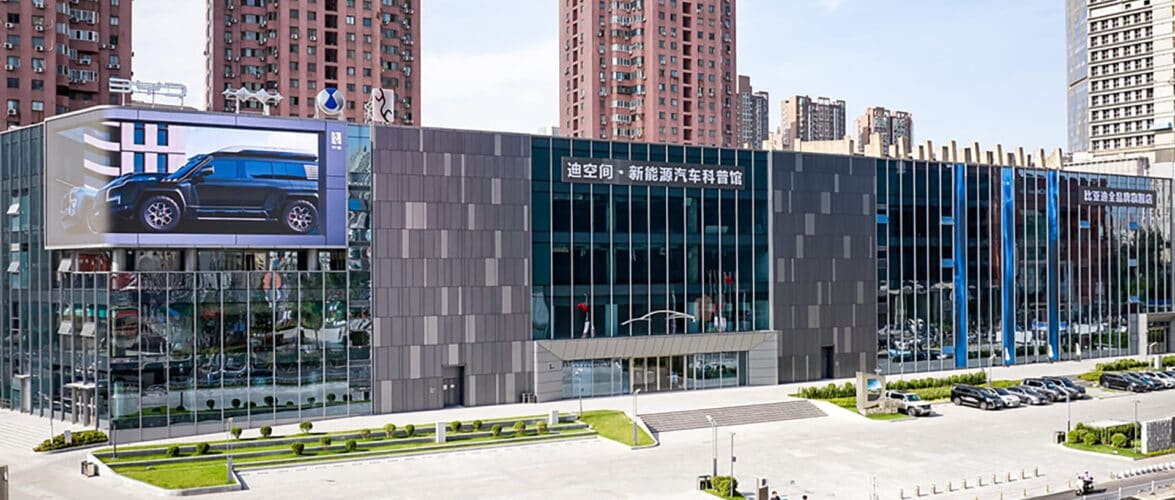
BYD will deploy its first humanoid robot at the company's D Space facility in Zhengzhou in early August, according to the automaker. The robot, developed entirely in-house, represents the electric vehicle manufacturer's initial foray into commercial humanoid applications beyond the factory floor.
The Shenzhen-based manufacturer confirmed the deployment through official social media channels, positioning the August debut as the robot's first public-facing role. D Space facilities serve as BYD's premium retail and experience centers, where customers interact with vehicle lineups and brand innovations.
The timing places BYD alongside a growing cohort of Chinese automakers integrating robotics into their operations. Xiaomi began testing humanoid prototypes in manufacturing settings earlier this year, while Geely has invested in robotics startups focused on logistics automation. BYD's decision to showcase the robot in a customer-facing environment rather than a production line suggests confidence in the technology's polish and reliability.
In-House Development Strategy
BYD's approach mirrors its broader vertical integration philosophy. The company manufactures batteries, semiconductors, and electric drivetrains internally, a strategy that has allowed it to maintain cost advantages and rapid iteration cycles. Applying the same model to robotics positions BYD to customize humanoid capabilities for automotive retail, service, and potentially assembly tasks.
The automaker has not disclosed technical specifications for the robot, including height, weight, degrees of freedom, or the tasks it will perform at the Zhengzhou location. Industry observers expect the unit to handle customer engagement, product demonstrations, or facility navigation tasks that showcase mobility and interaction capabilities without requiring the dexterity demanded by assembly work.
China's humanoid robotics sector has accelerated sharply over the past 18 months. Ministry of Industry and Information Technology guidelines released in late 2023 set a target for mass production of humanoid robots by 2025, with applications spanning manufacturing, logistics, healthcare, and consumer services. Several municipalities, including Shenzhen and Shanghai, have established robotics industrial parks with subsidies for companies commercializing humanoid platforms.
Retail as Testing Ground
Deploying humanoids in retail environments offers automakers a controlled setting to refine human-robot interaction protocols. Unlike factory floors, where robots operate in structured zones with predictable workflows, retail spaces require navigation through crowds, adaptation to varied customer queries, and tolerance for unpredictable behavior. Success in these conditions can validate technology readiness for broader commercial rollout.
BYD sold over 3 million electric and plug-in hybrid vehicles in 2023, surpassing Tesla in total battery-electric and hybrid unit sales. The company operates more than 3,000 retail locations across China, providing a substantial testbed for humanoid deployment if the Zhengzhou trial proves successful. Scaling humanoid robots across even a fraction of that network would represent one of the largest commercial humanoid deployments globally.
The automaker's robotics ambitions also align with China's push to dominate next-generation manufacturing technologies. As labor costs rise in coastal manufacturing hubs, automation has become a strategic priority for maintaining export competitiveness. Humanoid robots, with their ability to navigate environments designed for human workers, offer flexibility that fixed industrial robots cannot match.
Whether BYD's humanoid will remain a showroom novelty or evolve into a scalable commercial tool will depend on performance in Zhengzhou and the company's willingness to invest in iterative development. For now, the August debut signals that China's EV leaders view robotics not as a distant research project but as an immediate operational opportunity.
RELATED STORIES
China Targets 84% Share of AR-HUD Production by 2031
Cheng Wei-Lun · 3 min
BYD Sets Sights on 2 Million Overseas Sales in 2026 After Brazil, Europe Surge
Cheng Wei-Lun · 3 min
China's Battery Dominance Faces Quality Test as CALB Defect Spreads
Anand Sundaram · 3 min
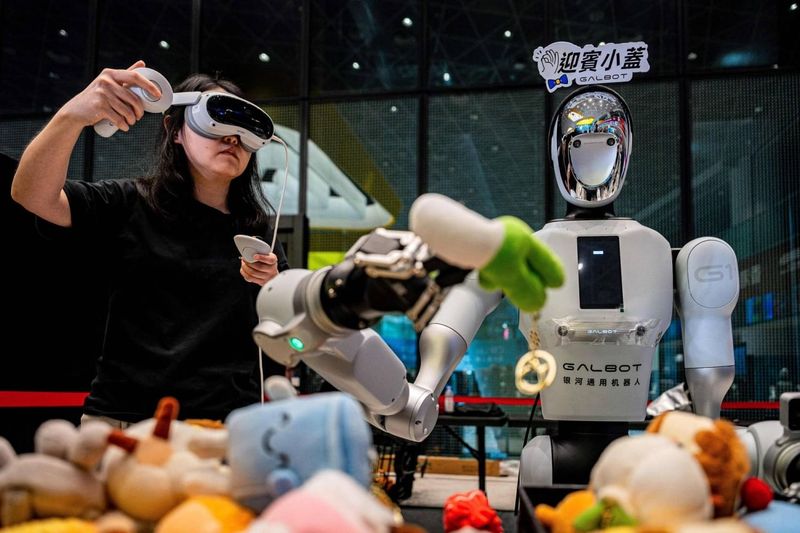
Hong Kong Debuts Robot-Run Convenience Store in Commercial Automation Push
Cheng Wei-Lun · 3 min
Spot something wrong? Email editor@briefasia.com. We log every correction publicly.