Technology · Products
BYD Sets Sights on 2 Million Overseas Sales in 2026 After Brazil, Europe Surge
China's largest EV maker expects to exceed its annual export target with monthly shipments reaching 200,000 units in the second half
KEY TAKEAWAYS
- ·BYD projects close to 2 million overseas vehicle sales in 2026, with monthly shipments of 180,000 to 200,000 units in the second half after selling nearly 800,000 by June.
- ·Strong performance in Brazil and Europe is driving the Shenzhen automaker's export growth, helping it exceed its original annual overseas target.
- ·The company has set a 2.5 million unit overseas sales target for 2027, signalling confidence despite rising competition and potential regulatory barriers in key markets.
Shenzhen Automaker Eyes Milestone Export Volume
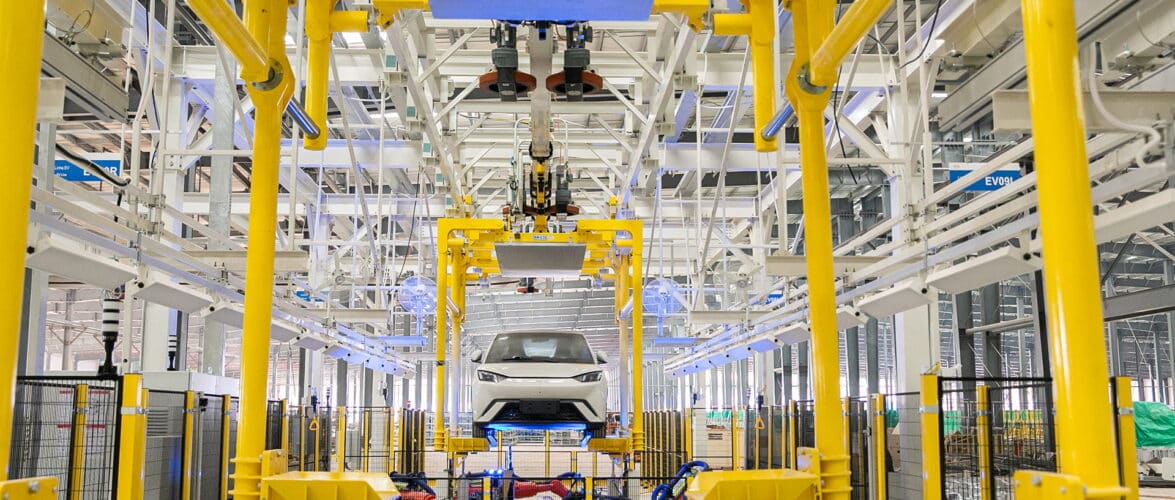
BYD is on track to sell close to 2 million vehicles outside China in 2026, management told analysts in early September, marking a significant acceleration in the Shenzhen-based company's international expansion. The projection would see the automaker exceed its original annual overseas target, with momentum continuing into 2027 when BYD plans to ship 2.5 million units to foreign markets.
The company's export engine is running at full capacity. Management confirmed that overseas shipments should reach between 180,000 and 200,000 cars per month during the second half of 2026, according to analysts who attended a post-earnings briefing on 7 September. By the end of June, BYD had already moved nearly 800,000 vehicles internationally, positioning the company well ahead of its earlier forecasts.
Brazil and Europe Lead Regional Growth
Two regions are driving the bulk of BYD's overseas performance. Brazil has emerged as a critical market for the Chinese EV maker, absorbing significant volumes as the country's appetite for electric vehicles grows alongside infrastructure development. European markets have similarly opened their doors, with BYD establishing distribution networks and retail presence across multiple countries despite ongoing regulatory scrutiny of Chinese automotive imports.
The company's ability to maintain high monthly shipment rates through the remainder of 2026 will determine whether it hits the upper end of its revised forecast. At 200,000 units per month for six months, BYD would add 1.2 million vehicles to its June tally, bringing the full-year total to approximately 2 million units. That volume would represent a substantial portion of BYD's overall production, underscoring how central international markets have become to the company's growth strategy.
2027 Target Signals Continued Ambition
The 2.5 million unit target for 2027 suggests BYD sees room for further expansion even as competition intensifies. European regulators continue to examine Chinese EV subsidies and market practices, while other automakers from Japan, South Korea, and the West ramp up their own electric vehicle programmes. BYD's confidence in hitting higher export volumes next year indicates the company believes it can navigate these headwinds through competitive pricing, product range, and localised assembly where necessary.
China remains the world's largest EV market, but saturation concerns and intense domestic competition are pushing manufacturers to seek revenue abroad. BYD's international push mirrors broader trends among Chinese automakers, many of whom are targeting Southeast Asia, Latin America, and parts of Europe as their next growth frontiers. The company's scale gives it cost advantages that smaller rivals struggle to match, allowing BYD to price aggressively in markets where EV adoption is still in early stages.
What This Means for Global EV Competition
BYD's export trajectory will reshape competitive dynamics in multiple regions. In Brazil, traditional automakers with long-established operations now face a well-funded challenger offering electric vehicles at price points that undercut many petrol-powered models. European brands, already under pressure to meet emissions targets, must contend with a Chinese manufacturer that can deliver volume at speed.
The question for 2027 and beyond is whether BYD can sustain this pace as tariffs, local content requirements, and political considerations come into play. Several governments are weighing measures to protect domestic automotive industries, and BYD's ability to build or acquire local manufacturing capacity will be crucial. The company has announced plans for factories in multiple countries, but timelines and production ramp-up remain uncertain.
For now, BYD's near-term outlook reflects a company capitalising on first-mover advantages in key markets. Whether those advantages hold as competition deepens will determine if the 2.5 million unit ambition for 2027 proves realistic or optimistic.
RELATED STORIES

Nio Sets 40,000-Unit Monthly Delivery Target for Q4
Anand Sundaram · 3 min
China's Auto Chip Race Shifts to Volume as Horizon Robotics Crosses 15 Million Units
Jun-ho Seo · 3 min
Chinese Automakers Target Hybrid Market After EV Dominance
Cheng Wei-Lun · 3 min
China's Battery Dominance Faces Quality Test as CALB Defect Spreads
Anand Sundaram · 3 min
Spot something wrong? Email editor@briefasia.com. We log every correction publicly.