Perspectives · Analysis
Asia's Investors Are Playing a Different Game This Time Around
The AI rally has put Asian chipmakers at the center of a trillion-dollar boom, but the region's retail investors now face risks their counterparts never shouldered during the dot-com era.
KEY TAKEAWAYS
- ·SK Hynix reported record quarterly profit and a 76 percent operating margin, but shares fell because results missed analyst estimates, signaling a shift in investor sentiment.
- ·Asian chipmakers like TSMC, Samsung, and SK Hynix are central to the AI rally, unlike the dot-com era when American firms dominated and Asian companies were peripheral players.
- ·Millions of retail investors across Japan, South Korea, and Taiwan have invested heavily in tech stocks, creating new vulnerabilities if the AI rally faces a correction.
- ·Semiconductor executives emphasize AI spending is a multi-year cycle, but volatility remains inevitable as the industry is historically cyclical despite structural demand growth.
The Trillion-Dollar Threshold
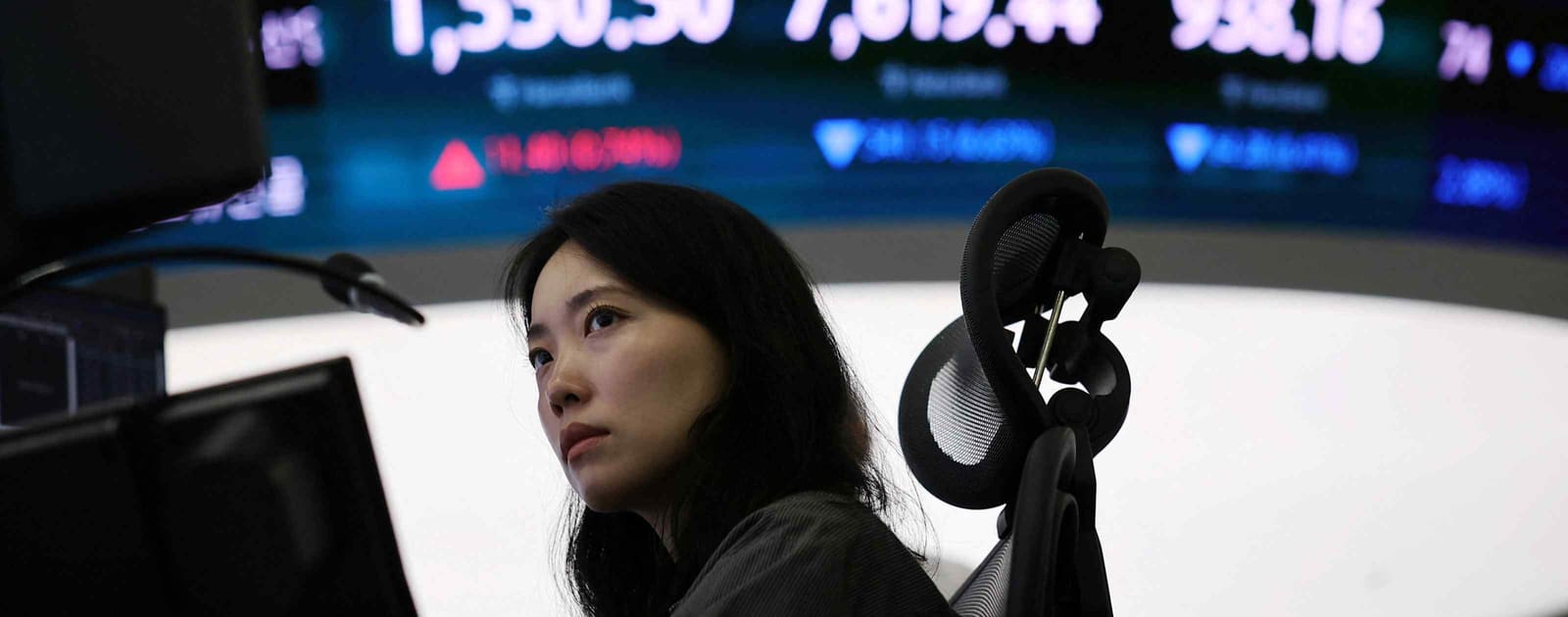
Two months separate euphoria from caution in equity markets. In late spring, Taiwan Semiconductor Manufacturing Company, Samsung Electronics, and SK Hynix each crossed the $1 trillion market capitalization mark, a milestone no Asian tech company had reached before. The rally was powered by American hyperscalers pouring capital into AI infrastructure, and Asia's semiconductor manufacturers stood at the center of that spending wave.
SK Hynix reported earnings this week that would have been celebrated in any other quarter. Net profit for April through June jumped more than thirteen times year-on-year. Operating margin hit 76 percent, a figure that defies the capital-intensive reality of chipmaking. Revenue, operating profit, and net income all reached quarterly records.
The stock fell anyway. Operating profit missed the average analyst estimate, and that shortfall was enough to trigger selling. By Friday, SK Hynix had clawed back some losses, but the company's market cap had slipped below the trillion-dollar threshold it had only recently breached.
A Shift in Sentiment
The market's reaction signals something deeper than a single earnings miss. Investor psychology has rotated from searching for reasons to buy to hunting for reasons to sell. Chip executives continue to emphasize that AI spending is a multi-year cycle, that capital expenditure will persist, and that demand for advanced memory and logic remains structural rather than cyclical. Yet skepticism is creeping in.
AI is transformative. The technology's potential to reshape industries, automate complex tasks, and unlock productivity gains rivals or exceeds what the internet accomplished over the past three decades. That does not immunize the current rally from excess. The dot-com bubble of the late 1990s was built on genuine innovation, too. The internet did change the world, but not fast enough to justify the valuations investors assigned to companies with no earnings, no clear business models, and no path to profitability. When reality caught up with expectations, trillions of dollars in market value evaporated.
What Makes This Boom Different
The comparison to the dot-com era is useful, but it misses a critical distinction that matters profoundly for Asia. In 2000, the companies at the heart of the bubble were overwhelmingly American. Cisco, Intel, Oracle, and a swarm of now-forgotten internet startups dominated the frenzy. Asian firms were suppliers, contractors, and peripheral players. When the bubble burst, the pain was concentrated in Silicon Valley and among American institutional investors.
Today, Asian companies are protagonists. TSMC fabricates the most advanced chips in the world. Samsung and SK Hynix dominate high-bandwidth memory, the critical component enabling AI model training. These are not bit players riding someone else's wave. They are the infrastructure on which the entire AI ecosystem depends.
More importantly, the capital backing these companies is increasingly Asian. Retail investors across Japan, South Korea, Taiwan, and increasingly Southeast Asia have poured substantial sums into tech stocks. The democratization of investing, accelerated by mobile trading platforms and zero-commission brokerages, has brought millions of individual investors into markets that were once the domain of institutions. When TSMC or SK Hynix shares rise, the gains flow to households in Taipei, Seoul, and Tokyo. When those shares fall, the losses do, too.
Volatility as the New Normal
Markets in Tokyo and Seoul saw sharp declines in late July, prompting dip-buying that supported shares temporarily. But the underlying choppiness reflects uncertainty about how long the AI spending cycle will last and whether current valuations have priced in too much optimism too soon. The semiconductor industry is notoriously cyclical. Periods of robust demand and tight supply give way to inventory corrections and falling prices. AI may extend the up-cycle, but it does not eliminate the cycle itself.
For retail investors who entered the market during the rally, volatility represents a risk they may not have fully priced in. Institutional investors have risk management frameworks, diversified portfolios, and professional analysts. Retail investors often have none of those. A 20 percent drawdown in a stock portfolio can force difficult decisions about whether to sell at a loss or hold through uncertainty.
The Long Game
Chip executives are right to frame AI as a long-term story. Capital expenditure by Microsoft, Amazon, Google, and Meta on data centers and AI infrastructure is running at unprecedented levels. Training large language models requires massive compute power, and inference at scale will require even more. TSMC's advanced packaging technologies and SK Hynix's high-bandwidth memory are not commodity products. They are specialized, high-margin offerings that take years to replicate.
But long-term growth does not preclude short-term volatility. The path from here to a world where AI is embedded in every application and every device will not be smooth. There will be quarters where growth disappoints, where inventory builds, where competition intensifies, and where macroeconomic shocks disrupt demand. Investors who understand that volatility is the price of participation will fare better than those expecting uninterrupted gains.
What to Watch
The next few quarters will test whether the AI rally can withstand rising skepticism. Earnings reports from chipmakers will be scrutinized not just for top-line growth but for margin sustainability and forward guidance. Any hint that hyperscaler spending is plateauing will trigger selling. Conversely, evidence that AI adoption is accelerating beyond the hyperscalers and into enterprise customers will support valuations.
Geopolitical risk remains a wildcard. Export controls, tensions over Taiwan, and competition between the United States and China over semiconductor supply chains introduce uncertainties that are difficult to model. Asian chipmakers sit at the intersection of those tensions, and any escalation could reshape the landscape quickly.
For Asia's retail investors, the lesson from the dot-com era is not that innovation bubbles always burst. It is that timing, valuation, and risk management matter. AI will change the world. Whether today's stock prices reflect that change accurately or have overshot is a question that will only be answered in hindsight. Until then, volatility is the reality, and preparation is the strategy.
RELATED STORIES

Kioxia Rules Out SK Hynix Merger, Focuses on Stabilising Memory Chip Prices
Tran Quoc Bao · 3 min

Kioxia Rules Out SK Hynix Manufacturing Partnership Despite Memory Boom
Jun-ho Seo · 3 min

Bank of Japan Prepares Third Rate Increase in Ten Months
Aiko Nakamura · 3 min

Japan's Megabanks Launch Digital Services to Capture SME Business
Aiko Nakamura · 3 min
Spot something wrong? Email editor@briefasia.com. We log every correction publicly.