Technology · Products
Xiaomi Prices New SUVs 23% Below Tesla Model Y in China Market Push
The Beijing smartphone maker's extended-range SkyNomad series targets premium buyers with aggressive pricing as competition intensifies in China's electric vehicle segment
KEY TAKEAWAYS
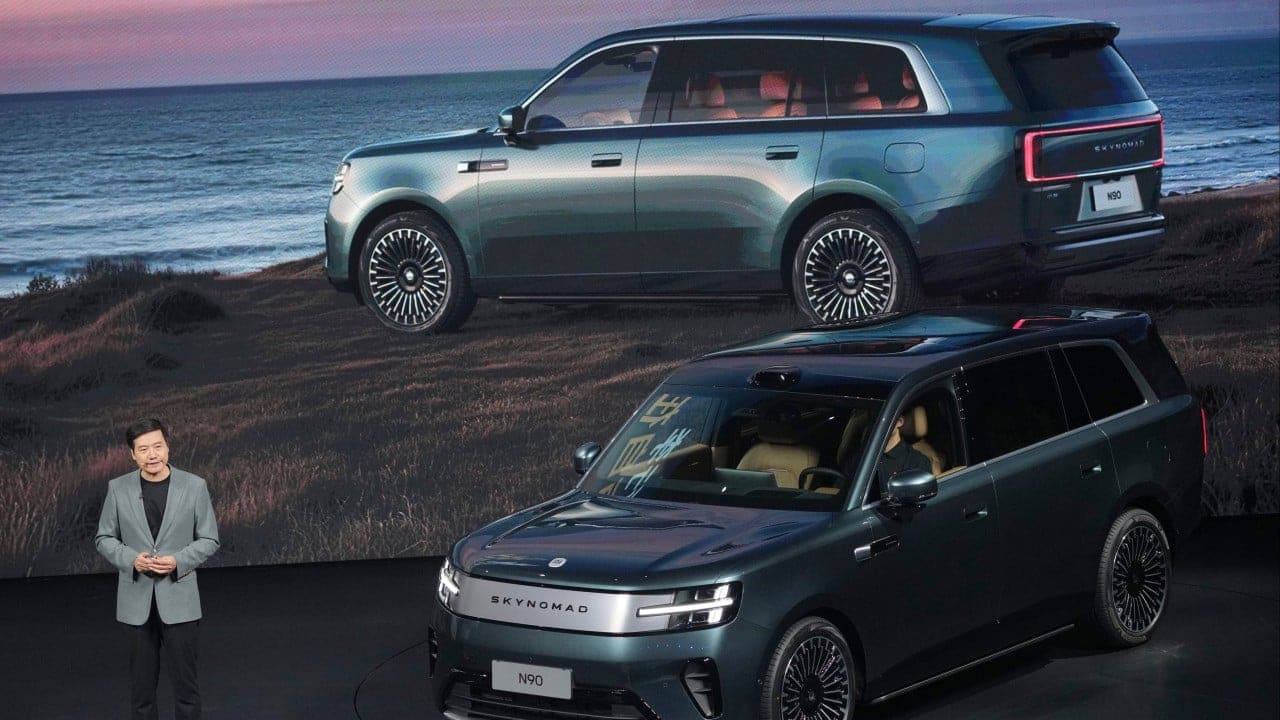
- ·Xiaomi launched its five-seat N70 Max at 259,900 yuan and seven-seat N90 Max at 299,900 yuan, pricing both models 23 percent below Tesla's Model Y L in China.
- ·The new SkyNomad series uses extended-range electric technology, pairing battery power with a combustion generator to address range concerns in areas with limited charging infrastructure.
- ·The pricing strategy intensifies competition in China's premium EV segment, where domestic and foreign automakers are battling for market share in the 200,000 to 400,000 yuan bracket.
Aggressive Pricing Strategy
Xiaomi announced Thursday that its five-seat N70 Max model will retail at 259,900 yuan (US$38,474), while the seven-seat N90 Max starts at 299,900 yuan, according to the company. Both vehicles belong to the newly launched extended-range SkyNomad series and are positioned to undercut Tesla's Model Y L by 23 percent in China's fiercely competitive premium electric vehicle segment.
The Beijing-based company, better known for smartphones and consumer electronics, has emerged as one of Tesla's most formidable competitors in mainland China over the past year. The pricing announcement signals Xiaomi's intent to capture market share through cost advantage while maintaining premium positioning in the 250,000 to 300,000 yuan bracket that has become a battleground for domestic and foreign automakers alike.
Deliveries of both models are scheduled to begin in the coming months, Xiaomi said, though the company did not specify exact timelines for production ramp-up or regional rollout priorities within China.
Extended-Range Technology
The SkyNomad series employs extended-range electric vehicle (EREV) technology, which pairs a battery-electric drivetrain with a small internal combustion engine that acts as a generator to extend driving range. This architecture has gained traction among Chinese consumers concerned about charging infrastructure gaps, particularly in lower-tier cities and rural areas where public charging networks remain sparse.
By offering extended-range capability, Xiaomi addresses one of the key friction points that have slowed pure battery-electric vehicle adoption in parts of China's vast interior. The approach mirrors strategies deployed by domestic rivals including Li Auto, which has built its entire lineup around EREV powertrains and captured significant premium SUV volume over the past three years.
Tesla, by contrast, offers only pure battery-electric vehicles and has relied on its Supercharger network and improving public infrastructure to alleviate range anxiety. The Model Y L, Tesla's long-wheelbase variant designed specifically for the Chinese market, competes primarily on brand cachet, performance, and the company's established charging ecosystem.
Intensifying Competition
The premium EV segment in China has become increasingly crowded as traditional automakers, tech companies, and startups vie for a slice of the world's largest car market. Domestic players including BYD, Nio, Li Auto, and Xpeng have all launched models in the 200,000 to 400,000 yuan range, forcing price compression and accelerating feature competition.
Xiaomi's entry into the automotive sector represents a broader trend of technology companies leveraging brand recognition, software expertise, and vertical integration to challenge incumbents. The company's existing ecosystem of smart home devices, wearables, and mobile services provides a foundation for differentiation through connected-car features and seamless integration with users' existing digital lives.
Price sensitivity remains high even in the premium segment, where buyers increasingly expect advanced driver-assistance systems, over-the-air software updates, and luxury-grade interiors as standard rather than optional. Xiaomi's decision to price aggressively suggests confidence in its ability to maintain margins through manufacturing efficiency and component sourcing advantages built over decades in consumer electronics.
Market Implications
The pricing gap between Xiaomi's offerings and the Tesla Model Y L creates pressure on the American automaker to either defend market share through incentives or accept potential volume loss in favor of margin preservation. Tesla has historically resisted deep discounting but has adjusted China pricing multiple times in response to competitive dynamics and local demand fluctuations.
For Xiaomi, the challenge will be scaling production and distribution quickly enough to capitalize on the pricing advantage before competitors respond. The company's manufacturing partnerships and supply chain capabilities will be tested as it transitions from smartphone-scale operations to the capital-intensive, quality-critical demands of automotive production.
China's EV market is expected to continue consolidating as weaker players exit and survivors battle for the 30 to 40 percent electrified vehicle penetration rates that industry forecasts project for the next three to five years. Premium segments, once dominated by foreign luxury brands, are now firmly contested by domestic players with strong local market knowledge and faster product iteration cycles.
RELATED STORIES
China Targets 84% Share of AR-HUD Production by 2031
Cheng Wei-Lun · 3 min
China's Auto Chip Race Shifts to Volume as Horizon Robotics Crosses 15 Million Units
Jun-ho Seo · 3 min

Li Auto Expands Battery Roster with CALB as Third Supplier
Siti Nuraini · 2 min
BYD Sets Sights on 2 Million Overseas Sales in 2026 After Brazil, Europe Surge
Cheng Wei-Lun · 3 min
Spot something wrong? Email editor@briefasia.com. We log every correction publicly.