Asia · Trending
Vietnam Fuel Stations Raise Pump Prices as Mideast Tensions Push Crude Higher
E10 gasoline and diesel both climbed this week, tracking a surge in global benchmarks driven by Iran-UAE trade freeze and Hormuz Strait disruptions
KEY TAKEAWAYS
- ·Vietnam raised E10 gasoline 2.49 percent to 22,660 dong per liter and diesel 4.81 percent to 28,540 dong, tracking a seven-day global crude rally that lifted RON95 to 116.60 dollars per barrel.
- ·The increase followed an Iran-UAE trade freeze and Hormuz Strait shipping disruptions that injected a risk premium into Asian refining costs and futures markets.
- ·Vietnamese pump prices remain 15 to 50 percent below Cambodia, Thailand, China and Laos due to a stabilization fund that absorbs part of the global swing and may face depletion if crude stays elevated.
Domestic Pumps Reflect Global Crude Rally
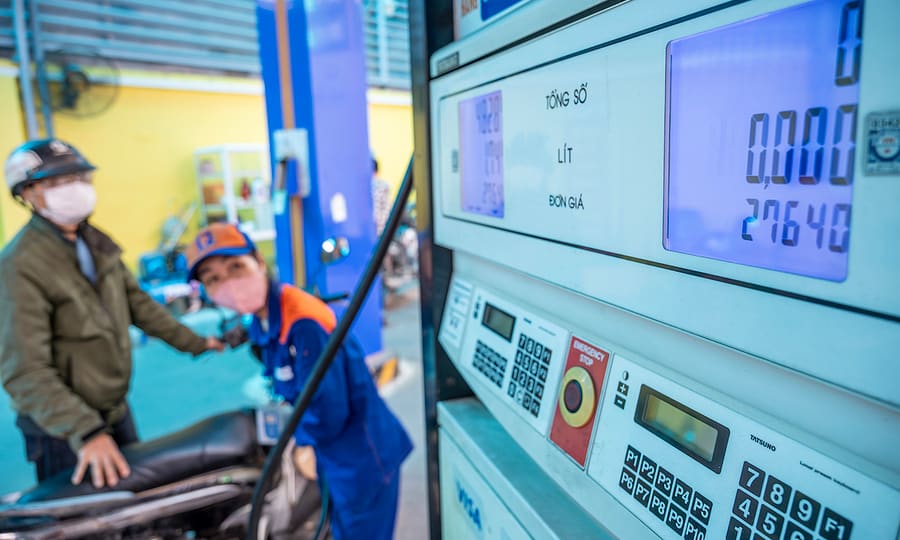
Vietnam's two ministries overseeing energy pricing adjusted retail fuel rates upward on Thursday, marking the latest transmission of global crude volatility into Southeast Asia's consumer markets. The widely used E10 RON95 blend now sells at 22,660 dong per liter, a climb of 2.49 percent from the previous pricing window. The alternative E5 RON92 formulation moved to 21,830 dong, up 2.83 percent, while diesel posted the sharpest gain at 4.81 percent to reach 28,540 dong per liter.
The adjustments mirror a seven-day run-up in international benchmark prices that pushed RON95 crude to 116.60 dollars per barrel, a 4.4 percent increase, and diesel to 160.30 dollars, climbing 6.1 percent over the same span. Vietnam's pricing mechanism, administered jointly by the Ministry of Industry and Trade and the Ministry of Finance, typically reviews world market trends on a fortnightly cycle and passes through cost movements with a lag that smooths short-term spikes but ensures longer trends reach the pump.
Mideast Flashpoints Drive the Rally
Two distinct geopolitical developments converged to tighten supply expectations and lift crude futures in recent trading sessions. Ongoing negotiations between Washington and Tehran over a revised nuclear framework have stalled, fueling concern that sanctions relief remains distant and that Iranian barrels will stay off mainstream export channels. Simultaneously, shipping through the Strait of Hormuz, the narrow waterway that handles roughly one-fifth of global petroleum flows, has faced intermittent delays and diversions tied to heightened military activity and insurance-rate spikes.
A more immediate jolt arrived when the United Arab Emirates announced a suspension of all trade and financial transactions with Iran, a move that ripples through regional energy logistics. The UAE hosts critical bunkering and transshipment infrastructure; its pivot away from Iranian counterparties forces traders to reroute cargoes and seek alternative credit lines, adding both time and cost to supply chains that feed Asian refineries. Markets interpreted the announcement as a signal that Gulf tensions may broaden rather than ease, and futures contracts responded accordingly.
Energy analysts note that the confluence of diplomatic deadlock, chokepoint risk, and a unilateral sanctions step by a major Gulf state creates a risk premium that extends beyond immediate supply math. Even if physical barrels continue to flow, the uncertainty embedded in forward curves raises hedging costs for refiners and importers across Asia, costs that eventually surface in retail pricing from Hanoi to Jakarta.
Regional Price Comparisons Reveal Vietnam's Subsidy Buffer
Despite the latest increase, Vietnamese consumers still enjoy a meaningful discount relative to neighbors. Current pump rates sit 15 percent below those in Cambodia, 23 percent under Thailand's equivalent grades, 29 percent cheaper than in southern China's border provinces, and a full 50 percent beneath Laos, where landlocked geography and limited refining capacity impose structural premiums.
That gap reflects Vietnam's continued use of a stabilization fund that absorbs part of the global price swing, a policy tool that successive governments have deployed to temper inflation and protect household purchasing power. The fund accumulates surpluses when world prices fall and disburses support when they rise, though its capacity is finite and policymakers periodically adjust the pass-through rate to prevent depletion.
Thailand, by contrast, dismantled most of its fuel subsidy apparatus in early 2025, allowing retail prices to track international benchmarks more closely. Cambodia imports the majority of its refined products and lacks a domestic stabilization mechanism, leaving consumers exposed to every uptick. Laos combines import dependence with high logistics costs and thin market competition, producing the region's steepest pump rates.
The differential matters for cross-border trade dynamics. Truck operators and fishing fleets in Cambodia routinely detour to Vietnamese border towns to refuel, a practice that Vietnamese customs and energy officials tolerate within limits but monitor to prevent large-scale arbitrage that would drain the stabilization fund. Thai hauliers have begun similar calculations, particularly for routes along the Mekong corridor where a short detour can yield double-digit percentage savings on diesel.
Implications for Inflation and Monetary Policy
Fuel price movements carry outsized weight in Vietnam's consumer price index because transportation and logistics costs propagate quickly through food, construction materials, and manufactured goods. The State Bank of Vietnam has held its benchmark refinancing rate steady at 4.5 percent since March, citing benign core inflation and a desire to support credit growth. Yet energy-driven headline inflation remains a wildcard that could complicate that stance if crude continues to climb.
August's adjustment alone is unlikely to shift the central bank's calculus. A 2.5 to 5 percent increase at the pump translates to roughly 0.15 to 0.25 percentage points on the headline CPI, manageable within the government's year-end target corridor of 4 to 4.5 percent. However, if Mideast tensions persist and crude benchmarks breach 120 dollars for RON95 or 170 dollars for diesel, the cumulative effect over successive pricing cycles could push inflation above the tolerance band by year-end, forcing a choice between tighter monetary policy and deeper subsidy commitments.
Finance ministry officials have signaled they prefer to let the stabilization fund bear the near-term burden rather than risk demand destruction through aggressive rate hikes. Yet the fund's reserves, estimated at approximately 8 trillion dong as of mid-year, can sustain only a limited number of large drawdowns before requiring fiscal replenishment or a shift to full pass-through pricing.
What Comes Next for Regional Energy Markets
Market participants will watch three variables in the weeks ahead. First, whether the UAE-Iran trade freeze broadens to include other Gulf Cooperation Council members, which would deepen the logistical snarl and further elevate the risk premium. Second, the trajectory of US-Iran talks; any breakthrough that lifts sanctions on Iranian crude exports could release an additional 500,000 to 700,000 barrels per day onto global markets, easing the tightness that underpins current prices. Third, seasonal demand patterns as Southeast Asia approaches the year-end holiday travel surge, which typically lifts gasoline consumption by 8 to 12 percent in November and December.
Refiners in Singapore and South Korea, the two dominant suppliers of finished products to Indochina, have already begun adjusting run rates to capture higher crack spreads. That response will eventually moderate prices if geopolitical risks fade, but the lag between refinery decision and product delivery means any relief at Vietnamese pumps is unlikely before mid-September at the earliest.
For now, Vietnamese motorists and hauliers face a new baseline that edges closer to regional norms, even as the subsidy cushion continues to offer partial insulation from the full force of global crude swings.
RELATED STORIES
Vietnam's Banking Sector Adopts AI Safety Measures Amid Digital Expansion
Priyanka V. Rao · 3 min
Khánh Hòa Province Positions for Halal Market Entry
Siti Nuraini · 3 min

Stavian Group Breaks Ground on $95.6 Million Industrial Park in Thái Nguyên
Priyanka V. Rao · 3 min
Dung Quat Economic Zone Pulls $19.4 Billion in Foreign Investment
Tran Quoc Bao · 2 min
Spot something wrong? Email editor@briefasia.com. We log every correction publicly.