Technology · Products
Unitree Robotics Shows R1 Humanoid at Shanghai Industry Exhibition
Chinese robotics maker displays its latest humanoid platform as domestic manufacturers accelerate push into embodied AI hardware
KEY TAKEAWAYS
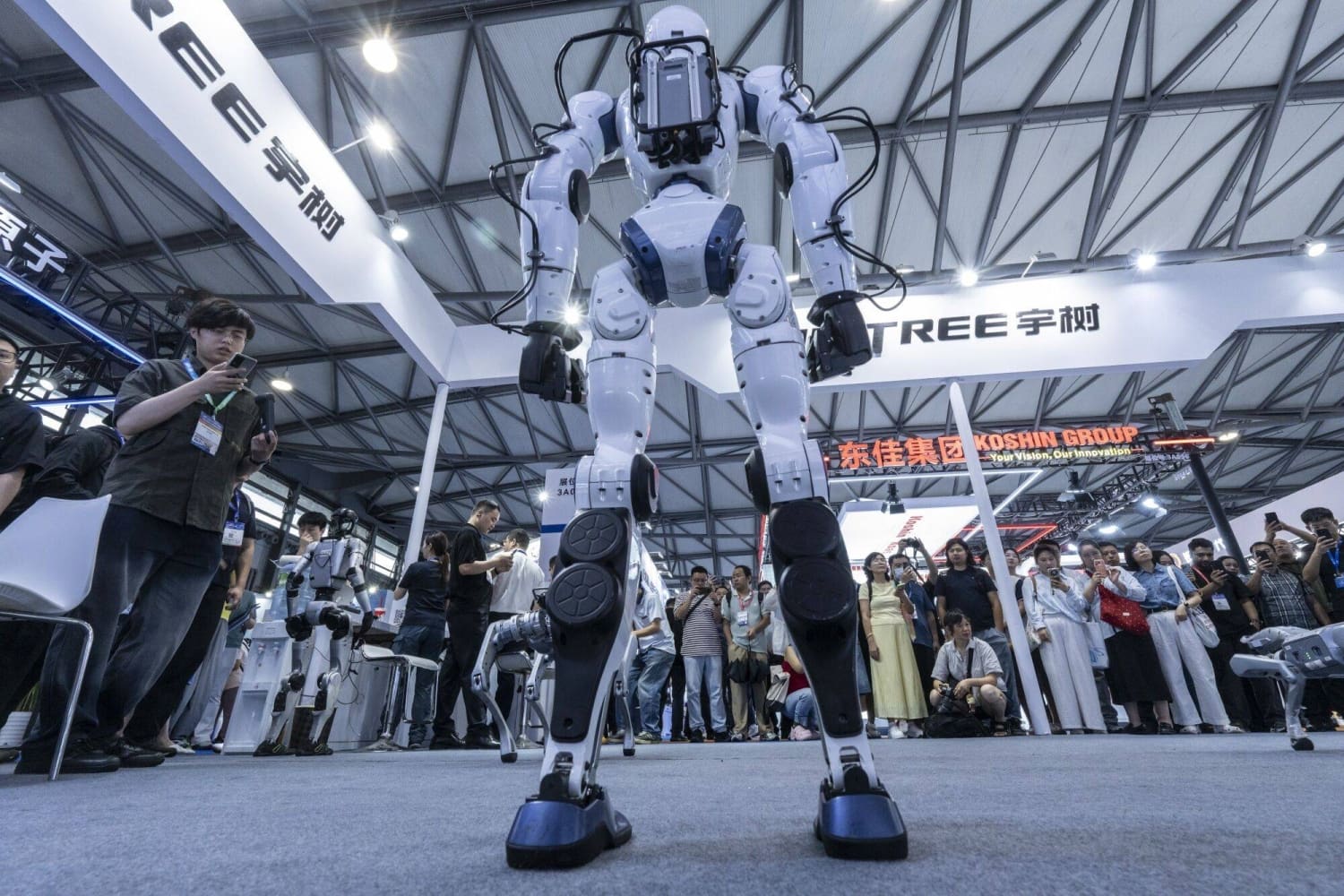
- ·Unitree Robotics displayed its R1 humanoid robot at the Embodied Intelligent Robot Industry Exhibition in Shanghai on August 12.
- ·China's Ministry of Industry and Information Technology has targeted mass production of humanoid robots by 2025 for manufacturing, logistics, and eldercare applications.
- ·Domestic supply chains for actuators and joint modules have expanded in Shenzhen and Suzhou, reducing component costs for Chinese humanoid assemblers.
Chinese Maker Joins Humanoid Race
Unitree Robotics presented its R1 humanoid robot at the Embodied Intelligent Robot Industry Exhibition in Shanghai on August 12, adding another contender to China's rapidly expanding roster of domestic humanoid platforms. The Hangzhou-based company, previously known for quadruped robots, is now positioning itself in the humanoid segment as Chinese manufacturers race to commercialize general-purpose robots.
The exhibition comes as China's robotics industry consolidates around embodied artificial intelligence, a category that combines physical robots with large language models and vision systems. Unitree has not disclosed technical specifications for the R1, but the company's previous track record in legged robotics suggests a focus on mobility and affordability.
China's Domestic Push
China has emerged as a critical testing ground for humanoid robotics, driven by government policy support and manufacturing scale. The Ministry of Industry and Information Technology issued guidelines in late 2023 targeting mass production of humanoid robots by 2025, with pilot applications in manufacturing, logistics, and eldercare.
Unitree competes in a crowded field that includes state-backed entities and venture-funded startups. Companies such as Fourier Intelligence, UBTech Robotics, and UBTECH have all unveiled humanoid prototypes in the past 18 months, while electric vehicle makers including Xiaomi and BYD have announced robotics divisions.
The Shanghai exhibition served as a preview for broader industry moves. Several manufacturers used the event to demonstrate grasping, navigation, and task-execution capabilities, aiming to attract investment and pilot customers in logistics and industrial settings.
Hardware Economics in Focus
The economics of humanoid robots remain a central question. Earlier entrants priced units between 100,000 and 200,000 yuan, but analysts expect costs to fall as component suppliers scale and software stacks mature. Unitree's previous quadruped models were priced aggressively compared to Western counterparts, a strategy the company may replicate in humanoids.
China's domestic supply chain for actuators, sensors, and control systems has matured rapidly, reducing reliance on imports and enabling faster iteration. Local production of harmonic reducers and joint modules, once dominated by Japanese suppliers, has expanded in Shenzhen and Suzhou, lowering bill-of-materials costs for assemblers.
Embodied AI remains an experimental category, and commercial deployment has been limited to controlled environments. Most demonstrations focus on simple tasks such as object sorting or guided navigation, far from the general-purpose capabilities suggested by promotional materials.
Regional Implications
Asia's robotics landscape is fragmenting along supply-chain and policy lines. Japan and South Korea maintain leads in precision components and industrial automation, while China focuses on integration, scale, and cost reduction. Taiwan's semiconductor capacity underpins the compute requirements for on-device AI, creating interdependencies that shape the region's robotics ecosystem.
Investors are watching deployment timelines closely. Humanoid robots require not only hardware reliability but also software that can generalize across tasks, a challenge that has slowed adoption in logistics and manufacturing. Companies that demonstrate repeatable use cases in the next 12 to 18 months are likely to attract follow-on funding and partnership deals.
Unitree's Shanghai appearance signals confidence in its development pipeline, but the company has yet to announce production volumes, customer pilots, or pricing for the R1. The exhibition underscores a broader trend: China's robotics sector is moving from research prototypes to market positioning, even as technical and economic uncertainties persist.
RELATED STORIES
Taiwan Think Tank Warns of China's National Push in Physical AI and Robotics
Cheng Wei-Lun · 3 min
Samsung's China Revenue Surpasses US Market as Memory Demand Climbs
Cheng Wei-Lun · 3 min
WeRide Eyes Regional Push Across Australia and Asia-Pacific Markets
Cheng Wei-Lun · 2 min

Microsoft Scales Back China Operations as AI Strategy Reshapes Regional Presence
Cheng Wei-Lun · 3 min
Spot something wrong? Email editor@briefasia.com. We log every correction publicly.