Technology · AI
Unitree IPO Roadshow Signals Humanoid Robotics Market Still Finding Its Footing
Chinese robot maker's investor presentation reveals cautious outlook on commercial viability as industry grapples with embodied intelligence challenges and supply chain constraints
KEY TAKEAWAYS
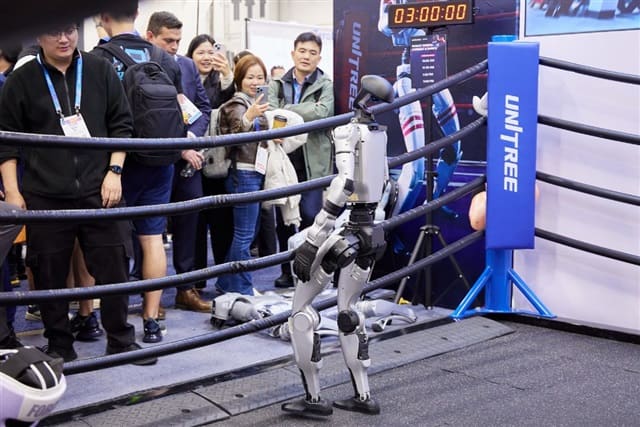
- ·Unitree Robotics held a three-hour IPO roadshow on August 7 with chairman Xingxing Wang detailing commercialization challenges facing the humanoid robot sector.
- ·Embodied intelligence integration and high component costs remain key bottlenecks preventing widespread industrial adoption beyond pilot programs.
- ·The company's conservative tone contrasts with sector hype and signals a longer path to profitability than many investors have priced in.
Early-Stage Market Realities
Unitree Robotics held a three-hour IPO roadshow on August 7 that provided unusual transparency into the current state of humanoid robot commercialization. Chairman Xingxing Wang and the company's management team addressed investor questions about technical maturity, market readiness, and the path toward profitability in a sector that has attracted substantial capital despite limited commercial deployment.
The presentation underscored a reality that contrasts with much of the sector's public messaging: humanoid robots remain far from widespread industrial adoption. While competitors and research labs have showcased impressive prototypes, the gap between demonstration and economically viable deployment remains significant.
Embodied Intelligence as the Bottleneck
Wang's team spent considerable time on embodied intelligence, the integration of AI systems with physical robot hardware that allows machines to perceive, reason, and act in unstructured environments. This capability represents the core technical challenge preventing humanoid robots from moving beyond controlled settings into factories, warehouses, and service environments.
Current-generation systems struggle with real-time decision-making in dynamic spaces. A humanoid robot can be trained to perform a specific task in a lab, but adapting to variations in lighting, object placement, or unexpected obstacles requires levels of sensor fusion and inference speed that remain expensive and unreliable at scale.
The company outlined its approach to narrowing this gap through iterative hardware-software co-design, but offered no timeline for when embodied intelligence would reach the threshold needed for broad commercial viability. That caution reflects broader industry consensus: the technology works in principle but not yet in practice at price points industrial customers will accept.
Supply Chain Strategy and Manufacturing Scale
Unitree's management also detailed supply chain considerations that will shape the sector's growth trajectory. Humanoid robots require precision actuators, high-torque servo motors, advanced sensors, and custom compute modules. Few suppliers currently operate at the scale needed to support mass production, and component costs remain prohibitively high for most applications.
The company is pursuing a vertical integration strategy for critical components while relying on third-party suppliers for commoditized parts. This approach mirrors strategies used by electric vehicle manufacturers in the previous decade, when battery and motor supply chains were immature. The trade-off is higher capital expenditure in the near term in exchange for cost control and supply security as volumes increase.
Manufacturing scale presents its own challenges. Humanoid robots are far more complex than industrial robotic arms, with dozens of degrees of freedom and intricate assembly requirements. Unitree has not disclosed production capacity targets, but the roadshow indicated that the company expects gradual volume ramps rather than exponential growth.
Market Positioning and Commercial Traction
Unitree positions itself in the mid-market segment, targeting applications where humanoid form factors offer advantages over wheeled or fixed robots but where customers are price-sensitive. Potential use cases include logistics environments with stairs or narrow passages, retail settings requiring customer interaction, and light manufacturing tasks that involve frequent reconfiguration.
The company has not disclosed firm order numbers or revenue projections tied to humanoid units. That absence suggests commercial traction remains limited, a pattern consistent across the sector. Most deployments to date have been pilot programs or research partnerships rather than volume contracts.
Wang's presentation acknowledged this reality without offering aggressive near-term sales forecasts. The conservative tone may reflect lessons learned from earlier robotics IPOs that overpromised on commercialization timelines and subsequently faced investor skepticism.
Investor Implications
The roadshow's candor provides a useful counterpoint to the hype cycle surrounding humanoid robotics. Capital markets have poured funding into the sector on the assumption that humanoid robots will become ubiquitous within the next five to ten years. Unitree's presentation suggests a longer, more uncertain path.
For investors, the key variables to monitor are progress in embodied intelligence benchmarks, component cost trajectories, and the emergence of repeatable commercial deployments beyond pilot programs. Unitree's willingness to discuss these challenges openly may build credibility, but it also highlights the gap between current capabilities and the market's expectations.
The IPO will test whether public market investors are prepared to fund a business model that remains pre-commercial in many respects. If Unitree's valuation holds, it may encourage other humanoid robot makers to pursue public listings. If it struggles, the sector may face a recalibration of timelines and capital availability.
The August 7 roadshow offered a rare unfiltered view of where humanoid robotics stands today: technically promising, commercially nascent, and far from the inflection point that would justify the sector's current valuations.
RELATED STORIES

China's SMIC Pushes Through Price Increases as AI Chip Orders Surge
Cheng Wei-Lun · 3 min
Chinese Robotics Firms Capture Near-Total Control of Humanoid Market
Cheng Wei-Lun · 3 min

Apple Builds Dedicated AI Model for China with Alibaba Partnership
Cheng Wei-Lun · 3 min
Lenovo Accelerates Toward $100 Billion Revenue on AI Momentum
Cheng Wei-Lun · 3 min
Spot something wrong? Email editor@briefasia.com. We log every correction publicly.